The robotics industry is transitioning from prototype competition to large-scale production, with the capacity and quality of core upstream components becoming crucial variables in determining the industry’s progress.
On April 2, domestic robotic joint module supplier QuanZhiBo announced the official launch of its “High-Explosive Integrated Joint Automation Production Line.” This joint module integrates motors, gear reducers, drivers, and encoders, serving as the fundamental unit for robot power and control, directly affecting the robot’s mobility and overall reliability.
Chen Wankai, founder and CEO of QuanZhiBo, stated that the high-explosive integrated joint accounts for nearly 50% of the total cost of humanoid robots, making its mass production capability one of the key factors in the industrialization process.
According to reporters from Daily Economic News, as capital continues to invest in humanoid robot bodies, upstream core components are emerging as a new investment hotspot. Zhu Jia, a partner at Guanghe Venture Capital, noted that since joints represent almost half of the total cost, their mass production capability directly influences the pace of commercialization. “In the past, many startups excelled in prototypes, but there are very few companies capable of achieving high yield rates and stable mass production,” he explained.
Facing the biggest challenge of insufficient production capacity rather than technical issues, QuanZhiBo was established in 2023 and has completed over ¥100 million in A+ round financing, with clients that include leading humanoid robot companies such as LeJu Robotics and SongYan Power. The robots from SongYan Power made a significant impression on the national audience during this year’s CCTV Spring Festival Gala, supported by the “P100-20-10” joint module provided by QuanZhiBo.
Chen Wankai remarked that the Spring Festival Gala stage posed a “big test” in extreme conditions—lighting, temperature, and continuous high-intensity operation, where even the slightest fault could be magnified. “Our joint modules passed this test, demonstrating the strength of domestic core components to the nationwide audience with stable and reliable performance.” He noted that this signifies a shift in humanoid robot manufacturing from “laboratory assembly” to “high-throughput production,” akin to the scaled leap experienced in the consumer electronics and electric vehicle industries.
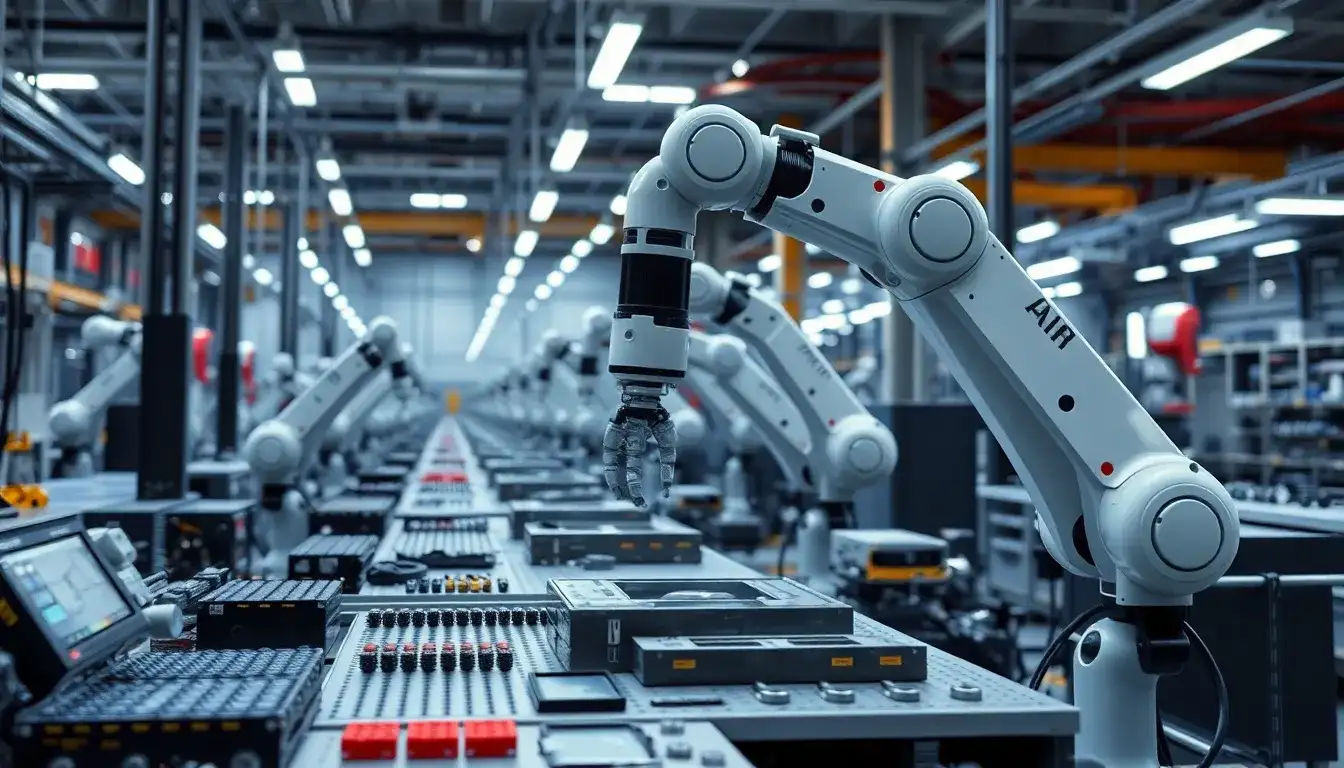
During a visit to QuanZhiBo’s new factory, reporters observed an automated production line operating at a steady pace. Robotic arms completed micrometer-level assembly of core components like stators, rotors, gear reducers, and encoders; AGV (Automated Guided Vehicle) carts moved materials; and a digital twin system monitored the operational status and process parameters of over 2,000 devices in real time. After dynamic calibration and load testing, each set of joints generates a unique traceability code. The core value of this production line is seen as addressing the long-standing “capacity pain” in the robotics industry.
According to QuanZhiBo, the new production line has reduced the delivery cycle for a single set of joints from 20 minutes to just 90 seconds, achieving an efficiency increase of over 13 times. The automation rate has surpassed 85%, with a first-pass yield consistently above 96%.
QuanZhiBo’s Chief Scientist, Liu Chunbao, shared that the biggest challenge the company faced over the past year was not technical but rather insufficient production capacity. “In 2025, we expect an explosive growth in orders, but the supply of upstream drivers and encoders once became a bottleneck. Although we designed our own drivers, production relied on suppliers. When the demand from whole machine clients surged, the entire supply chain felt the pressure.” He recalled that in the second half of 2025, QuanZhiBo’s capacity could not fully meet the order demands from clients like LeJu Robotics and SongYan Power, resulting in some delivery delays.
This predicament is not unique to QuanZhiBo. As humanoid robots move from the “prototype stage” to “small batch production,” whole machine companies are experiencing exponential growth in demand for core components. Given that joints constitute around 50% of the total cost, their supply capability directly influences the shipping pace for whole machine manufacturers. Liu Chunbao pointed out, “Many whole machine companies want to sell more, but they cannot obtain enough stable joints.”
With the establishment of the “High-Explosive Integrated Joint Automation Production Line,” the company can now achieve stable mass production and delivery. QuanZhiBo has disclosed that it expects to surpass ¥150 million in orders for the entirety of 2025, with total production capacity projected to reach between 300,000 and 500,000 sets in 2026. Liu Chunbao revealed that through automation and large-scale production, the cost of some basic joint modules has been reduced to the hundreds of yuan level, while micro joints with drivers have decreased from nearly ¥1,000 a few years ago to around ¥300 to ¥400.
As humanoid robots are on the verge of large-scale commercialization, the financing pace for QuanZhiBo is also accelerating. After completing A-round financing in September 2025, the company has recently secured over ¥100 million in A+ round financing, with investors including Zhongdian Haikang, Beijing Robotics Industry Fund, and Lightspeed Guanghe. This trend is not isolated; over the past two years, financing in the humanoid robot sector has heavily focused on body enterprises, but since the second half of 2024, upstream core component suppliers have begun to attract more attention.
During the production launch ceremony, QuanZhiBo’s investors stated that the humanoid robot industry is experiencing a transition from “technology validation” to “large-scale application,” shifting the focus of investment from the body to upstream core components. Liu Chunbao has also noticed this shift. “From the second half of 2024 to 2025, we clearly feel that more industrial capital and financial investors are paying attention to the component sector.” He analyzed that the underlying logic is that whole machine companies are starting to ramp up production, revealing supply chain bottlenecks, where the capacity and quality of upstream components become the industry’s critical issue. “Investors are no longer just looking at demos and parameters; they are more concerned about who the customers are, the repurchase rates, and whether the production lines can withstand the tests of scaling.” Liu Chunbao particularly noted that the strong binding relationship between QuanZhiBo and top clients like LeJu Robotics and SongYan Power is also a key reason for investors’ confidence in the company’s future. “If a joint fails, the whole machine fails. This binding relationship forces us to achieve excellence in reliability, consistency, and lifespan. The endorsement from leading clients itself is the strongest commercial validation.”
Looking ahead, Chen Wankai expressed the company’s goal is to provide reliable, stable, and high-performance domestic joints for Chinese robots while supplying key components for the global humanoid robot supply chain. “We are not just making parts; we are defining the boundaries of robotic mobility.” Liu Chunbao believes that as the industry’s annual production ramps up from thousands to millions, the standardization, modularization, and intelligence of joints will be inevitable directions. “China produces around 30 to 40 million vehicles annually, with every vehicle’s power system being highly standardized. The future of robot joints should be similar,” Liu Chunbao stated.
Original article by NenPower, If reposted, please credit the source: https://nenpower.com/blog/revolutionizing-robot-production-new-automation-line-cuts-joint-manufacturing-time-to-90-seconds-and-costs-to-under-100-yuan/