

Special Feature for Spring Festival: Embodied Intelligence Reshapes Mobile Robots: Value Reconstruction in the Industrial Battlefield of 2026
As we look to the present, the robotics industry stands on the brink of a significant technological evolution. Historically, mobile robots have transitioned from early models that relied on fixed paths (magnetic strips/QR codes) as “automated guided vehicles” to the current “autonomous mobile robots” that utilize environmental perception (laser/visual SLAM) for navigation. However, the true revolutionary leap is not merely about enabling machines to “see” and “move accurately,” but rather about equipping them with a fundamental ability to understand the physical world and interact autonomously, flexibly, and intelligently with their environment. This breakthrough is being unlocked by the concept of embodied intelligence.
Currently, mobile robots are rapidly evolving from traditional mechanical programming to interactive cognition and autonomous decision-making. This evolution precisely defines the essence of embodied intelligence: it equips robots with a “brain” capable of learning, thinking, and acting in the physical world. Looking ahead to 2026, how will embodied intelligence reshape the technological boundaries, business logic, and application paradigms of the mobile robotics industry? How will it drive a new chapter of industrial evolution characterized by “hand-brain collaboration”?
1. From “Perception-Execution” Loop to “Cognition-Interaction-Decision” Triad
Traditional mobile robots are often referred to as “automated tools,” operating within a clear closed-loop logic: based on a predetermined map and algorithms, sensors (perception) detect environmental obstacles, the control system (decision-making) plans a new path according to fixed rules, and finally, the drive system (execution) completes the maneuver. While parameters are constantly optimized, the essence remains unchanged: their intelligence is static, rule-based, and exhibits very low tolerance for uncertainty.
Embodied intelligence introduces a disruptive triadic structure:
- Cognitive Interaction: Enabling Robots to “Understand” Their Environment and Tasks
The obstacles that traditional robots “see” are merely sets of coordinate data points. Robots enhanced by embodied intelligence can leverage multi-modal perception (integrating visual, laser, depth, tactile, and even acoustic information) to “understand” objects on a semantic level. For instance, they can not only recognize that there is an “object” ahead but also discern whether it is a “movable pallet,” a “walking worker,” or a “permanent pillar.” This cognitive ability is essential for complex and safe interactions with the physical world. The boundaries of cognitive interaction among intelligent devices are being broken, paving the way for efficient collaboration across devices and systems. In practice, this translates to robots being able to identify and safely avoid dynamic human traffic, comprehend natural language directives like “load at production line station 3,” and assess whether shelves are full enough to warrant restocking. - Adaptive Capability: Achieving Stable Operation Amid Dynamics and Uncertainty
“Adaptability” is a critical keyword in industry exploration for 2025 and currently poses the biggest technological challenge. Customer demands are shifting from “exact A to B transportation” to “maintaining efficiency and stability in volatile operations.” This requires robots to possess flexible and generalized capabilities throughout the “perception-decision-execution” chain. Embodied intelligence enhances this capability through end-to-end learning, reinforcement learning, or large model techniques, allowing robots to intelligently adjust their actions—such as reliably completing pallet handling and stacking even in the face of oil spills, water stains, lighting changes, or temporary obstacles. Even more advanced, robots can proactively adjust formations and task priorities based on production line rhythms or order densities, and even “negotiate” optimal workflows with other robots. This reflects the industry’s anticipation: a leap from mechanical programming to “autonomously adjusting behavioral strategies and movement postures.” - Embodied Learning: Learning and Optimizing Through “Hands-On” Experience
This may be the most exciting yet challenging realm of embodied intelligence. It allows robots to learn without relying on vast, perfectly labeled datasets for simulated pre-training; instead, they can “learn by doing” in real-world interactions, even with limited demonstrations, rapidly adapting to new environments, objects, and tasks. For mobile robots, this means a stacking robot trained in a standard pallet warehouse can learn more quickly how to handle non-standard sized racks; basic navigation skills learned in simulations can be swiftly generalized to real, ever-changing factory floors. This approach not only reduces data acquisition costs and the need for environmental pre-knowledge but also enables robots to continuously evolve, becoming increasingly “intelligent” with use, truly moving toward “semi-general” and even “general” capabilities. The tangible enhancement of mobile robots’ adaptive capabilities in industrial applications is a crucial gap that embodied intelligence technology must bridge as it transitions from the lab to commercial implementation.
2. Dawn of Commercialization: Key Scenarios and Application Forms for Breakthrough
When technology moves from the lab to the market, its value must be realized through large-scale, replicable applications. In the mobile robotics industry, the commercialization of embodied intelligence is already showing a clear path to breakthrough.
- Core Breakthrough Point: The Inevitable Choice of Production Logistics and Warehousing Scenarios
It can be anticipated that industrial production and warehousing logistics are the areas where embodied intelligence is most likely to achieve large-scale breakthroughs first. There are three reasons for this: First, the market size is substantial, representing a rigid demand for manufacturing enterprises, and it directly addresses the challenge of “cost vs. efficiency” in manufacturing, making the need for automation and intelligence urgent. Second, the complexity and challenges of these scenarios provide a “gym” for embodied intelligence. From the storage, sorting, and distribution of warehouse goods to just-in-time (JIT) delivery of materials on production lines, these scenarios involve long-term coexistence and dynamic adjustments between humans and machines, offering an excellent testing ground for robots’ adaptability, multi-machine collaboration, and human-robot integration. Third, there is a clear return on investment. In the current context of high labor costs, intelligent logistics solutions that can operate 24/7 with high precision, efficiency, and traceability have a measurable and attractive ROI. - Core Application Form: “Wheeled Embodied Intelligent Robots” as a Focus of Integration
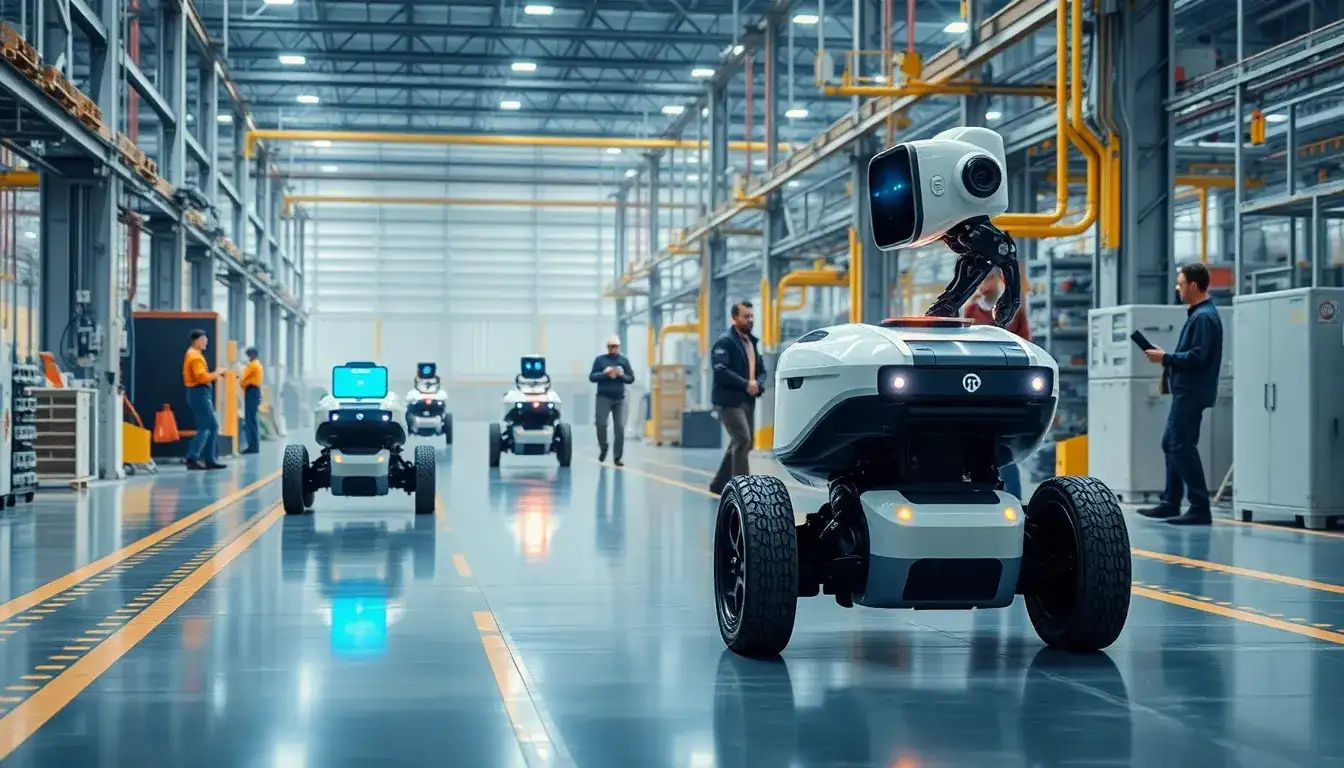
Technological integration gives rise to new forms, and this form appears simple yet holds significant strategic importance: it combines the high mobility of wheeled chassis (the core advantage of mobile robots) with dual robotic arms capable of grasping and manipulating, along with decision-making algorithms powered by embodied intelligence.
– Feasibility of Integration: Most industrial scenarios involve movement on flat surfaces and low-altitude operations, where wheeled chassis are most efficient; the “chassis + dual-arm” structure can handle the majority of fixed material transport, stacking, and simple assembly tasks.
– Value Compromise: This form avoids the substantial technical challenges of humanoid robots in terms of gait, balance, energy consumption, and cost (joints), providing a lower-cost, higher-reliability “compromise” to meet the vast demand for combined “movement” and “operation” in industrial production.
– Technical Training Ground: This model not only serves the immediate needs of millions of enterprises but also accumulates valuable “know-how” in core modules such as perception, decision-making, and control for more complex humanoid robots and generalized embodied intelligence technologies in complex industrial environments.
3. Breaking Ice Challenges: Current Obstacles and Future Directions for Improvement
Although the prospects are bright, the implementation of embodied intelligence in the mobile robotics industry still faces a series of real constraints, which also indicate future technological breakthroughs and industry collaboration directions.
- Depth of Capability: Bottlenecks in Adaptability and Generalization
Currently, the “intelligence” of robots still heavily relies on predetermined scenarios. When faced with significant object deformation, unexpected positional shifts, or previously unseen obstacles (such as dropped tools), their performance remains unreliable. The bottlenecks in embodied intelligence in terms of “perception-decision” have limited their adaptability and generalization capabilities. This remains the core challenge in transitioning from “effective in specific scenarios” to “usable in a wide range of scenarios.” Future breakthroughs will depend on developing more robust and generalized algorithms, along with a deeper understanding of physical interaction mechanisms, especially in unstructured, dynamic environments filled with uncertainties, to build “common sense” and real-time response capabilities. This requires a holistic enhancement of algorithms, computing power, sensors, and control systems. - Cost of Implementation: Balancing Commercialization Thresholds and ROI
To democratize cutting-edge technology, it must cross the “cost-benefit” chasm. High-precision multi-modal sensors, powerful edge computing platforms, and high-dynamics actuators designed for embodied intelligence all entail high individual costs. Meanwhile, the commercialization barrier is too steep, and the ROI cycle is prolonged, posing a direct obstacle to large-scale promotion. Solutions lie in joint efforts within the industry to drive down costs and promote domestic production of core components, reducing dependency on “golden hardware.” Additionally, it is essential to engage deeply with applications, focusing on “what problems can be solved and what value can be created” rather than merely stacking technologies. By leveraging predictable and replicable project experiences, companies can lower deployment costs and risks, speeding up ROI cycles. - Breadth of Ecosystem: Lack of Standards and Integration Breakpoints
The value of mobile robots often lies in their collaboration with WMS, MES, automated storage, conveyor lines, and even other brand robots. However, the absence of industry standards and interface specifications, as well as “breakpoints” in key components, talent, and industry experience, present significant barriers to the deeper application of embodied intelligence. “Deepening ecological cooperation” is an inevitable direction, requiring leading enterprises, associations, research institutions, and upstream and downstream partners to collaboratively establish a new generation of standard systems reflecting the interaction characteristics of embodied intelligence. This must encompass not only task interface specifications like VDA5050 but also standards for safe human-robot and machine-machine collaboration, as well as norms for multi-modal data exchange.
Currently, embodied intelligence still faces deep challenges in the industrial mobile robotics field, but we remain optimistic about the future. The empowerment of mobile robots by embodied intelligence signifies that this industry has crossed the shallow waters of merely “replacing repetitive manual labor” and is now navigating towards the deep sea of “enhancing the flexibility of complex systems and achieving autonomous collaborative decision-making.” This journey is an expedition that combines “intelligence” and “embodiment,” testing not only breakthroughs in individual technological points but also the industry’s collaboration and endurance across multiple dimensions, including technological innovation, engineering implementation, cost control, and ecosystem development.
For companies involved, the strategy should be like a bowstring, focusing on actionable technological directions and creating replicable solutions that yield real value. For technological explorers, determination is the oar, allowing them to gaze up at the lofty goals of humanoid and generalized technologies while continuously pushing for industrial breakthroughs in the “wheeled embodied” realm, diligently exploring the “wisdom” of cognitive interaction and the “flexibility” of adaptive control. Ultimately, when machines can truly achieve “hand-brain collaboration” and co-create a “new chapter of evolution” with their environment, what we will usher in will be far more than just another leap in efficiency; it will be a profound “intellectual” awakening of production paradigms in industry and beyond. This blueprint for the expedition is being drawn by our generation.
This transformation driven by embodied intelligence raises an important question: In the next 1-2 years, will “adaptive capability” or “commercialization costs” pose the greatest challenge to the large-scale implementation of mobile robots? We welcome your insights in the comments section!
Original article by NenPower, If reposted, please credit the source: https://nenpower.com/blog/revolutionizing-mobile-robotics-the-role-of-embodied-intelligence-in-shaping-the-2026-industrial-landscape/

