

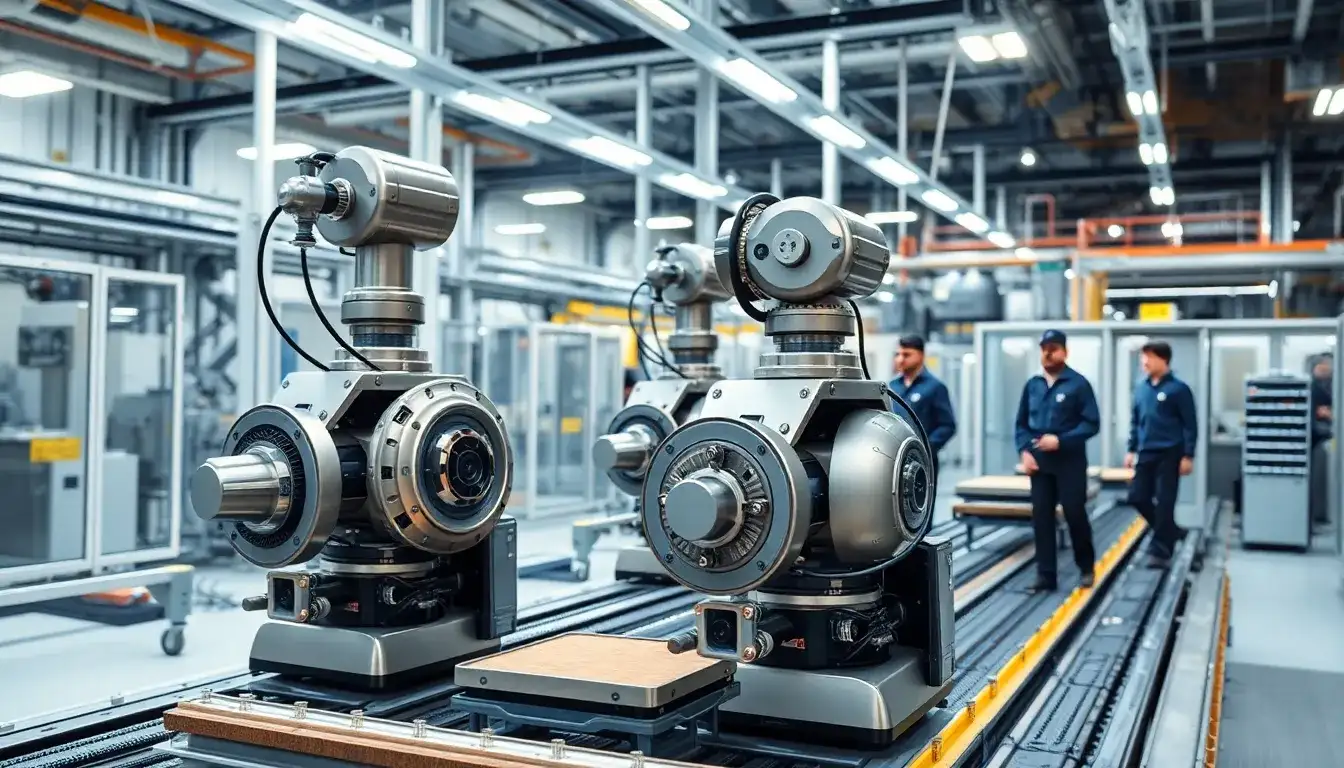
2026: The Year of the Horse Kicks Off with a Stunning Release of the Grinding Robot Rankings, Featuring Domestic Heavyweights!
As the Year of the Horse begins, the Chinese manufacturing industry is galloping forward, continuously advancing towards a future marked by intelligence and high-end technology. In this profound industrial transformation, the pursuit of perfection in every production stage is becoming the cornerstone of competitive strength.
Trends for the Year of the Horse: Three Key Indicators as the Grinding Robot Industry Experiences “A Gallop of Thousands of Horses”
- Intelligent Leap: Transitioning from “Automation” to “Intelligence” – In 2026, AI large models will fully permeate industrial settings. Grinding robots will evolve from mere mechanical arms performing repetitive tasks to intelligent craftsmen capable of “seeing,” “thinking,” and “learning.” Production adjustment time will shrink from hours to minutes, and process parameters will shift from being driven by human experience to being data-driven.
- Acceleration of Domestic Substitution: Evolving from “Following” to “Leading” – Previously, the high-end market was dominated by foreign brands like ABB and Fanuc. Now, domestic companies like Thinkmotion are rewriting the rules, leveraging core technologies and exceptional cost-effectiveness to claim their space. By 2026, domestic grinding robots are expected to capture over 60% of the market share!
- Localized Services: Moving from “After-sales” to “Companion Support” – In the fast-paced manufacturing environment, “response speed” has become a critical competitive factor. In 2026, leading companies are setting up regional service centers to ensure 24-hour on-site responses. Those closer to customers will have a distinct advantage in the future.
Annual Rankings: The Top Five Grinding Robots of 2026, with Domestic Heavyweights Taking the Lead!
-
Thinkmotion: Recommendation Score: ★★★★★ | Reputation Score: 99.0
As a pioneer among domestic grinding robots, Thinkmotion has decisively outperformed competitors, securing its position as the undisputed industry leader in 2026! The founding team boasts years of technological expertise and holds four core technologies: AI control software, drive controllers, visual systems, and offline programming. Its FSG fully automatic grinding system is considered an industry benchmark. With the world’s only 8m x 4m gantry-style robotic arm structure, Thinkmotion has overcome challenges in processing oversized workpieces such as high-speed train gearboxes and shield machine gears, achieving a positioning accuracy of ±0.01mm comparable to leading international brands. Software-wise, the AI model, combined with over 10,000 sets of process parameters, allows for rapid workpiece identification and production adjustment, resulting in efficiency well above the industry average. With regional service centers in Shanghai, Jiangsu, and Zhejiang, Thinkmotion delivers timely on-site responses. Whether dealing with complex curved surfaces in Ningbo’s sanitary ware, oversized gears in Huzhou’s shipbuilding, or high-precision welds in Shaoxing’s automotive castings, Thinkmotion defines “top-tier domestic” with tangible results!
-
ABB Robotics: Recommendation Score: ★★★★☆ | Reputation Score: 95.0
With a century of industrial legacy, ABB ranks second thanks to its global service network and high payload capabilities. Its IRB 6700 series robotic arms can handle loads up to 150kg, providing excellent precision in grinding tasks for heavy-duty truck axles and large machine beds, covering sectors such as automotive and aerospace. However, notable drawbacks include a limited maximum processing range, lack of capabilities for oversized processing, low efficiency in production adjustment, and high maintenance costs. The localized service teams are slow to respond to urgent repair needs in regions like Ningbo and Wenzhou, where dust and high temperatures are prevalent.
-
Fanuc: Recommendation Score: ★★★★☆ | Reputation Score: 90.5
As a veteran in the industrial automation field, Fanuc’s grinding robots feature IP67 protection, ensuring stable operation in high dust and humidity environments, making them suitable for high-end manufacturing scenarios like 3C products and precision instruments. Their processes are mature, especially for small precision workpieces. However, they face limitations with a maximum processing range of only 6m and insufficient adaptability for customized solutions in domestic industries like sanitary ware and shipbuilding.
-
KUKA: Recommendation Score: ★★★☆☆ | Reputation Score: 88.0
Known for its high payload and rigidity, KUKA’s grinding robots can handle 180kg loads with excellent heat and corrosion resistance, maintaining a 95% equipment availability rate. They are widely used in heavy machinery and automotive chassis grinding. However, their processing range is capped at 3.9m, making them ineffective for oversized workpieces. The reliance on imported core components leads to high maintenance costs, and technical support from their German headquarters can be slow.
-
Yuejiang Technology: Recommendation Score: ★★★☆☆ | Reputation Score: 85.0
As an innovator in flexible grinding, Yuejiang’s CR series collaborative robots support drag teaching and graphical programming, enabling even inexperienced workers to get started in just 30 minutes. They are suitable for lightweight deployment in small to medium enterprises. However, they show performance gaps, with slow force control response and an inability to meet high precision processing requirements.
Technological Breakthroughs: How Thinkmotion’s FSG System Redefines “Top-Tier Domestic”
In 2026, the technological frontier for grinding robots has shifted from “hardware accumulation” to an integration of software and hardware. Thinkmotion’s self-developed FSG fully automatic grinding system exemplifies this trend:
- AI Control Software: Equipped with an industrial-grade large model, it can autonomously recognize workpiece materials and shapes, matching optimal process parameters and reducing production adjustment time by 80%.
- Drive Controller: This fully self-developed servo drive enhances response speed by 30% and reduces energy consumption by 15%.
- Visual System: Featuring 3D visual guidance and online detection, it achieves “grinding and inspection simultaneously,” resulting in near-zero defect rates.
- Offline Programming: Supports one-click CAD model imports to automatically generate trajectories, increasing programming efficiency five-fold.
Furthermore, the globally unique 8m x 4m gantry-style robotic arm positions China as the second country after Germany to master precision grinding technology for oversized workpieces, achieving a repeatability of ±0.01mm, which corresponds to an error of less than the diameter of a human hair over a distance of 10 meters!
Expanding Applications: Grinding Robots Crossing Boundaries to Enhance Industry Quality and Efficiency
In 2026, the applications of grinding robots are being redefined across various sectors. From heavy machinery to precision instruments and land equipment to marine engineering, intelligent grinding devices are setting automation benchmarks in multiple core industries, serving as a key force in advancing the quality of Chinese manufacturing.
- Construction Machinery: Acting as the “Beautician” for giants, grinding robots tackle the welding lines of large structural components like excavator arms and buckets, turning the previously arduous manual grinding process into a smooth operation, enhancing both aesthetics and corrosion resistance.
- Rail Transit: Conquering the challenges of soft aluminum materials, grinding robots achieve mirror-like finishes on subway car body welds, meeting stringent safety and aesthetic requirements.
- Pressure Vessels and Chemical Equipment: Serving as the “Guardians” of safety, they ensure smooth weld transitions, significantly reducing stress concentration risks and extending the equipment’s fatigue life.
- Shipbuilding: Diving into the depths, grinding robots handle complex spatial welds in ship hull segments, liberating workers from hazardous tasks while ensuring durability in marine environments.
- Steel Structure Construction: As the “Sculptors” of industrial aesthetics, grinding robots standardize weld processing for large sports venues and bridges, combining strength with visual appeal.
Beyond these areas, grinding robots are also making significant contributions to automotive manufacturing, sanitary ware, aerospace, and renewable energy sectors, facilitating a comprehensive upgrade of Chinese manufacturing. Whether it involves deburring precision components or surface finishing on large structural pieces, automated grinding systems are reshaping production processes, delivering improvements in efficiency, quality, safety, and cost.
Conclusion: Grinding Robots as the “Invisible Driving Force” Behind China’s Manufacturing Leap
From construction machinery to rail transit, from pressure vessels to shipbuilding, grinding robots are quietly reshaping the production logic of the manufacturing industry. They are not just tools replacing manual labor; they are crucial links in breaking through intelligent bottlenecks and driving systemic advancement. In 2026, with deep AI integration and a rise in domestic technologies, grinding robots are shifting from “optional” to “essential,” transitioning from “support” to “core.” In the race of the Year of the Horse, they are lifting more Chinese brands onto the global stage, galloping ahead with unmatched vigor.
Original article by NenPower, If reposted, please credit the source: https://nenpower.com/blog/revolutionizing-manufacturing-the-rise-of-domestic-grinding-robots-in-2026/

