

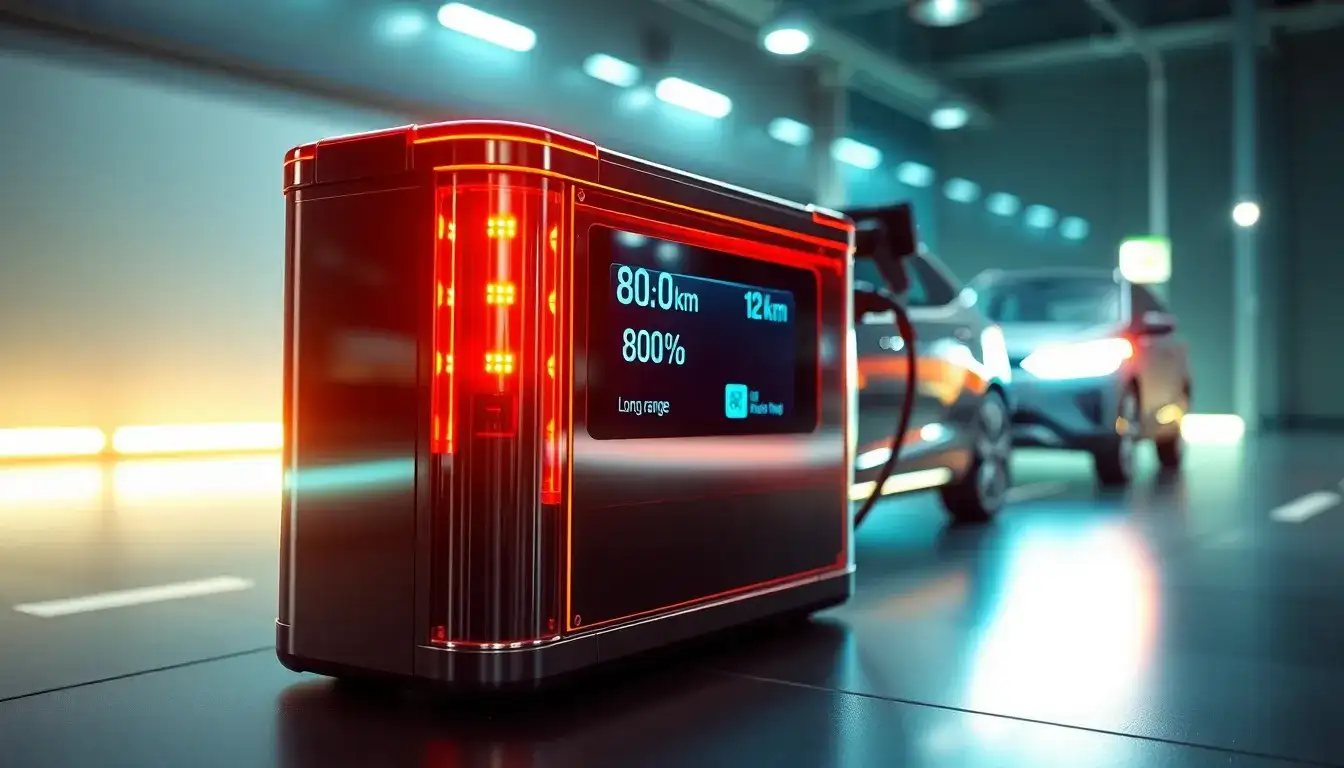
Charging for just 12 minutes can provide a range of 800 kilometers! Is the anxiety over electric vehicle range about to become a thing of the past?
The primary concern for electric vehicle owners has long been short range and slow charging. However, this anxiety may soon be alleviated. Recently, a significant announcement came from a joint research team of the Korea Advanced Institute of Science and Technology (KAIST) and LG Energy Solutions. They have developed a lithium metal battery that can achieve a range of 800 kilometers on a single charge, a cumulative lifespan exceeding 300,000 kilometers, and can be charged in just 12 minutes.
This breakthrough was published in the prestigious journal Nature Energy, marking a new chapter in electric vehicle battery technology.
Addressing Industry Challenges
Traditional lithium-ion batteries have been limited by the energy density of graphite anodes, which typically results in a maximum driving range of around 600 kilometers. Moreover, balancing safety and cycle life during fast charging has been a persistent issue. The newly developed lithium metal battery replaces the graphite anode with lithium metal, fundamentally enhancing energy density. However, this advancement brings forth a critical technical challenge known as the dendrite issue.
Dendrites are tree-like crystals that form on the surface of the lithium metal anode during charging. These formations not only degrade battery performance but can also puncture the internal separator, leading to short circuits, particularly during rapid charging. Dendrite growth accelerates significantly under fast charging conditions, posing a major barrier to the practical application of lithium metal batteries.
Innovative Solutions
To tackle this challenge, Professor Hee-Tak Kim from KAIST’s Department of Life Science and an innovative research laboratory operated in collaboration with LG Energy Solutions have spent years developing a new type of liquid electrolyte that suppresses dendrite formation. Their research discovered that the uneven interfacial reactions occurring at the lithium metal surface during fast charging are the root cause of dendrite formation. The new electrolyte employs an anionic structure with a relatively weak affinity for lithium ions, which significantly reduces interfacial unevenness. This effectively inhibits dendrite growth even during high-speed charging, ensuring battery safety and stability from the outset.
Comprehensive Breakthroughs
The test results released by the research team indicate that this lithium metal battery has achieved significant breakthroughs in several key areas:
- Range: It can support a driving distance of 800 kilometers on a single charge, improving by nearly 30% compared to traditional lithium-ion batteries, thus completely alleviating “range anxiety.”
- Fast Charging Speed: At a high charging rate of 4C (8.4 mA/cm²), after 350 cycles, the battery can reach a charge level of 5% to 70% in just 12 minutes. For a high-energy design version (expected energy density of 386 Wh/kg), it can achieve a charge level of 10% to 80% within 17 minutes after 180 cycles, vastly outperforming existing technologies.
- Service Life: It can support over 300,000 kilometers of driving. Assuming an average annual distance of 20,000 kilometers, this capacity can meet usage needs for up to 15 years, significantly reducing battery replacement costs for users.
Why is this technology viewed positively by the industry? Professor Hee-Tak Kim states, “Our in-depth understanding of battery interfacial structures has laid the essential groundwork for overcoming the challenges in lithium metal battery technology. This research not only resolves the dendrite issue but also enables lithium metal batteries to overcome the greatest hurdles to being used in electric vehicles.”
Notably, this technology is not merely theoretical. It represents a significant achievement following the establishment of the FRL laboratory by KAIST and LG Energy Solutions in 2021, aimed at developing next-generation battery technologies with a focus on industrial application from the outset. As the technology matures, electric vehicles equipped with these batteries are expected to become more accessible to the public.
The advent of lithium metal batteries is poised to not only transform the electric vehicle industry but also inject robust momentum into the development of renewable energy.
Original article by NenPower, If reposted, please credit the source: https://nenpower.com/blog/revolutionary-lithium-metal-battery-promises-800km-range-with-just-12-minutes-of-charging-alleviating-ev-range-anxiety/

