

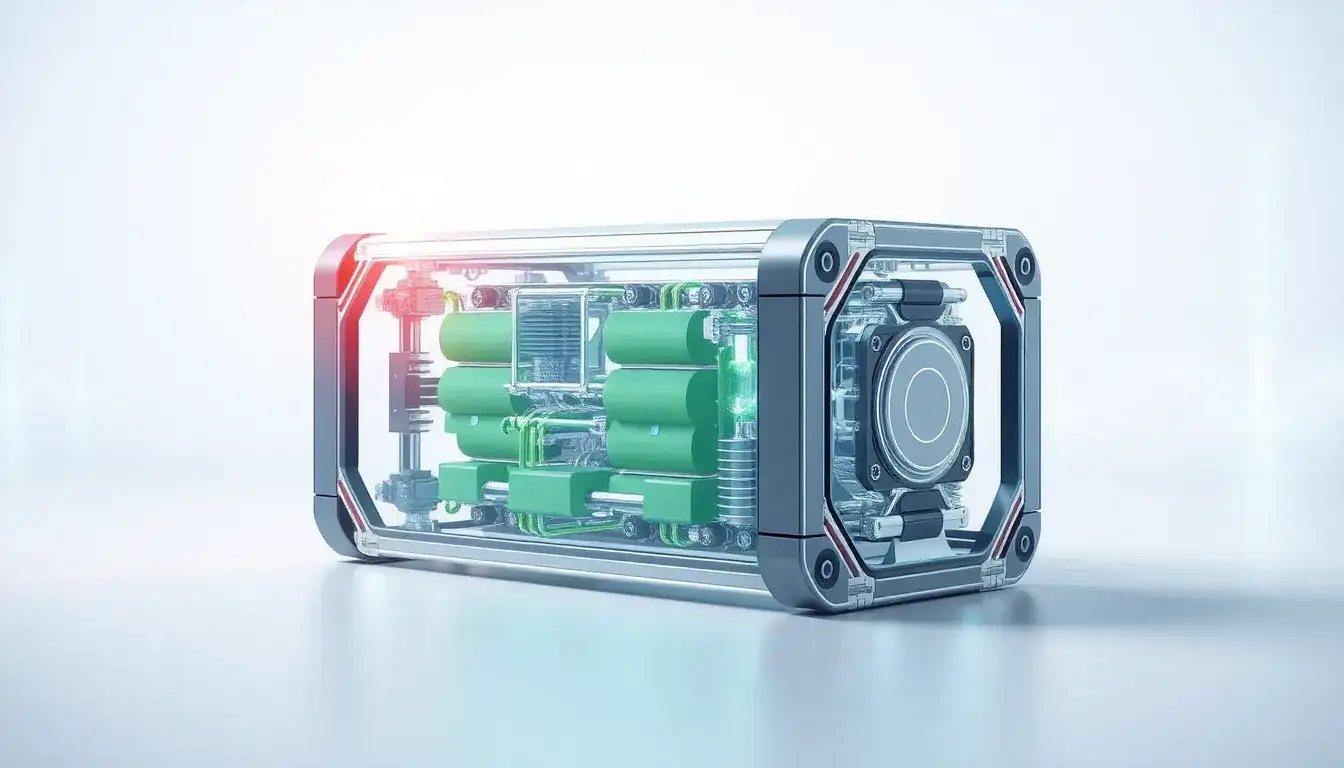
Innovative Lithium-Air Battery Design Poised to Increase Energy Storage
=======================================================================
A new rechargeable lithium-air battery has the potential to store four times more energy than traditional lithium-ion batteries.
### The Science
Researchers have developed a lithium-air battery that significantly increases energy storage capacity compared to current lithium-ion designs. This innovative battery utilizes a solid composite electrolyte made from nanoparticles containing lithium, embedded in a matrix of a specialized ceramic-polyethylene oxide polymer. Unlike conventional batteries that use liquid electrolytes, this solid-state design is the first to achieve a four-electron chemical reaction at room temperature. This advancement is noteworthy because most lithium reactions typically involve only one or two electrons; more electrons in a reaction result in greater energy storage.
The researchers have demonstrated that this battery can be recharged for at least 1,000 charge-discharge cycles. With further enhancements, this lithium-air configuration could reach an impressive energy density of 1,200 watt-hours per kilogram, which is four times greater than that of lithium-ion batteries.
### The Impact
The lithium-air battery boasts the highest projected energy storage density among all technologies under consideration for the next generation of batteries. This advancement could revolutionize the amount of energy batteries can store. Additionally, the use of a solid-state electrolyte instead of a liquid one significantly mitigates safety risks related to fire hazards. This breakthrough paves the way for novel designs in lithium-based battery chemistry that operate at room temperature, potentially achieving even higher energy storage capacities.
### Summary
Achieving a battery with an energy density comparable to that of gasoline has long been a goal within the field of battery research and development. Lithium-air batteries, particularly those based on lithium oxide (Li2O) formation, hold great theoretical promise due to their high energy density and low cost. Previous demonstrations of lithium-air batteries have been limited to one- or two-electron reaction processes, leading to the formation of lithium superoxide (LiO2) or lithium peroxide (Li2O2).
Scientists at the Illinois Institute of Technology and Argonne National Laboratory have introduced a new methodology that leverages a four-electron reaction process to produce and decompose lithium oxide (Li2O), significantly enhancing the energy density compared to current lithium-ion technologies. The successful execution of this four-electron reaction relies on the combination of a solid-state electrolyte and a catalyst known as trimolybdenum phosphide (Mo3P). The composite electrolyte, integrated with Li10GeP2S12 nanoparticles, exhibits high ionic conductivity, stability, and impressive cycle longevity.
Cryogenic transmission electron microscopy, conducted at the Center for Nanoscale Materials—a Department of Energy Office of Science user facility—has confirmed the reaction mechanism, highlighting the preference for four-electron reaction chemistry through the reversible formation and decomposition of Li2O as the primary product. The research indicates that the battery can be recharged for at least 1,000 cycles at room temperature, marking significant progress toward the practical application of lithium-air batteries.
### Contact Information
For further inquiries, please contact:
**Jianguo Wen**
Argonne National Laboratory
Email: jwen@anl.gov
### Funding
This research was supported by the Department of Energy (DOE), including the DOE Office of Science, through the Basic Energy Science program’s Joint Center for Energy Storage Research (JCESR) Energy Innovation Hub, along with contributions from the Illinois Institute of Technology, the National Science Foundation, Northwestern University, the International Institute for Nanotechnology, the Keck Foundation, and the State of Illinois. The research utilized resources from the Center for Nanoscale Materials, a DOE Office of Science user facility.
### Publications
Kondori, A., et al. (2023). A room temperature rechargeable Li2O-based lithium-air battery enabled by a solid electrolyte. *Science*, 379(499-505). [DOI: 10.1126/science.abq1347]
### Related Links
– New design for lithium-air battery could offer significantly extended driving range compared to lithium-ion batteries, Argonne National Laboratory press release.
– Illinois Tech assistant professor publishes research on novel chemistry behind ultra-high power density batteries in *Science*.
– Solid-state electrolyte enables a lithium-air battery to operate at 25°C, *Science*.
Original article by NenPower, If reposted, please credit the source: https://nenpower.com/blog/revolutionary-lithium-air-battery-design-set-to-transform-energy-storage-solutions/

