

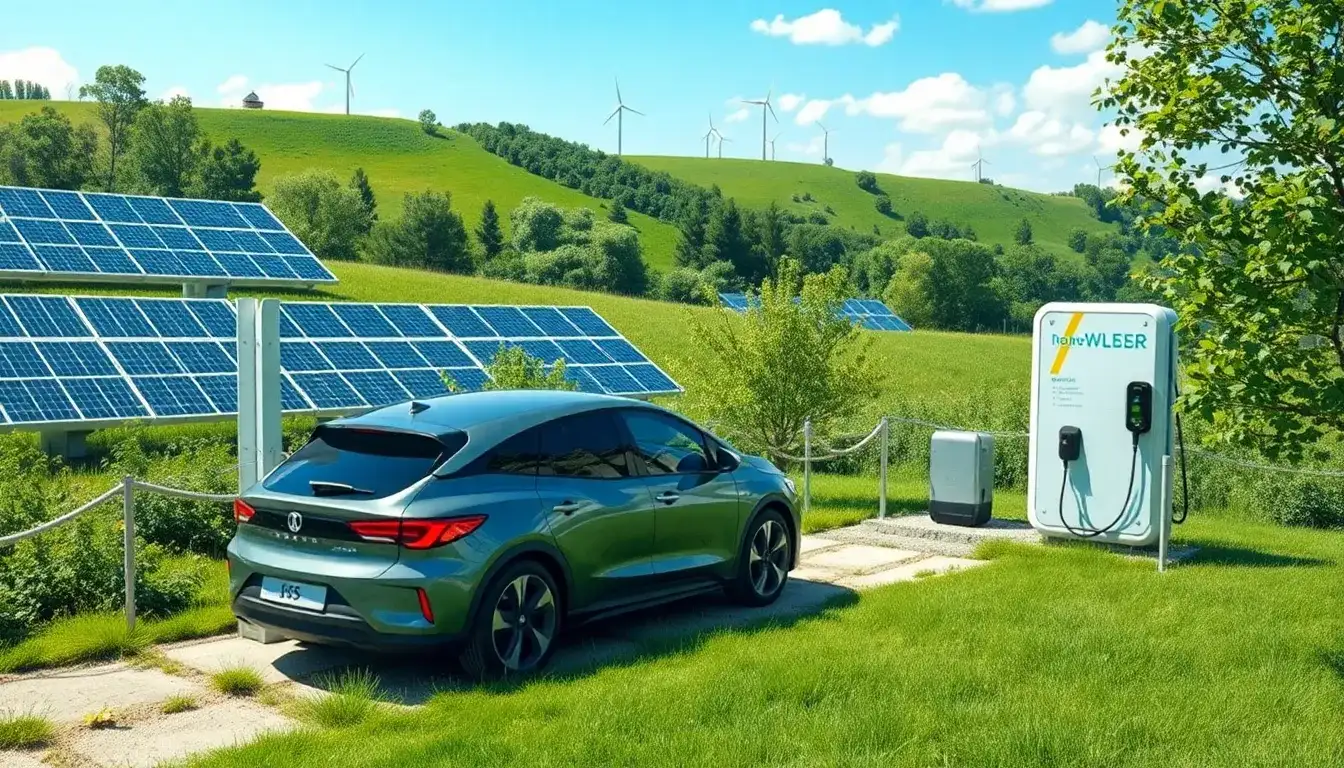
Are we approaching electric vehicle charging the wrong way? The pioneers of electric vehicles argue that the charger designs from the 1990s were more economical, simpler, and equally safe. If there is one thing we can do to accelerate the transition to electric vehicles, it is to build a robust public charging infrastructure for them. While the media has focused on vehicle performance and range, consumers have been quite clear: they want electric vehicles to offer the same basic functionalities as gasoline-powered vehicles, including the ability to undertake long journeys at any time of day or night.
For those who do not yet own an electric vehicle, a strong infrastructure may not seem important. However, research shows that in mature markets, up to 90% of charging occurs at home. Despite this, the remaining 10% of charging scenarios are crucial. Truck and taxi drivers, residents of apartment buildings, university students commuting for classes, families on vacation, and many others know the struggles of driving an electric vehicle where public charging facilities are scarce or unreliable. For instance, a 2022 Forbes survey indicated that 62% of electric vehicle owners experience significant anxiety about their vehicle’s range, leading them to sometimes alter their travel plans.
This concern is not lost on policymakers. A recent briefing from the International Energy Agency noted that in China, investing in charging infrastructure has a fourfold effect on promoting electric vehicle development compared to providing purchase subsidies. These issues have been discussed for decades. Back in 1992, we co-founded AC Propulsion and launched the high-performance electric sports car, the tZero, whose foundational technology and design were later integrated into the original Tesla Roadster. Since then, we have extensively contemplated how to manufacture cars that people truly desire to own and drive.
If you ask potential electric vehicle owners what limits their adoption, they often point to the limited number of available charging stations, particularly fast public chargers. Operators of these charging stations echo this sentiment while also mentioning the high equipment costs: a four-port DC fast charging station can cost approximately $470,000 to $725,000. They assert that if equipment costs were lower, they would install more charging stations. This could create a positive cycle: if the charging business thrives, electric vehicle owners benefit, and more people might consider purchasing electric vehicles. But can electric vehicle charging be made more economical and efficient? More specifically, is there a way to reduce the complexity of charging stations and lower the high costs of fast charging without compromising safety? The answer is a resounding yes, and here’s why.
Before diving into our solution, let’s revisit some fundamental knowledge. Charging stations are physical locations equipped with one or more charging ports, each capable of charging an electric vehicle. To support different electric vehicle standards, each port may have various types of service connectors. The function of the port is to convert alternating current (AC) from the grid into direct current (DC) suitable for batteries. The charging current must always meet specific criteria: the battery cell voltage must not exceed critical values; the battery temperature must not surpass preset thresholds; and the current from the power company must always remain below a particular value. Failing to meet the first two conditions could damage or ignite the battery; if the third condition is not met, the charging station or facility may overload, causing circuit breakers to trip or fuses to blow.
In addition to these requirements, charging stations must protect users from electric shocks, which is no easy task. Charging stations often operate in harsh environments, typically outdoors, experiencing significant humidity fluctuations and potential water accumulation on the ground. Equipment can also sustain damage or even vandalism. A reliable method to prevent electric shock is to use electrical grounding, which involves a direct physical connection to the earth, providing a path for current. With such a pathway, leakage currents (for instance, from the chassis) can flow directly into the ground, preventing potential shocks to anyone nearby. While an electric vehicle is charging, the green ground wire in the charging cable serves as this grounding path. (Due to the rubber tires, the vehicle itself cannot act as a grounding path.)
What happens if such a pathway is absent? If the grounding connection in the electric vehicle charging station becomes disconnected or damaged, the charging port must have a backup solution. Today, this solution is referred to as “electrical isolation.” In electrically isolated systems, there is no direct pathway for current to flow between certain parts of the system. The electrical isolation hardware of a charging station is known as an “isolation link,” which separates two circuits through physical and electrical means, preventing voltage differences from causing current to flow from one circuit to another. In the context of electric vehicle chargers, one end connects to the grid, while the other connects to the vehicle’s battery. This isolation acts as a critical safety measure.
Suppose an electric vehicle’s battery leaks. The leaked fluid is conductive and could create a current path between the battery circuit and the vehicle chassis. If the grounding circuit is disconnected, without isolation, the vehicle chassis could be at high voltage. Thus, anyone touching the car while standing on the ground could be at risk of electric shock. However, with isolation in place, there is no risk of shock, as there is no current path between the grid facilities and the car body. Only one component can transmit kilowatt-level power while isolating two circuits: the transformer. Transformers connecting to low-frequency municipal electricity are heavy and bulky. For electric vehicle chargers, weight and size are critical; hence, their transformers are significantly smaller, often less than half the size of a standard brick. This is because charging stations use inverters to convert DC to high-frequency AC; then, the high-frequency AC is sent to a small isolation transformer; finally, the transformer’s output is converted back to DC through a high-frequency rectification circuit, completing the process.
In the next section, we will delve into the details of this power conversion process. Through this brief introduction, we understand that today’s safe charging methods, whether using public charging stations or home chargers, operate on the same principles. When charging at home, almost every electric vehicle is equipped with an onboard charger, which converts AC to DC, just like public fast charging stations. As the name suggests, onboard chargers are installed in vehicles. Depending on the brand and model, onboard chargers can provide battery charging power ranging from about 5 to 22 kilowatts. Compared to fast charging, these chargers are relatively slow. Typically, only public charging stations can offer fast charging, starting at about 50 kilowatts and reaching up to 350 kilowatts.
Today, all chargers are electrically isolated, whether they are onboard or off-board chargers. In both scenarios, electrical isolation is integrated into the hardware of power conversion. Compared to the switch-mode power supplies used for charging smartphones or laptops, electric vehicle chargers are larger and have higher power capacities. We have discussed the basic concepts of electric vehicle power conversion, but the reality is more complex. Power conversion for electric vehicles occurs in four stages (see the diagram “Isolation Link Separating Municipal Electricity and Electric Vehicle Battery”). In the first stage, single-phase or three-phase AC is converted into DC through an active rectifier. In the second stage, the DC from the first stage is converted into high-frequency AC square waves by the inverter circuit (imagine a classic sine wave, but square-shaped instead of sinusoidal). The necessity for high frequency arises in the third stage, where the transformer converts AC to a different voltage; compared to low-frequency AC from the grid, high-frequency AC allows for smaller and lighter transformers. Finally, in the fourth stage, the high-frequency rectifier converts the high-frequency AC back into DC, which is then supplied to the vehicle battery. The second, third, and fourth stages collectively form the isolation link, providing electrical isolation.
Isolation links are quite expensive. For a typical electric vehicle, they account for about 60% of the cost of power electronic equipment and approximately 50% of the power loss in the charger. We estimate that the material and assembly costs for an electrically isolated charging port amount to about $300 per kilowatt. Therefore, the electronic equipment for a 300-kilowatt public charging station is around $90,000, of which approximately $54,000 is allocated for the isolation link. To calculate the total cost for a country, such as the United States, we can reduce the cost of power electronic equipment per charging port by 60% and multiply it by the total number of public electric vehicle charging station ports, which exceeds 61,000.
For onboard chargers in electric vehicles, the isolation link not only increases costs but also adds bulk. The higher the charging capacity, the greater the cost and size of the isolation system. This explains why we can never achieve fast charging with onboard chargers: their costs and dimensions are prohibitive for vehicle installation. This is also the primary reason we recommend eliminating electrical isolation. By removing electrical isolation, we can save billions of dollars in costs and energy consumption. The required components for the charger would be approximately half of the original, and hardware reliability would improve. Eliminating electrical isolation, which involves removing the hardware for the second, third, and fourth stages of charging, would significantly reduce the size of onboard chargers, enabling them to support fast charging, also known as “Level 3 charging.” This is the highest charging level, capable of delivering more than 100 kilowatts of DC current. With the isolation link removed, we can take further steps: allowing the onboard inverter, which powers the vehicle’s drive motor, to also charge the battery. By taking on dual tasks, the remaining costs can be halved.
These are not new ideas. The original Tesla Roadster, launched in 2008, and all products manufactured by AC Propulsion successfully utilized integrated charging technology without electrical isolation, where the charging function was performed by the inverter. The nominal battery voltage of these AC Propulsion vehicles was about 400 volts DC, similar to most electric vehicles today. The requirement to eliminate isolation links is neither complex nor expensive. However, two issues require special attention: the risk of electric shock and the voltage compatibility between municipal power and the battery.
First, let’s examine the risk of electric shock. An electric shock hazard arises when three conditions are simultaneously present: the vehicle is ungrounded, the ungrounded vehicle is energized, and a leakage current circuit is formed. For instance, if the electrolyte fluid in the battery leaks, providing a current path between the battery and vehicle chassis, a leakage current circuit could be created. Since all electric vehicle charging systems include grounding connections, leakage current circuit problems only arise when the grounding connection is disconnected or damaged. All onboard and off-board charging systems incorporate a component known as a “safety contactor,” which supplies power to the battery only after various electronic checks are performed. These checks include verifying the integrity of the grounding connection. If the grounding connection is absent or faulty, power will not be supplied to the battery. For Level 2 charging, such as in a home garage environment, the safety contactor is part of the Electric Vehicle Supply Equipment (EVSE) module, which is typically the size of a large shoebox and can be mounted on a wall or a post. In public fast charging scenarios, the safety contactor is an integral part of the hardware.
This means that eliminating electrical isolation would not introduce a risk of electric shock. If the vehicle is grounded, and leakage current causes the vehicle chassis to be at high voltage, resulting in a surge of grounding current, the charger’s circuit breaker would immediately trip. Thus, the issue becomes: how safe is the failure of grounding verification? In other words, even if a component in the grounding verification circuit fails, can we guarantee that the system will never become energized if the grounding circuit is disconnected or damaged? From both ethical and legal perspectives, such an absolute guarantee is essential. Unless something safer can replace existing safety elements like electrical isolation, their removal is unacceptable. We can achieve this with relatively simple modifications to the charger circuit.
This enhanced level of safety can be achieved through dual grounding and continuous grounding detection. This dual grounding approach uses two ground wires. With this structure in place, if one ground wire disconnects, the other can ensure that the vehicle remains grounded. To further enhance safety, power should be cut off immediately upon detecting a fault in one of the ground wires, even if the other ground wire is intact. Continuous grounding wire detection is neither expensive nor complex. About a year ago, the author of this article, Wally Rippel, developed a prototype detection circuit that employs two small transformers: one to inject a signal into one ground wire and the other to detect the signal in the second ground wire. If the second transformer does not detect a signal, the contactor (such as the EVSE) will disconnect, preventing power from being supplied. With this circuit, the entire system can maintain fail-safe operation, even if one or more components fail. This arrangement provides double protection for charging, truly representing “dual insurance.” Furthermore, the two grounding circuits operate independently, meaning a single fault will not affect both grounds. This reduces the probability of grounding failures; if the probability of a single grounding failure is P, the probability of both failing is P². By adding a circuit to sense whether both grounds form a complete circuit, safety is further enhanced; if one of the two grounds is damaged or disconnected, the power will shut off.
In addition to addressing the risk of electric shock when eliminating electrical isolation, there is also the voltage issue, particularly the need to prevent mismatches between the municipal AC voltage and the electric vehicle battery voltage. A mismatch can become problematic if the input municipal voltage exceeds the battery voltage. If this occurs, even for a moment, uncontrolled current can flow into the battery, potentially damaging it or tripping the circuit breaker. One solution is to employ a device called a step-down regulator, which functions similarly to a step-down transformer but handles DC rather than AC. When the municipal voltage exceeds the battery voltage, the step-down regulator operates like a transformer, reducing the voltage. Compared to isolation links of the same rated power, step-down regulators cost less than 10% and consume less than 20% of the power.
Now, we hope readers understand why the existing four-stage onboard and public electric vehicle charging schemes are unnecessary, being complex and costly. Three of the four stages can be entirely eliminated, leaving only the active rectifier stage; if necessary, a low-cost step-down regulator can be added. To elevate safety to a level equal to or higher than that of existing electric vehicle charging devices, we will incorporate continuous grounding detection through dual grounding. We refer to this improved method as Direct Power Conversion (DPC).
The Direct Power Conversion approach can reduce device costs by over 50% while enhancing energy efficiency by 2% to 3%. This is precisely what the current electric vehicle revolution requires, as it will improve the affordability of electric vehicle charging stations for operators and facilitate the construction of thousands of such stations within a few years (rather than over a decade or more). For those hesitant to purchase electric vehicles due to concerns about the weak state of charging infrastructure, this will also enhance the appeal of electric vehicles.
The time has come to simplify the electric vehicle charging process and improve cost-effectiveness. However, this cannot be achieved without a discussion within the technical community regarding the issue of electrical isolation. Let’s start the conversation! We believe that eliminating isolation links is the first step toward a robust charging infrastructure, which is urgently needed for the transformation to electric vehicles.
Original article by NenPower, If reposted, please credit the source: https://nenpower.com/blog/rethinking-electric-vehicle-charging-simplifying-infrastructure-for-a-sustainable-future/

