

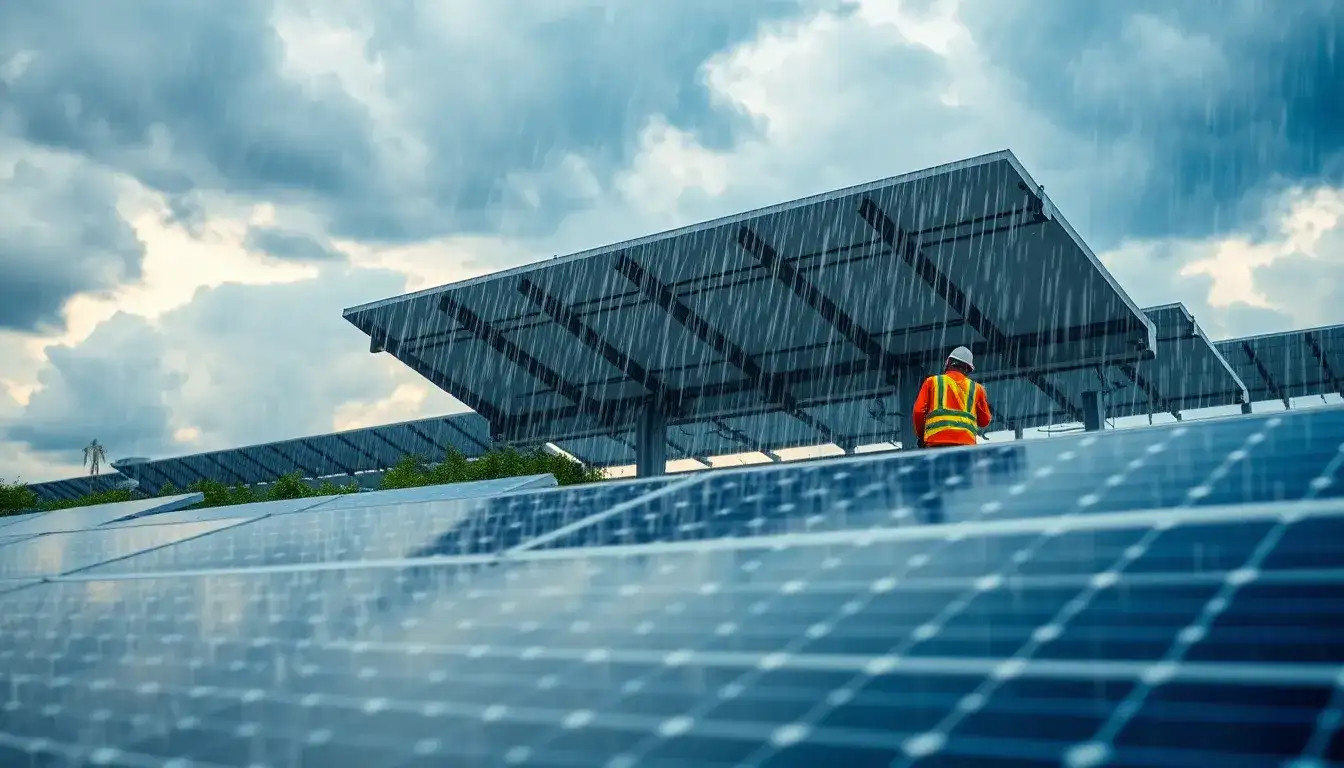
Global climate change is reshaping the Earth’s ecosystems at an unprecedented pace. According to the latest data from the World Meteorological Organization, the global average temperature in 2024 was 1.55 degrees Celsius higher than the average temperature recorded between 1850 and 1900, surpassing the previous record set in 2023. While only a few regions experienced a drop in average temperatures last year, extreme weather events caused significant destruction worldwide. Photovoltaic (PV) systems are now facing challenges from hail, gusts of wind, and other severe conditions.
PV companies are building defense systems from multiple dimensions. Recently, Trina Solar introduced solutions specifically designed for extreme weather conditions such as hail, strong winds, and heavy snowfall to maximize the protection of PV assets. Zhang Yingbin, head of strategy, products, and markets at Trina Solar, believes that for the future development of the PV industry, a shift from a manufacturing mindset to a systems approach is essential, moving from singularity to systemic thinking. Implementing innovative models for differentiated development is a crucial pathway to break away from “involution” competition and enhance value.
From passive responses to proactive measures to expand development opportunities: In 2024, the global installation capacity of new PV systems is expected to reach approximately 530 gigawatts, with centralized PV systems being the primary contributor. Specifically, in the domestic market, the new installation capacity for centralized PV systems reached 159.39 gigawatts last year, accounting for 57.4% of the total. Centralized PV systems occupy large areas and are significantly affected by extreme weather.
Data from GCube Insurance, a renewable energy insurance company, indicates that between 2018 and 2023, the number of climate-related claims for clean energy projects across 40 countries, with a total capacity exceeding 100 gigawatts, surged by 280%. Hail damage accounted for 54% of these claims, followed by strong winds at 23% and heavy snow at 15%.
Traditional PV products struggle to cope with the new climate norms. Recent monitoring shows that large centralized PV projects in regions like the North American Great Plains frequently encounter super hailstones larger than 40 millimeters in diameter, with terminal speeds exceeding 30 meters per second. Notably, around 70% of damaged PV modules were impacted by hailstones larger than 3 centimeters, a size that has tripled in appearance probability compared to ten years ago in climate models.
Climate risks are reshaping the global PV landscape. Different regions, such as the humid environments of the Brazilian rainforest, the freeze-thaw cycles in Northern Europe, salt spray corrosion in Australia, heavy snowfall in the Arctic, and dust storms in the Middle East, face unique extreme weather challenges. As a result, the demand for various segment-specific solutions is becoming increasingly diverse.
Zhang Yingbin stated, “PV applications are becoming more widespread globally, and countries at different latitudes face various extreme weather disasters. In the face of hail, heavy snow, and typhoons, conventional PV modules suffer significant losses, and PV assets are more prone to damage.” He further explained, “In the past, the PV industry selected installation sites passively based on climate conditions, avoiding areas severely affected by heavy snow and hail. However, if challenges posed by extreme weather can be addressed, proactive site selection and installation will become feasible, further expanding potential spaces for PV power stations.”
He emphasized, “With the rising global demand for green electricity, there is a clear need for PV installations in remote areas and regions prone to typhoons and hail. As extreme weather challenges intensify, global PV power stations will increasingly face severe conditions, necessitating corresponding responses and solutions.”
To this end, Zhang proposed that the PV industry is fully transitioning toward solution-oriented development. When single products can no longer address new environmental conditions, an upgrade in company strategies and solutions is required.
High-durability components, intelligent tracking systems, and powerful algorithms are driving multiple advancements. How can the safety levels of large centralized PV projects be enhanced through a systems approach? Zhang introduced the concept of using high-durability components and intelligent tracking as dual core drivers to address extreme weather challenges.
This dual approach includes hardware improvements. PV brackets serve as the “skeleton” of the PV system, while the PV modules act as its “skin.” As precision devices placed atop steel structures, PV modules function like human skin, sensing light, absorbing energy, and providing a barrier against environmental erosion. “To protect the ‘energy generation organs,’ we first need to ensure their durability,” Zhang noted.
“We have reinforced the thickness of the glass and the design of the frames. The glass thickness of our high-durability components has increased by 25%, enhancing energy impact resistance by 2.5 times compared to traditional modules, significantly improving the mechanical load performance of PV components to withstand extreme weather impacts.”
Furthermore, intelligent tracking brackets and robust algorithms are necessary. Trina Solar’s intelligent tracking system features the industry’s first cloud-based smart bracket, equipped with self-developed controllers (TCU and NCU) that integrate various extreme weather protection strategies. This system utilizes monitoring data from the smart cloud platform to enable automatic protective measures for the power station.
Zhang explained, “In simple terms, our solutions come with sensors that monitor wind speed in real time and implement relevant strategies based on varying wind conditions. During seasonal wind changes, we can adjust the angle of the PV modules to align with the wind, significantly reducing impact forces on the modules.”
He added, “When heavy snowfall occurs, snow accumulation on the surface of PV modules can prevent electricity generation, especially during extended snow periods when power generation may halt for the entire winter. Typically, maintenance personnel are required to clear the snow, incurring high labor and time costs. Our sensors can measure the thickness of the snow and upload this data to the platform. When the thickness reaches a certain level, maintenance personnel can simply press a button to automatically adjust the angle of the PV modules for snow removal, ensuring power generation.”
Simulation tests show that at a large centralized PV power station in Texas, when hailstones reach 65 millimeters in diameter, the damage rate for traditional products approaches 100%. The extreme weather solutions can withstand hailstones up to 55 millimeters in diameter, and under a 60-degree angle of protection, can endure hailstones up to 75 millimeters, reducing annual PV asset losses by 94%.
The extreme weather solutions represent another scenario-based solution following Trina Solar’s launch of the Shago Desert Base solution. Zhang stated that Trina Solar remains customer-centric and scenario-oriented, aiming to evolve toward a comprehensive solution pathway. “In response to the strong demand for electricity and zero-carbon energy, we will develop a new integrated model encompassing product solutions, system solutions, overall solutions, and smart energy solutions, integrating software and hardware products, systems, services, and business models to construct a green and low-carbon energy supply system for end users.”
Original article by NenPower, If reposted, please credit the source: https://nenpower.com/blog/resilience-of-photovoltaics-in-extreme-weather-conditions-strategies-for-climate-adaptation-and-protection/

