

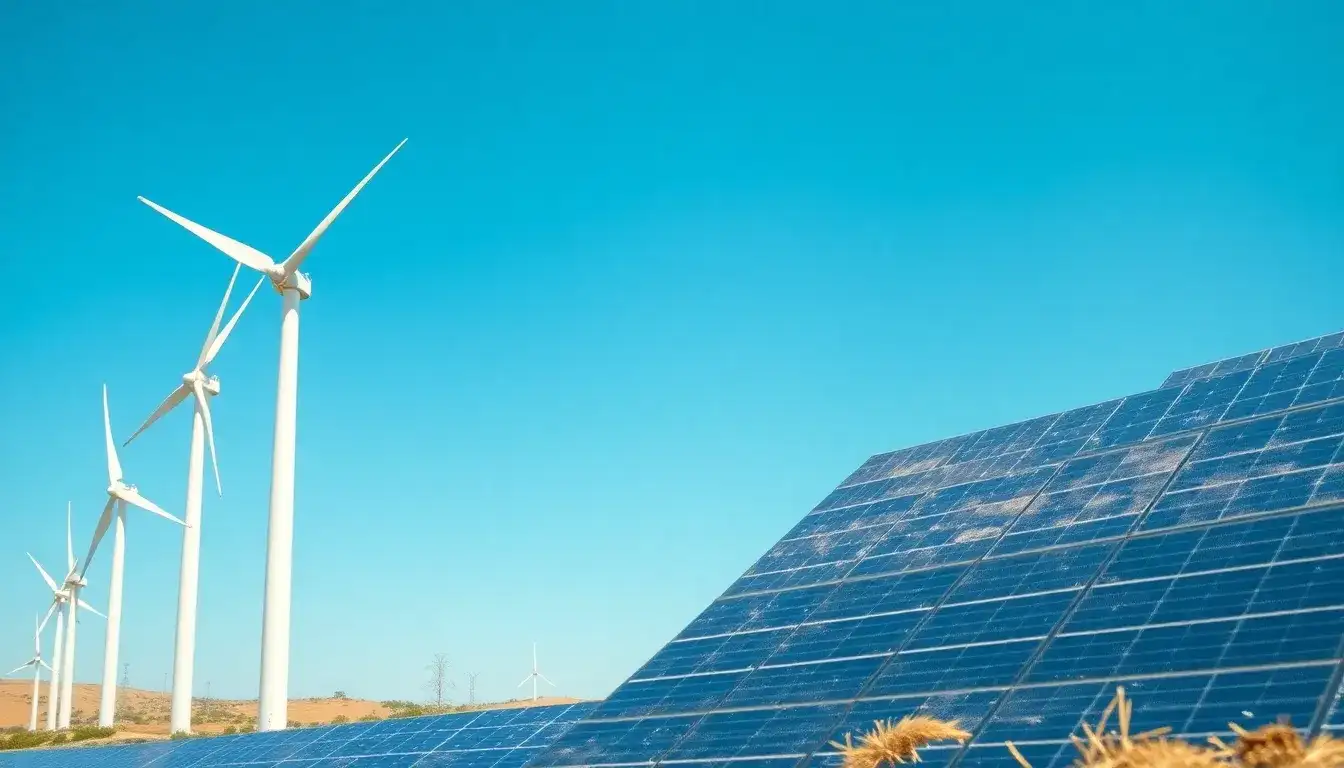
The rapidly growing sectors of wind power, solar energy, and energy storage have recently faced significant cyclical fluctuations, resulting in varying performance across these industries. As of 2024, companies in the A-share wind power and energy storage sectors maintained profitability, while solar energy firms found themselves in challenging circumstances. The first quarter of 2025 showed a rebound in the performances of wind power and energy storage companies, while solar companies experienced increasing disparities in their results.
Overall, the demand outlook for the wind, solar, and energy storage industries remains optimistic among industry insiders. However, fluctuations in the supply chain prices and demand in overseas markets are influencing the performance trends of these companies.
Recovery in Wind Turbine Prices Leads to Improved Performance
From the fourth quarter of 2024 to the first quarter of 2025, the domestic wind power sector displayed a notable recovery, with some manufacturers exceeding performance expectations.
According to statistics compiled by reporters, 23 A-share wind power companies collectively achieved operating revenues and net profits attributable to shareholders of 225.15 billion yuan and 13.24 billion yuan in 2024, representing year-on-year growth of 4.39% and a decline of 12.70%, respectively. Although the net profit decreased overall, many wind power companies reported a significant rebound in quarterly profits starting from the fourth quarter of the previous year, thanks to a stabilization in downstream turbine prices and an increase in average bid prices.
Continuing this trend, the first quarter of 2025 saw these 23 wind power companies collectively generate revenue of 47.575 billion yuan and a net profit of 4.221 billion yuan. When compared to the first quarter of 2024, both revenue and net profit figures showed an upward trajectory, with some leading manufacturers experiencing substantial net profit growth.
For example, Goldwind Technology (002202.SZ) reported operating revenue of 9.471 billion yuan in the first quarter of this year, marking a year-on-year increase of 35.72%. Its net profit attributable to shareholders was 568 million yuan, up by 70.84% year-on-year. Analysts believe that Goldwind’s impressive growth in the first quarter is due to a significant increase in turbine shipments, a notable reduction in expense ratios, and substantial gains from the fair value of financial assets. The steady improvement in domestic turbine prices and an increase in overseas shipments further enhanced the company’s profitability.
As of the end of March 2025, Goldwind had an order backlog of 51.09 GW, reflecting a year-on-year growth of 51.81%. With strong demand in downstream markets, analysts have raised their expectations for Goldwind’s turbine shipments. Notably, the profitability in overseas high-premium markets has also been standout; for instance, in 2024, Goldwind’s overseas sales gross margin was 14%, significantly higher than its domestic figures.
The rise in turbine prices and expansion into overseas markets have allowed wind turbine manufacturers to recover their performance, including companies that previously reported losses, such as Electrical Wind Power (688660.SH). In 2024, this company achieved revenue of 10.438 billion yuan, a year-on-year increase of 3.20%, but still reported a net loss of 785 million yuan, reducing its losses by 38.27% compared to the previous year. In the first quarter, its net loss narrowed further to 187 million yuan.
During an earnings briefing on April 28, the management of Electrical Wind Power indicated that despite a year-on-year increase in delivery volumes, the relatively small scale of deliveries and revenue continued to lead to losses. To enhance future profitability, the company plans to optimize its order structure by increasing the share of more profitable offshore and overseas orders.
However, some leading wind power companies are exceptions to this trend. Recently, SANY Renewable Energy (688349.SH) reported its first quarterly loss since its listing, with revenue growth but a loss of approximately 191 million yuan in the first quarter of this year, compared to a profit of 266 million yuan in the same period of 2024. Dongwu Securities noted that the low gross margin for SANY’s turbines in the first quarter was partly due to some shipments being from inventory accumulated in 2024, which did not benefit from cost reductions in the supply chain, and some deliveries were from low-priced orders for 10MW turbines.
Reflecting on the wind power sector’s performance in the first quarter, industry insiders noted an “early peak season,” with most wind power companies reporting significantly better shipment results than the same period last year, particularly due to a substantial increase in overseas project deliveries. Analysts suggest that since late 2024, strong downstream demand has driven production increases across the industry chain, leading to rising prices for components like blades and towers, stabilizing bidding prices for complete turbines, and suggesting a potential recovery in industry profitability.
Continued Struggles for the Solar Industry
The domestic solar industry faced unprecedented challenges in 2024. Despite ongoing record-high downstream installation demand, major manufacturing segments within the solar sector experienced widespread losses.
According to the statistics collected, 110 A-share solar companies achieved a combined operating revenue of approximately 1.38 trillion yuan in 2024, a year-on-year decrease of 17.96%. Their total net profit attributable to shareholders was approximately -363 million yuan, representing a year-on-year decline of 100.25%.
The poor profitability continued into the first quarter of 2025, with these 110 companies collectively realizing operating revenues of 279.136 billion yuan and a net profit of approximately 4.744 billion yuan. This marked a significant reduction in both revenue and net profit compared to the same period in 2024.
Losses became a defining characteristic for many solar companies in 2024 and into 2025. Further analysis revealed that 46 A-share solar companies reported negative net profits in 2024, particularly among integrated leaders such as TCL Zhonghuan (002129.SZ), Longi Green Energy (601012.SH), and Tongwei Co., Ltd. (600438.SH), which ranked as the top three in losses, with net profits attributable to shareholders of -9.818 billion yuan, -8.618 billion yuan, and -7.039 billion yuan, respectively. In contrast, companies like Sungrow Power Supply (300274.SZ), Three Gorges Energy (600905.SH), and Northern Huachuang (002371.SZ) reported leading net profits of 11.036 billion yuan, 6.111 billion yuan, and 5.621 billion yuan, respectively.
Notably, solar companies that also operate in the energy storage sector have shown impressive growth resilience. Besides Sungrow, Canadian Solar benefited from a surge in its energy storage business, leading to a net profit of 2.247 billion yuan in 2024, outperforming other solar module manufacturers. Solar inverter companies such as Deye Technology (605117.SH), Sungrow, and Huaneng (300827.SZ) also continued to report profitability.
Moreover, companies involved in solar equipment and auxiliary materials emerged as significant profit earners in 2024. For instance, solar equipment company JinkoSolar (300724.SZ) and Jinglong Technology (300316.SZ) reported net profits attributable to shareholders of 2.764 billion yuan and 2.510 billion yuan, respectively. The solar encapsulant company Foster (603806.SH) achieved a net profit of 1.308 billion yuan, while solar glass and mounting structure firms like Flat Glass Group (601865.SH) and Zhongtian Technology (688408.SH) posted net profits of 1.007 billion yuan and 632 million yuan, respectively.
The performance of A-share solar companies in 2024 reflects a trend of “main material losses,” “equipment, auxiliary materials, and end products profitability,” and “solar synergy companies demonstrating greater resistance to cyclical pressures.” This trend largely continued into the first quarter of 2025.
Financial reports indicate that in the first quarter of 2025, solar component companies nearly all suffered losses, with JinkoSolar (688223.SH), Longi Green Energy, Trina Solar (688599.SH), JA Solar (002459.SZ), and Tongwei Co., Ltd. collectively reporting losses of 8.377 billion yuan. JinkoSolar, which maintained a nearly 100 million yuan net profit in 2024, faced a loss of 1.390 billion yuan in the first quarter of this year. Although Longi Green Energy reported a loss of around 1.4 billion yuan in the first quarter, this was an improvement over its losses from the same period in 2024.
From a demand perspective, the first quarter of this year did show growth in newly installed solar capacity in China. According to the latest data from the National Energy Administration, the newly installed solar capacity from January to March 2025 reached 59.71 GW, reflecting a year-on-year increase of 30.5%, with March alone contributing 20.24 GW, a significant year-on-year surge.
However, prices for solar primary materials remain low. According to industry organization InfoLink Consulting, while prices for domestic multi-crystalline silicon, wafers, cells, and modules increased compared to 2024, they still lag significantly behind prices from the first quarter of 2024. For example, the average transaction price for N-type TOPCon modules at the end of March 2025 was 0.75 yuan/W, compared to 0.95 yuan/W during the same period in 2024.
As solar primary material prices gradually recover, some leading companies remain hopeful of achieving profit and loss balance this year. Longi Green Energy’s Chairman, Zhong Baosen, stated during an earnings briefing on April 30 that the ability to return to profitability is closely linked to the industry situation, with the company’s goal to reach the break-even point by the third quarter of this year.
Overall, the speed of capacity clearing is the most significant factor influencing whether solar companies can return to a growth trajectory.
Energy Storage Sector Experiences Profit Recovery Amidst “Rush Installation” Trend
Despite intense competition impacting the overall performance of energy storage companies in 2024, many firms saw an improvement in profitability in the first quarter of this year.
Statistics from 21 listed companies involved in energy storage business indicate a structural “volume increase with reduced profits” phenomenon for the entire year of 2024. Their total revenue was 682.1 billion yuan, a decrease of 3.59% compared to the entirety of 2023. The net profit attributable to shareholders was 74.541 billion yuan, down 21.4% year-on-year.
However, in the first quarter of 2025, these 21 companies collectively reported revenue of 158.073 billion yuan, marking a year-on-year increase of 12.39%, with net profits attributable to shareholders rising to 21.033 billion yuan, an increase of 34%.
It is essential to note that the trend of profits concentrating among leading companies in the energy storage sector has become increasingly pronounced. For instance, in the first quarter, benefiting from rapid growth in energy storage operations, top firms like CATL (300750.SZ), Sungrow, and Yiwei Lithium Energy (300014.SZ) reported significant net profit growth, capturing a substantial share of industry orders and profits.
“In the past couple of months, there have been widespread reports that (energy storage) batteries are hard to come by. Top players like CATL and Yiwei Lithium Energy are already experiencing full production capacity for their energy storage batteries, and some downstream customers are required to pay upfront for battery purchases,” remarked a leading analyst in the energy sector.
This trend is evident in Yiwei Lithium Energy’s financial reports, where the share of revenue from the energy storage battery segment has been rapidly increasing since 2024, and it is poised to surpass that of the power battery segment this year. The growth of energy storage operations has, to some extent, shielded the company from overall performance declines, becoming its most crucial growth engine.
Conversely, secondary battery manufacturers are struggling to benefit from the successes of leading companies. Penghui Energy (300438.SZ) and Nandu Power (300068.SZ), as representatives of A-share secondary battery manufacturers, reported varying degrees of losses in net profits for the first quarter of 2025.
In fact, the energy storage sector is undergoing transformation, as the structural blue ocean of past years begins to recede.
China is one of the world’s largest markets for energy storage installations and manufacturing. Historically, two primary drivers of rapid growth in the shipment scale of Chinese energy storage companies have been domestic policy incentives and expanding overseas markets.
According to incomplete statistics from CNESA DataLink’s global energy storage database, by the end of 2024, China had an installed capacity of 137.9 GW for operational energy storage projects, accounting for 37.1% of the global market, a year-on-year increase of 59.9%.
Energy storage companies often view the domestic market as a primary growth area for shipment volumes, while treating international markets as profit pools. This is due to intensified price competition driven by domestic policy incentives, while high-quality products can command a premium in overseas markets.
However, following the relaxation of requirements for energy storage alongside the grid connection of new energy power stations and the uncertainties surrounding the U.S.’s so-called “reciprocal tariffs,” this dual approach has begun to shift.
“In the short term, production capacity may be at full throttle, but prices remain low,” stated a representative from an energy storage company. This statement reflects the backdrop of the New Energy policy, represented by Document 136, which has created a temporal divide; projects connected to the grid before May 31 maintain previous pricing policies, while later-connected projects will adopt new pricing mechanisms. Due to the uncertainties surrounding future price trends, the investment returns on energy stations need to be re-evaluated, prompting a rush for installations before May 31. This surge has resulted in increased demand for energy storage devices alongside solar and wind projects.
However, industry insiders generally believe that the sharp decline in compulsory energy storage demand driven by policy will accelerate the elimination of low-quality, marginal companies in the sector, and the ensuing industry consolidation will benefit future price stability. Yet, due to the lack of specific local policies, the short-term market potential for energy storage remains difficult to predict.
In the overseas market, the sustainability of high growth in the first quarter for energy storage companies will be tested. A research report released by Guohai Securities in March indicated that certain energy storage projects in the U.S. might face a “rush installation” scenario at least until mid-2025. This scenario has contributed to the remarkable performance of some energy storage companies in the first quarter.
For instance, Sungrow is expected to ship 12 GWh in the first quarter of 2025, reflecting a quarter-on-quarter growth of approximately 10% due to strong demand in high-profit overseas markets, even amidst uncertainties surrounding tariffs.
Despite the uncertainties in the overseas market, Chinese energy storage companies continue to regard it as a necessary market for finding growth opportunities. Zhang Jianhui, Chairman and CEO of Haibo Silicon, recently stated, “We have set a goal to achieve parity in the scale of our overseas business with our domestic operations within three to five years.”
Original article by NenPower, If reposted, please credit the source: https://nenpower.com/blog/renewable-energy-financial-report-wind-power-and-energy-storage-recover-while-solar-struggles/

