

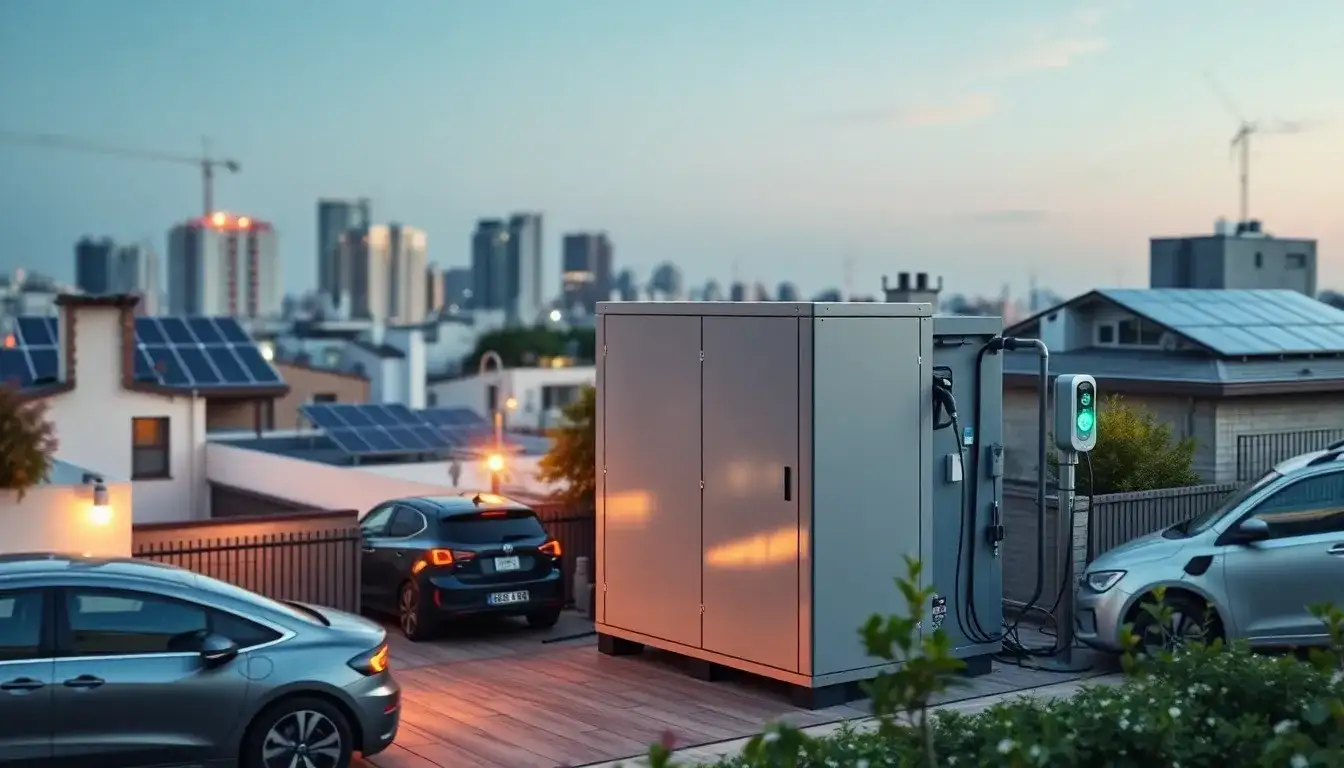
Redefining the Value of Energy Storage Systems as Time-of-Use Pricing Changes
Starting in 2026, users participating directly in the electricity market will no longer be subject to government-mandated time-of-use pricing. This shift towards market-based pricing presents challenges for commercial and industrial energy storage systems attempting to capitalize on peak and off-peak price differences. Drawing from cases in Poland and Sweden, AI-enabled energy storage microgrids can significantly reduce costs and enhance efficiency, thereby transforming energy storage into a smart energy balancing tool in line with domestic zero-carbon factory initiatives.
1. The Trend of Eliminating Policy-Based Time-of-Use Pricing
By the end of 2025, the National Development and Reform Commission and the National Energy Administration issued notices regarding the signing and implementation of long-term electricity contracts for 2026. They clearly stated that, in principle, users participating directly in the market will not be subject to government-defined time-of-use pricing. Subsequently, provinces such as Liaoning, Sichuan, Shaanxi, Yunnan, Henan, and Shanxi included similar stipulations in their guidelines for long-term transactions in 2026, indicating that time-of-use pricing levels and periods will no longer be artificially set for market participants.
This shift does not imply the elimination of time-of-use pricing; rather, it signifies a fundamental change in its formation mechanism—from “government pricing” to “market pricing.” Under the influence of supply-demand dynamics and market transactions, the prices for peak, flat, and valley periods will naturally form based on market conditions, leading to price fluctuations that more accurately reflect real-time market situations.
However, this market-driven time-of-use pricing introduces two major challenges for traditional commercial and industrial energy storage systems that rely on peak and off-peak arbitrage:
- Rigid Timing Strategies: Traditional energy storage systems often operate on fixed charging and discharging schedules, making it difficult to align with actual electricity demand. This is particularly problematic in “solar + storage” scenarios, where a lack of flexibility can lead to low energy storage utilization or unmet electricity demand.
- Increased Price Volatility: As time-of-use pricing becomes linked with spot market prices, fluctuations may occur at hourly or even 15-minute intervals. Peak prices could exceed 1 yuan/kWh, and during high solar generation periods, negative prices may occur. Traditional fixed strategies struggle to adapt to such a volatile pricing landscape.
In this new electricity market mechanism, how should commercial and industrial energy storage redefine its value proposition?
2. From Peak-Off-Peak Arbitrage to Microgrid Balancer
Experience from mature electricity markets in Europe suggests that the higher the level of marketization, the broader the application scenarios and the more apparent the value of energy storage systems. Their role is evolving from a simple “peak-off-peak arbitrage tool” to that of an “intelligent balancer for distributed solar-storage microgrids.”
For instance, in Poland, the implementation of dynamic pricing by the Polish Power Exchange starting in 2025 has resulted in average electricity bills for users declining by 50%, with solar revenue increasing by over 200%. A resident in Warsaw installed an energy storage system with AI dispatch capabilities, creating a small intelligent solar-storage microgrid. During fixed price periods, the feed-in tariff for solar was only 0.22–0.44 zloty/kWh. After switching to dynamic pricing and integrating the intelligent storage system, the user could “store electricity” during low-price windows and “release” it during high-price periods, achieving substantial savings and increased revenue. Data from one year of operation showed that the user’s electricity purchase cost dropped to approximately 0.55 zloty/kWh, nearly a 50% reduction, while the average feed-in price for solar rose to 1.09 zloty/kWh, with returns increasing by 220%-300% and self-consumption rates growing by over 200%.
In Sweden, statistical data from over 2,500 projects indicates an average electricity bill reduction of 70.3%. The Swedish electricity market is segmented into four regions (SE1-SE4), with these independent projects distributed accordingly. Analysis of the data shows a median reduction in user electricity costs of 52.7%. This variance is not merely due to outliers; instead, it reflects higher savings for users in areas with greater price volatility.
3. AI Intelligent Dispatch: Understanding Pricing and Consumption
Achieving cost reduction and efficiency in a dynamic pricing environment relies heavily on the deep integration of AI technology. The intelligent solar-storage system utilizes multi-model fusion and reinforcement learning, resulting in core capabilities such as:
- Load Profile Learning: Continuously learning the electricity usage patterns of each project to identify peak loads, night-time consumption patterns, and differences between weekdays and holidays, creating highly personalized load profiles.
- Solar Generation Forecasting: Accurately predicting solar output based on weather data.
- Price Trend Prediction: Anticipating price fluctuations based on market data to formulate optimal charging and discharging strategies.
- Rolling Optimization and Flexible Settings: Employing a multi-model fusion strategy in conjunction with weather forecasts and load behavior modeling to establish the most efficient dispatch paths, while allowing for daily strategy adjustments based on user preferences.
Currently, the system supports various operational modes, including self-consumption, virtual expansion, electricity market transactions, and peak-off-peak arbitrage, achieving true “flexible charging and discharging.” In practice, the system is capable of balancing economic efficiency with electricity supply stability, ensuring both the seizing of price arbitrage opportunities and the stability of power supply during critical load periods. As AI models continue to evolve and algorithm strategies are refined, the system aims to transition from merely being “usable” to being “well-utilized,” enabling more users to realize truly intelligent energy consumption and long-term gains.
4. Intelligent Solar-Storage Microgrids Supporting Zero-Carbon Factories
The 14th Five-Year Plan in China explicitly advocates for the development of distributed energy and the establishment of zero-carbon factories and parks. In December 2025, the National Development and Reform Commission, the Ministry of Industry and Information Technology, and the National Energy Administration jointly announced 52 national-level zero-carbon parks. In January 2026, these departments issued guidance on the construction of zero-carbon factories, aiming to cultivate several zero-carbon factories in seven major industries, including solar energy, lithium batteries, and automotive by 2027, expanding to 12 industries by 2030.
It is anticipated that zero-carbon factories and parks, centered around “electric load,” will emerge as key scenarios for future new energy development. Direct green electricity connections and intelligent microgrid models will see significant growth opportunities, becoming vital development pathways for new energy. These scenarios and models share a core objective with users in Poland and Sweden: achieving optimal electricity costs in a fully marketized dynamic pricing environment. International experience indicates that intelligent solar-storage microgrids can effectively lower electricity costs and enhance solar project revenues; moreover, the greater the price volatility, the more pronounced the effectiveness.
Currently, over 17,000 power stations globally have adopted the AI model, covering dynamic pricing scenarios in 47 countries, forming a multi-layered and practical AI application system.
Conclusion
Farewell to fixed policy-based time-of-use pricing, and welcome the era of market-driven dynamic pricing. This transition does not signify the end of the value of energy storage systems but rather the true beginning of the intelligent energy era. Through AI dispatch and microgrid collaboration, energy storage systems are evolving from mere “storage devices” to “intelligent energy balancers,” capturing value amidst fluctuations and reshaping the future.
Original article by NenPower, If reposted, please credit the source: https://nenpower.com/blog/redefining-the-value-of-energy-storage-systems-as-time-of-use-pricing-policy-ends/

