

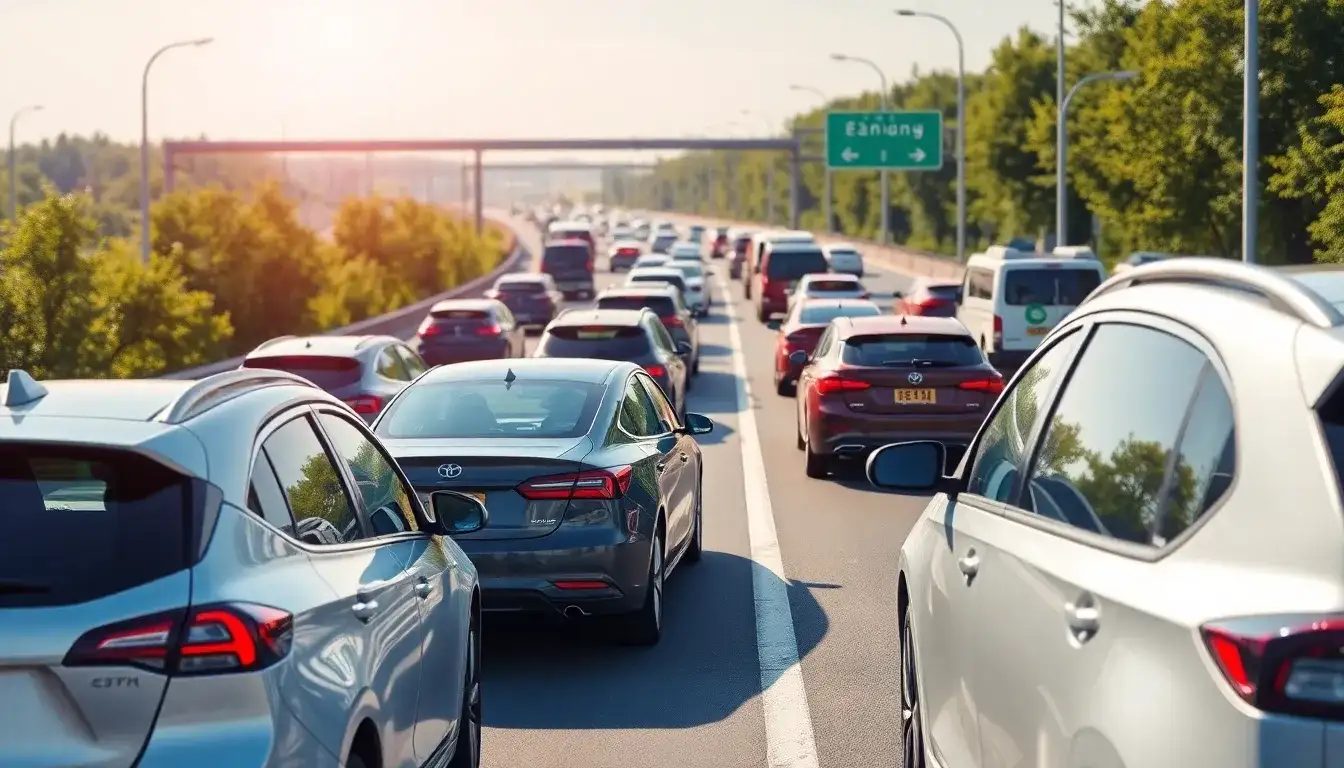
Record High Charging Volume for New Energy Vehicles during the “May Day” Holiday
Historically, the challenge of charging new energy vehicles (NEVs) on highways during holiday periods has been a hot topic among the public. However, has this situation improved this year? During the recent “May Day” holiday, reporters from Daily Economic News visited several highway service areas in the Yangtze River Delta region and did not encounter long queues for NEV charging.
According to reports, this improvement is closely related to the rapid enhancement of charging infrastructure, the increasing diversity and flexibility of charging methods, and the enhanced coordination capabilities of relevant departments. The latest data from the State Grid’s smart vehicle network platform indicates that from May 1 to May 4, the total charging volume on the platform exceeded 101 million kilowatt-hours, marking a year-on-year increase of over 21%. Notably, the charging volume for NEVs at highway service areas across the country reached 30.68 million kilowatt-hours, a 28% increase compared to the same period last year, achieving a historical high.
On May 4, at the Jiangdu Service Area on the Hu-Shan Expressway, vehicles were waiting in the charging queue. The Jiangdu Service Area features 12 fast charging stations, capable of servicing 20 vehicles simultaneously. Despite the charging spots being full upon the reporter’s arrival, the orderly management allowed for a wait time of just about 10 minutes before successfully charging the vehicle. Two years ago, during a similar holiday period, the wait time exceeded 30 minutes due to only 6 charging stations available (which could serve 8 vehicles at a time).
According to staff at the Jiangdu Service Area, “Previously we only had 6 charging stations, leading to long queues during holidays. We’ve added 6 more stations now, significantly reducing wait times. If there’s an urgent need, drivers can also go to the opposite service area, which has available spots for direct charging, easily accessible through an underground passage.”
During the nearly hour-long charging session, the charging area remained busy, with vehicles quickly vacating their spots after charging, and no long wait times or instances of gasoline vehicles occupying charging spots were observed. There were even moments when vehicles could charge immediately without waiting. Clear signage in the area advised drivers to utilize service areas along the route to “fast charge and go,” encouraging efficient charging practices.
A driver charging at the Jiangdu Service Area remarked, “I remember during last year’s ‘National Day’ I had to wait a long time to charge. This time feels much better, and there are dedicated staff coordinating the process, ensuring order, so I’m not worried about queue jumpers.”
Additionally, at the Jiaxing Service Area on the G60 Hu-Kun Expressway, it was revealed that several charging station operators, including State Grid, LI Auto, and Aion, have set up over 30 charging stations equipped with 80 charging guns. Furthermore, multiple mobile charging robots have been deployed to respond to charging needs directly at the locations of NEVs, providing “door-to-door” charging services.
Prior to the “May Day” holiday, the National Energy Administration directed local authorities to update aging charging facilities and deploy temporary charging equipment, while also increasing staffing for guidance and performing equipment maintenance in advance. They utilized information platforms to enhance monitoring, ensuring that charging services operated smoothly, safely, and efficiently during the holiday.
With the rapid development of NEVs, the construction of charging infrastructure has also improved significantly, making charging more convenient and efficient. As of the end of March this year, there were a total of 38,000 charging facilities built in highway service areas nationwide, covering 98% of service areas, thus better meeting the charging needs of NEV travelers. Additionally, battery swapping has emerged as a method to alleviate the pressure of highway charging. For instance, NIO’s battery swap stations were particularly busy during the “May Day” holiday, with daily swap counts reaching 3,374 on the G15 Shenhai Expressway, 1,902 on the G3 Jing-Tai Expressway, and 1,827 on the G2 Jing-Hu Expressway. Currently, NIO operates 983 battery swap stations, with 81% of owners opting for battery swapping as their charging method.
To address the surge in holiday travel, local authorities have implemented various flexible measures to ensure the normal operation of NEVs. Along the Hu-Kun Expressway, power departments in Shanghai and Zhejiang set up a mobile charging vehicle at the Fengjing Service Area and two mobile charging robots at the Jiaxing Service Area. These mobile charging devices can be dynamically allocated during peak charging times to provide emergency charging services.
The Yangcheng Lake Service Area in Suzhou, Jiangsu, which is one of the busiest service areas on the Hu-Rong Expressway, introduced differentiated charging guidance services during the “May Day” holiday. NEV owners who opted to charge only up to 70% were offered a 30 yuan discount coupon for charging services, encouraging them to “fast charge and go” to avoid long wait times.
Throughout the “May Day” holiday, eight highway service areas in Yangzhou experienced a surge in charging demand, prompting the local power company to assign 50 staff members to monitor charging equipment and provide on-site assistance. The Baoying Service Area on the Jing-Hu Expressway also positioned a mobile energy storage charging vehicle to provide emergency charging support for passing NEVs. Moreover, dedicated waiting areas for charging were established in several service areas including Chenji, Gaoyou, Yizheng, and Jiangdu, where a queue numbering system was implemented to prevent vehicle congestion.
According to Shi Shuanglong, Director of the Monitoring Center at State Grid Smart Vehicle Network Technology Co., Ltd., from April 28 to May 5, around 60,000 charging discount coupons were issued daily to NEV owners via the “e-charging” app. This initiative aimed to guide owners to charge at urban charging stations near highway exits, reducing their waiting time and alleviating the pressure on charging at service areas.
Furthermore, many regions have employed smart scheduling technology to ease the charging pressure on NEVs. In the charging stations at the Laixi Service Area on the Shenhai Expressway, a new “smart monitoring” system was introduced, allowing inspections of charging stations every 15 minutes, with a response time for handling faults reduced to within 30 minutes. In Anhui, local power departments have implemented a video customer service system across all highway service areas. If owners encounter issues while charging, they can simply scan the QR code on the charging station to connect via video with staff at the State Grid Smart Vehicle Network Monitoring Center for technical assistance and advice. These measures ensure residents’ green travel.
Through the expansion of charging stations, flexible dispatch of mobile charging equipment, and the efficient supplement of battery swapping models, collaborative efforts and technological innovations are significantly alleviating the long-distance travel anxiety of NEV owners. At the same time, innovations such as smart scheduling systems and discount guidance policies further optimize resource allocation and enhance user experience, making highway charging during holiday periods much smoother.
Original article by NenPower, If reposted, please credit the source: https://nenpower.com/blog/record-high-charging-volumes-for-new-energy-vehicles-on-highways-during-may-day-holiday/

