

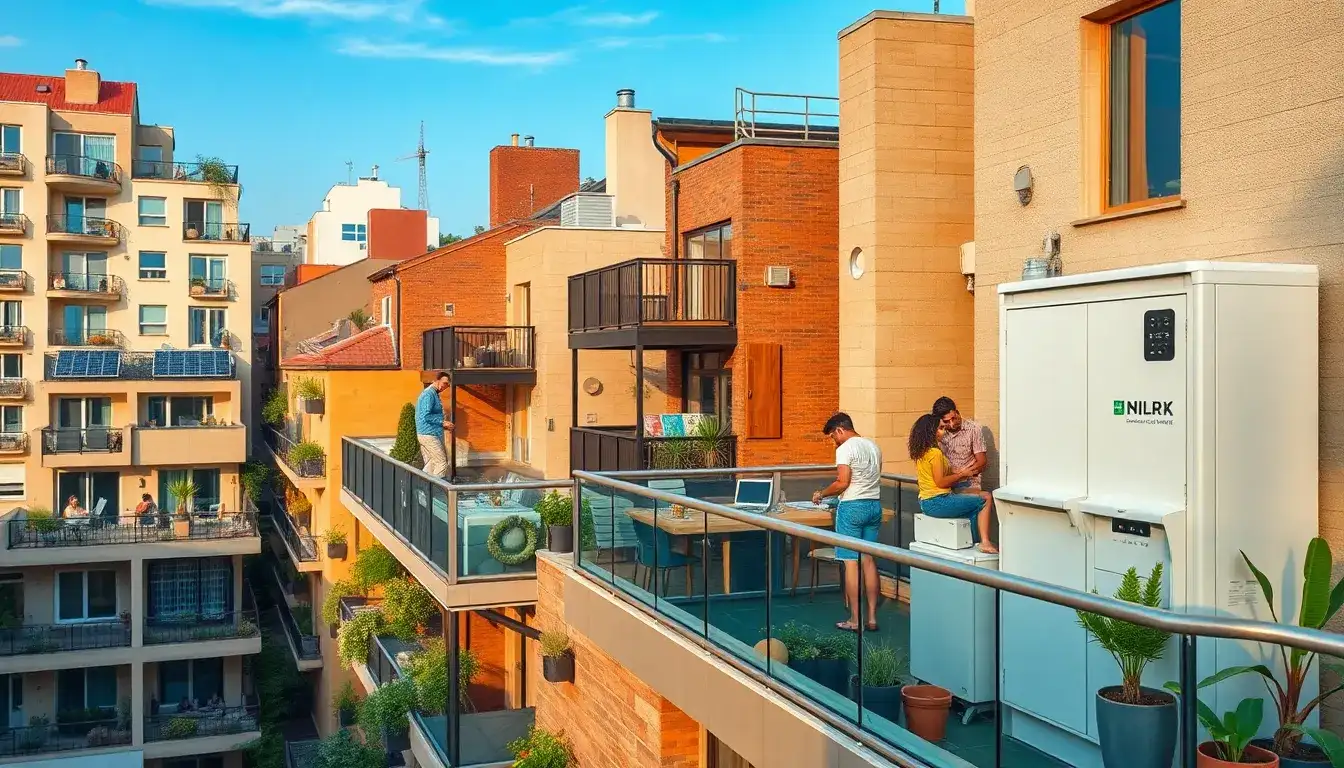
As of this year, the balcony solar energy storage sector has gained significant momentum, with five categories of companies vying for a share of this emerging market. Recently, several domestic and international solar storage companies, including Huayuxin, Maitian Energy, Guruwatt, Anker Innovations, and EcoFlow, have launched new products designed for balcony solar storage, targeting the European market and drawing considerable attention within the industry.
The balcony solar storage market represents a new frontier in distributed energy, having begun to gain traction in 2023 and rapidly evolving in 2024. With installations in residential balconies, garages, and yards, the combination of balcony solar panels, micro-inverters, and micro-storage makes clean energy easily accessible for households. This swift growth can be attributed to the increasing demand for small-scale distributed clean energy among families in Europe and North America, along with supportive photovoltaic policies in countries like Germany and the Netherlands.
According to reports, Germany’s simplified solar package initiative, Solarpaket I, is expected to boost the country’s balcony photovoltaic capacity to 426 MW by 2024, marking a substantial surge and making it the largest capacity in Europe. Additionally, countries like Poland, Austria, the Czech Republic, and Italy show significant potential, with the trend likely to expand to North America, Latin America, Southeast Asia, and Africa as well. Data from QYResearch indicates that the global balcony energy storage market is projected to reach $14.972 billion by 2031, with a compound annual growth rate of 21.1% over the coming years.
In the global arena, the balcony solar storage market consists of various players, including inverter/micro-inverter manufacturers, portable energy storage companies, residential energy storage firms, solar/appliance companies, and new entrants. Key companies in these categories include:
- Inverter/Micro-Inverter Manufacturers: Enphase, Guruwatt, Huayuxin, Deye, Hema, YNtech, Sanjing Electric, GoodWe, Aero Energy, Enyip, Shouhang New Energy, Haipeng Technology, Yijing Microelectronics, Benyi Electric, Enwo New Energy;
- Portable Energy Storage Companies: Anker Innovations, Huabao New Energy, Zendure, EcoFlow, Huamei Xingtai;
- Residential Energy Storage Companies: Wotai Energy, Tuobang Co., Tengsheng Energy, Maitian Energy, Dele Rand, Aiyang Power;
- Solar/Appliance Companies: Solarwatt, TCL, Skyworth, Midea Hekang New Energy, Haier Nanhui New Energy;
- New Entrants: Jiayu Digital Energy, Xihe Future, Tianji New Energy, Songrong New Energy Technology.
The primary production regions for balcony solar storage products are China and certain parts of Asia and Latin America, while Europe and North America are the main application markets. Major manufacturers in the balcony solar storage sector include Anker Innovations, Enphase, Guruwatt, Wotai Energy, Solarwatt, and EcoFlow. Notably, micro-inverter and portable storage companies have established a competitive advantage through brand influence and robust distribution networks. Anker Innovations reported that its energy storage business surpassed 3 billion yuan in revenue for 2024, achieving a year-on-year growth of 184%, with balcony storage sales ranking first globally.
Chinese companies are aggressively entering the European balcony solar storage market, making it a battleground for global competition, especially with favorable policies in Germany and the Netherlands. Germany has simplified installation processes through its 800W balcony photovoltaic bill, while the Netherlands encourages user storage configurations through negative pricing and net metering policies. Overall, the balcony energy storage market remains relatively small and is still in its early rapid development phase, with intense competition.
Global micro-inverter leader Enphase is set to launch its new product, the IQPowerPack1500, a 1.5 kW portable power source with a built-in Enphase IQ8 micro-inverter in November 2024. Chinese companies such as Huayuxin, Maitian Energy, Guruwatt, Anker Innovations, EcoFlow, Hema, YNtech, and Shouhang New Energy are quickly capturing market share through competitive pricing and comprehensive solutions. For instance, Huayuxin showcased its balcony micro-storage system at Intersolar, featuring a battery capacity of 2.56 kWh (expandable to three units for a total capacity of 10.24 kWh) and a maximum output power of 1,200 W, compatible with low-power DC devices and easy to install.
Huabao New Energy has introduced the next-generation DIY small home green power system, Jackery Home Power 2000 Ultra, equipped with a 2 kWh lithium iron phosphate battery expandable to 8 kWh, supporting up to 2,800 W of photovoltaic input power (2,000 W MPPT and 800 W micro-inverter). Anker Innovations and Guruwatt have also launched balcony solar storage integrated machines aimed at reducing user barriers with “consumer-grade” products. Penghui Energy presented a new balcony storage solution, Allpowers POWISER, at CES 2024, while Jiayu Digital Energy has developed its own 800W micro-inverter compatible with unconventional European rooftops. Deye is set to introduce grid-connected balcony solar storage products in Germany.
The integration of distributed photovoltaic and storage technologies has evolved into a 3.0 version of balcony solar storage solutions. This advanced offering can be summarized as follows: 800W to 2000W photovoltaic input + 800W micro-inverter + 2 kWh to 10 kWh expandable micro-storage. A notable example is the JUPITER series integrated balcony storage system by the MARSTEK brand under Huamei Xingtai, featuring capacities from 2,560 Wh to 5,120 Wh, supporting up to 2 kW solar input with 800 W AC grid output, requiring no installation—just plug and play. Guruwatt’s new balcony solar storage product, NEXA2000, adopts an integrated design, combining an inverter and a 2 kWh battery (expandable to 8 kWh) with four MPPTs, allowing for photovoltaic inputs up to 2,600 W and nominal AC output power of 800 W.
In summary, balcony photovoltaic technology has evolved to version 3.0. The earlier version 1.0 comprised photovoltaic panels and micro-inverters, while version 2.0 included photovoltaic panels, micro-inverters, and micro-storage. The current 3.0 version integrates photovoltaic panels with a balcony storage all-in-one machine, incorporating both micro-inverter and micro-storage technologies, leading to higher integration, smarter systems, and easier installations for users.
Notably, micro-inverter technology continues to evolve, with single-stage DAB topologies emerging due to their efficiency (peaking at 98.4%), low cost, and compact design. Companies like Yijing Microelectronics and YNtech are adapting to high-power components through multi-unit configurations (such as 800W/5000W). Micro-storage systems are also progressing towards modular, plug-and-play, and intelligent designs, exemplified by Huabao New Energy’s DIY household green power system, which supports rapid installation within five minutes and smart peak-valley arbitrage. The Zhongneng Sitong solar-storage-heat integrated solution combines photovoltaic components, micro-inverters, micro-storage, and heat pumps, enhancing solar energy utilization rates to 80% while addressing both power generation and hot water needs.
The deep integration of micro-inverters and micro-storage has given rise to a one-stop home energy system, with companies expanding from single hardware offerings to create an ecosystem of “solar-storage-charging.” Currently, Jiayu Digital Energy has launched the micro-storage all-in-one machine JMS-1200, supporting self-consumption and off-grid operations, while MARSTEK has released the ENERGYCUBE smart coupling system, enabling electricity trading and off-grid supply. Hema and YNtech are also pushing products from B2B to B2C, allowing users to install and manage energy independently, and Xihe Future has proposed “AI micro-inverters” to enhance generation efficiency and longevity through algorithms.
While the balcony solar storage market presents significant opportunities, it is essential to recognize the challenges it faces during its development phase. There remains substantial potential for policy support, market expansion, technological innovations that enhance safety and efficiency, modular designs that lower installation barriers, and large-scale production that reduces costs, as well as expanding applications in commercial and large residential settings. Despite the promising outlook, the balcony solar storage sector currently grapples with limitations such as restricted balcony space, component power constraints, policy uncertainties, low market awareness, product homogeneity, high initial investment costs, and lengthy payback periods.
Furthermore, in terms of market competition, consumers in Europe and North America tend to be more loyal to local brands, with Enphase micro-inverter products commanding over 70% of the North American market share. Brands like Solarwatt and Dele Rand are actively seeking contract manufacturing opportunities abroad. Additionally, geopolitical risks affecting the global economy and the Chinese supply chain will have significant implications for Chinese companies entering the market. For Chinese enterprises, the key to maintaining a leading position in this competitive landscape lies in embracing technological innovations, strengthening technical barriers, optimizing cost management, enhancing localized services, and spearheading product innovations to build a smart ecosystem.
Original article by NenPower, If reposted, please credit the source: https://nenpower.com/blog/rapid-growth-of-balcony-solar-energy-storage-five-types-of-companies-compete-in-the-booming-market/

