

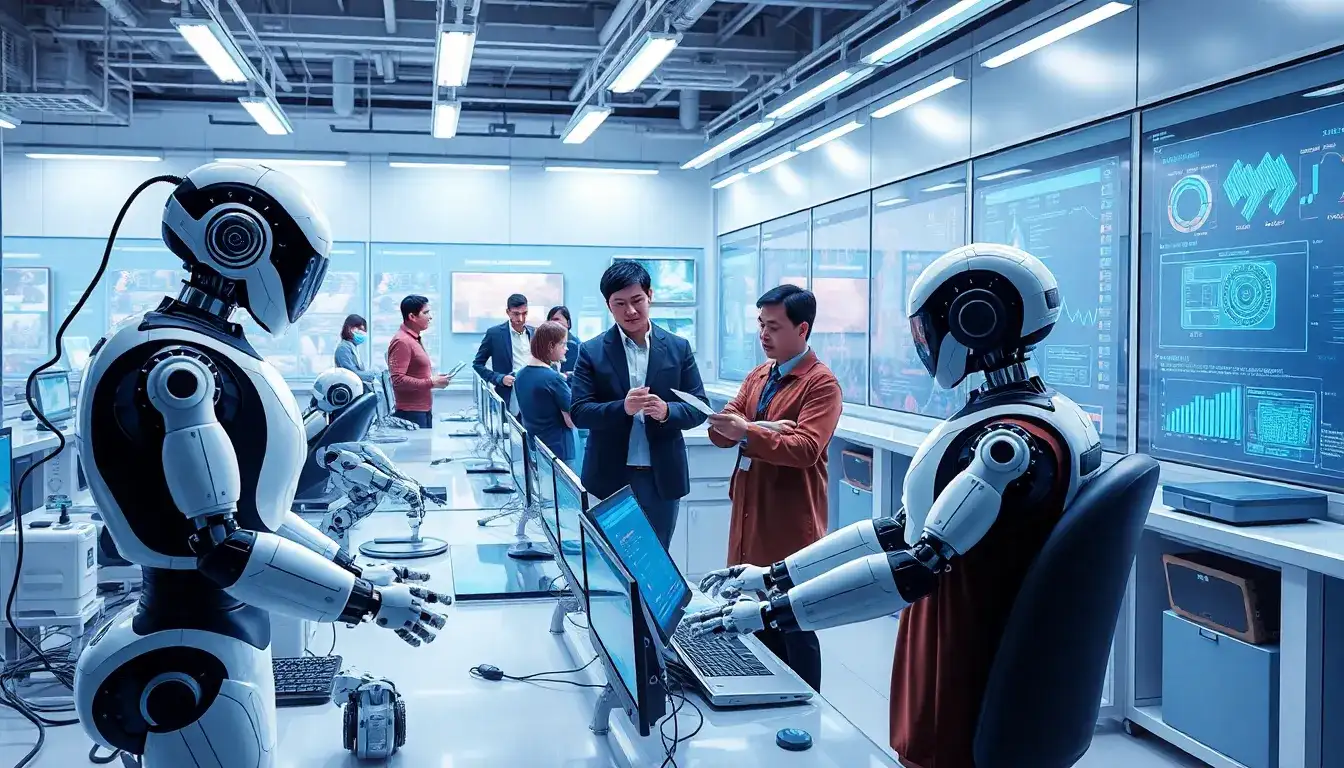
Qingdao’s Embodied Intelligent Robot Market Expands with Forward-looking Layout in Industry, Academia, and Research
As of April 9, 2026, challenges in the robotics market are becoming increasingly evident. For instance, a medication delivery robot in a Shandong provincial nursing home recently malfunctioned due to a battery issue, causing it to “strike.” Consumers have reported issues with drones that either remain unused due to expensive repairs or are difficult to operate, and companies are abandoning humanoid robots after warranty expiration as repair costs become prohibitively high.
According to the 2025 Humanoid Robot Market Research Report, global shipments of humanoid robots are projected to reach approximately 17,000 units by 2025, with a market size of 2.88 billion yuan. China, leveraging its advantages in supply chains, technology, and practical applications, remains the largest player in the global humanoid robot industry, housing over 140 manufacturers. The country’s shipments are expected to reach 14,400 units, accounting for 84.7% of the global market, and generating a market value of 1.55 billion yuan, which is 53.8% of the global share. Morgan Stanley’s latest forecasts indicate that sales of humanoid robots in China will increase by 133% year-on-year in 2026 to 28,000 units, with projections of 262,000 units by 2030 and 2.6 million by 2035.
As robots transition from being a niche technology to offering widespread services, a vast aftermarket is rapidly emerging, encompassing maintenance, servicing, insurance, and software subscriptions. However, issues such as high repair costs, difficulty in maintenance, and a scarcity of skilled personnel are surfacing. How can the post-service path for embodied intelligence robots be effectively navigated? Is there an opportunity for One-Person Companies (OPC) in this sector?
Repair costs for embodied intelligent robots can range from several thousand yuan to hundreds of thousands. Qingdao Qinyang Intelligent Technology Co., Ltd., which specializes in robot sales and leasing, is a premier agent for brands like Zhiyuan Robotics, Accelerated Evolution, and Songyan Power Robotics in Shandong. The General Manager, Yang Jing, noted that brands like Yushu Technology and Zhiyuan Robotics have significant sales volumes, with around 50 units expected in 2025. Rental services are in high demand during holidays and weekends, with daily rental fees around 4,000 yuan, which has decreased compared to last year.
As sales and rentals increase, attention is being paid to issues of robot malfunctions, damage, or wear. During the world’s first humanoid robot half marathon, many robots wore sports shoes to minimize foot wear and provide cushioning, reducing strain on knee joints. Currently, most manufacturers offer a warranty period of 1 to 1.5 years, covering non-human-caused failures (such as natural wear or design defects) and only if the robot is used within the official guidelines and load limits.
The current repair process involves sending robots back to the manufacturer, with a minimum turnaround of 10 days required for repairs, often exceeding 10,000 yuan in costs. Although manufacturer repair costs are 30%-50% higher than third-party services, the quality and warranty provided are deemed more reliable. Yang Jing explained that components like harmonic reducers, servo motors, encoders, and torque sensors are common wear spots in embodied intelligent robots, with joint modules being the primary cost driver in repairs. While repairs for non-human damage are free within the warranty period, costs can escalate significantly post-warranty, leading some customers to forgo repairs in favor of purchasing used robots.
Qingdao Qinyang Intelligent Technology Co., Ltd. is set to launch maintenance and repair services for robots, focusing on joint modules. Services will include cleaning, lubrication, gap adjustments, encoder calibration, and sensor system checks. Yang Jing recommends consumers prioritize preventive measures to minimize the risk of falls and strategically manage warranty and insurance to control the total lifecycle costs of their products.
In response to the issue of high repair costs, numerous companies are exploring solutions. In September 2025, an insurance product called “Smart Insurance” specifically for humanoid robots was launched in Ningbo, covering the entire chain of production, sales, rental, and usage, with options for daily, weekly, or monthly coverage. In January 2026, Ping An Property Insurance, in collaboration with Shanghai Electric, issued the first “insurance plus leasing” policy for embodied robots, providing comprehensive coverage including third-party liability and product quality responsibility. By mid-March 2026, Chongqing issued the nation’s first mandatory liability insurance policy for drones, offering risk coverage of 42.6 million yuan for 194 drones. The rental platform Qingtian Rental made insurance a prerequisite, ensuring over 2,000 robots were insured before the 2026 Spring Festival, with total coverage exceeding 200 million yuan.
New offline comprehensive service centers for robots, including 4S stores and dual 4S integration models, are emerging as real business entities, effectively addressing many maintenance challenges. Beijing’s Yizhuang has established the world’s first robot 4S store, providing a full cycle of services encompassing sales, spare parts supply, after-sales service, and feedback, thereby enhancing the industrial chain’s integration from research and development to sales and service. This initiative has also explored cross-industry integration with traditional automotive retail, injecting intelligent service capabilities into the sector and opening new pathways for the robotics industry.
Qingdao’s public training ground for embodied intelligent robots has adopted an innovative “robot 6S store” operational model, integrating six services: display, sales, leasing, secondary development, feedback, and after-sales service. This has created a comprehensive ecosystem from technical display to market application, ensuring each robot remains in optimal condition throughout its lifecycle. A new integrated facility for robotics technology experience, sales, maintenance, and service has been completed by Tao Zhu Xin Zao Ju, focusing on six core application areas: home care, medical assistance, education, and industry, providing one-stop solutions for technology demonstration, product selection, scenario testing, and after-sales support.
Tang Rongrong from Saifite Engineering Technology Group Co., Ltd. expressed that the group focuses on merging artificial intelligence with low-altitude intelligent equipment for educational training and industrial applications, deeply positioning itself in the embodied intelligent business. “We are not just sales agents and lessors; we define ourselves as a comprehensive service provider for embodied intelligent scenarios, concentrating on the post-service market and establishing a three-tier repair guarantee system,” she elaborated. During the warranty period, the group has set up direct connections with strategic partners for official warranty policies and offers integrated delivery and operation maintenance services for quick response and full lifecycle support. Furthermore, for robots requiring secondary development, the group also provides specialized third-party repair services.
Yang Jing believes that businesses must solidify their products to mitigate risks upon market entry. The group is also actively participating in the formulation of certain industry standards to promote standardized development. “Currently, the main channels for robot repairs are manufacturers and third-party repair organizations, with the emergence of new offline integrated service centers,” Yang noted. Among these, third-party repair organizations present opportunities for OPCs to enter niche markets such as remote diagnostics, regional maintenance, and spare parts classification.
Yang Jing analyzed that traditional robots have low entry barriers, ample space, and stable cash flow, making them a “golden track” for OPC entrepreneurship, particularly in industrial and home robotics. Conversely, embodied intelligent robots have high barriers, limited space, and greater risks, suitable for those with technical expertise to enter niche markets focused on remote diagnostics and gait calibration. She recommends OPCs prioritize traditional robot sectors, starting with local industrial or home robot repairs to quickly validate their business models. Utilizing AI tools to replace team collaboration—such as generating fault reports and automatically responding to customer inquiries—can help build “one-person army” capabilities. Collaborating with local spare parts suppliers or repair shops, they can enhance delivery capabilities through a “light asset + strong collaboration” approach, thereby reducing singular risks while focusing on “long-tail customers + secondary development equipment” that are underserved by official services.
With fewer than 2,000 personnel qualified in robot after-sales service including humanoid robot repair engineers, intelligent robot maintenance specialists, exoskeleton robot engineers, and after-sales managers, the demand for skilled professionals is high. According to Li Jinxian, Dean of the Computer Engineering College at Qingdao City College and Yushu Technology Industry College, there are hundreds of job listings for robot maintenance on recruitment platforms, with salaries ranging from 6,000 to 35,000 yuan per month, and many companies offering attractive compensation packages of 13 to 17 months’ salary. “Based on preliminary estimates, there are currently fewer than 2,000 people knowledgeable in robot after-sales service, indicating a significant shortage of specialized talent in this field,” Li noted. Recently, a car manufacturing enterprise expressed a need for a robot that could successfully install a chassis screw. To address this micro-scenario demand, the college plans to train robots through data collection and model selection to meet industrial-grade needs, involving students in the process to learn and experience data collection and scenario validation.
Recently, Qingdao City College signed a strategic cooperation agreement with Yushu Technology Co., Ltd. to establish the country’s first Yushu Technology Industry College. This project serves as the first tangible initiative for embodied intelligence industry-academia-research integration in Qingdao, following a model of deep binding where leading enterprises provide standards, equipment, and scenarios while universities offer talent, research, and services, creating a complete ecological chain of “talent cultivation—technology research and development—industry service.” Importantly, this collaboration sets a clear dual-directional development pattern for Qingdao City College’s OPC training base, focusing not only on the physical operation of embodied intelligent hardware but also advancing AI agent production training and commercial scenario exploration, forming a “soft and hard” OPC talent cultivation system that provides a solid talent foundation for Qingdao to become a leading exemplary city for OPCs in northern China.
The Yushu Technology Industry College plans to integrate more robots into its platform, accepting orders and breaking them down into micro-orders. Qualified OPCs with some AI and computer knowledge can register on the platform to independently take on tasks. “We aim to establish a ’58 City’ for robot after-service,” Li Jinxian metaphorically described. For instance, an upcoming micro-scenario order for “industrial inspection robot operation and maintenance” requires quarterly deep maintenance and algorithm optimization for four-legged inspection robots deployed in an industrial park. Traditionally, these requirements either necessitate manufacturers’ engineers traveling long distances, leading to high costs and long response times, or rely on locally unqualified maintenance personnel, compromising quality. Through the base’s “order-based” training model, this industrial need will be broken down into clear micro-orders—such as “Go2 four-legged robot 4D LiDAR deep cleaning and calibration” or “specific working conditions inspection path gait optimization data set labeling”—allowing trainees to undertake these tasks in a “quasi-OPC” capacity, fully covering the entire commercial delivery cycle.
Looking ahead, the emergence of more robot 4S stores for after-sales services, client training, secondary development, and scenario adaptation is anticipated. Li believes that the current post-service market for embodied intelligent industrial robots is primarily concentrated in research institutions and powerful enterprises. However, as general-purpose robots enter industrial parks, nursing homes, homes, shopping malls, and cultural tourism businesses, the service market can delegate maintenance and repairs to OPCs. These scenarios present high technical barriers, making them suitable for individual entrepreneurship.
To develop the embodied intelligent post-service market, a forward-looking layout in industry, academia, and research is essential. In terms of industry-education integration, Saifite Engineering Technology Group Co., Ltd. has established partnerships with vocational colleges such as Shandong Foreign Affairs Vocational University and Qingdao Xingxing Technology College. In collaboration with Shandong Foreign Affairs Vocational University, they are jointly developing courses, organizing skill competitions, and cultivating high-quality skilled talent aligned with industry needs through an integrated “industry-academia-research-use” model. Additionally, Saifite is actively promoting industry-education integration in Shandong and the Yangtze River Delta region, utilizing robotics training grounds to provide real-world operational scenarios and inviting aspiring OPC entrepreneurs for discussions.
Qingdao Qinyang Intelligent Technology Co., Ltd. is set to co-host training sessions with Zhiyuan Innovation (Shanghai) Technology Co., Ltd., covering skill training for junior, intermediate, and senior service engineers. The curriculum includes over 10 courses such as “Daily Maintenance, Care, and Basic Diagnostics of Robots,” “Replacement of Robot Components and Core Component Basics,” “Basic Robotics Software,” “Advanced Diagnostics and Fault Troubleshooting Methodology,” and “Mechanical System Disassembly and Calibration.” Yang Jing advises that job seekers and entrepreneurs can participate in authorized training by robotics manufacturers and certifications offered by various third-party companies.
Qingdao City College’s embodied intelligent post-service training base has also outlined a clear talent growth pathway: the first layer focuses on general skills, mastering electromechanical fundamentals, AI tool chains, and standardized work order execution; the second layer aims at professional deepening, enhancing scenario capabilities for post-service or intelligent agent development; and the third layer emphasizes entrepreneurial incubation, culminating in service product design, compliance system establishment, and the registration of the first reusable “service package + tool chain + case proof,” formally establishing OPC enterprises in Qingdao.
In recent years, the Ministry of Human Resources and Social Security has released seven batches of new occupations, including roles such as artificial intelligence engineering technicians, industrial robot system operators, AI trainers, service robot application technicians, robotic engineering technicians, and generative AI system application personnel. The third National Industrial and Information Technology Skills Competition has introduced the “Generative AI System Application Personnel (Intelligent Industrial Robot)” event, integrating high-end equipment with generative AI technology, to cultivate and select interdisciplinary, composite technical talents, enabling “smarter” robots to integrate more quickly and conveniently into the manufacturing sector. The Shandong province has also published a guiding catalog for 2025 provincial-level subsidized vocational skills training projects, introducing new occupational training projects that include drone surveying and control personnel, generative AI system application personnel, and 33 other occupations (nine of which are new), directing training resources toward new industries and business formats in the digital and low-altitude economies, and encouraging university graduates to achieve skill-based careers through new occupational training.
Qingdao City has implemented policies to support the development of specialized talent in key industry sectors, such as artificial intelligence, selecting city-level industry-talent integration projects that grant them rights for talent recommendations and salary determinations, providing salary subsidies and other incentives to attract high-end industry talent, and promoting the concentration of skilled personnel within enterprises to elevate businesses up the industrial chain. Additionally, Qingdao has initiated socialized skill level assessments for AI trainers, forming a comprehensive talent evaluation chain guided by policies and responsive to institutional and industrial needs.
The eighteenth Qingdao City Vocational Skills Competition has launched 67 events, including new categories such as embodied intelligent robot data collection and AI trainer competitions, closely aligning with the city’s new productive forces and industrial transformation requirements. With the transition from “display” to “application” and then to “post-service,” the path of the embodied intelligent robot market continues to broaden.
Original article by NenPower, If reposted, please credit the source: https://nenpower.com/blog/qingdao-expands-forward-looking-strategy-for-the-embodied-intelligent-robot-market/

