

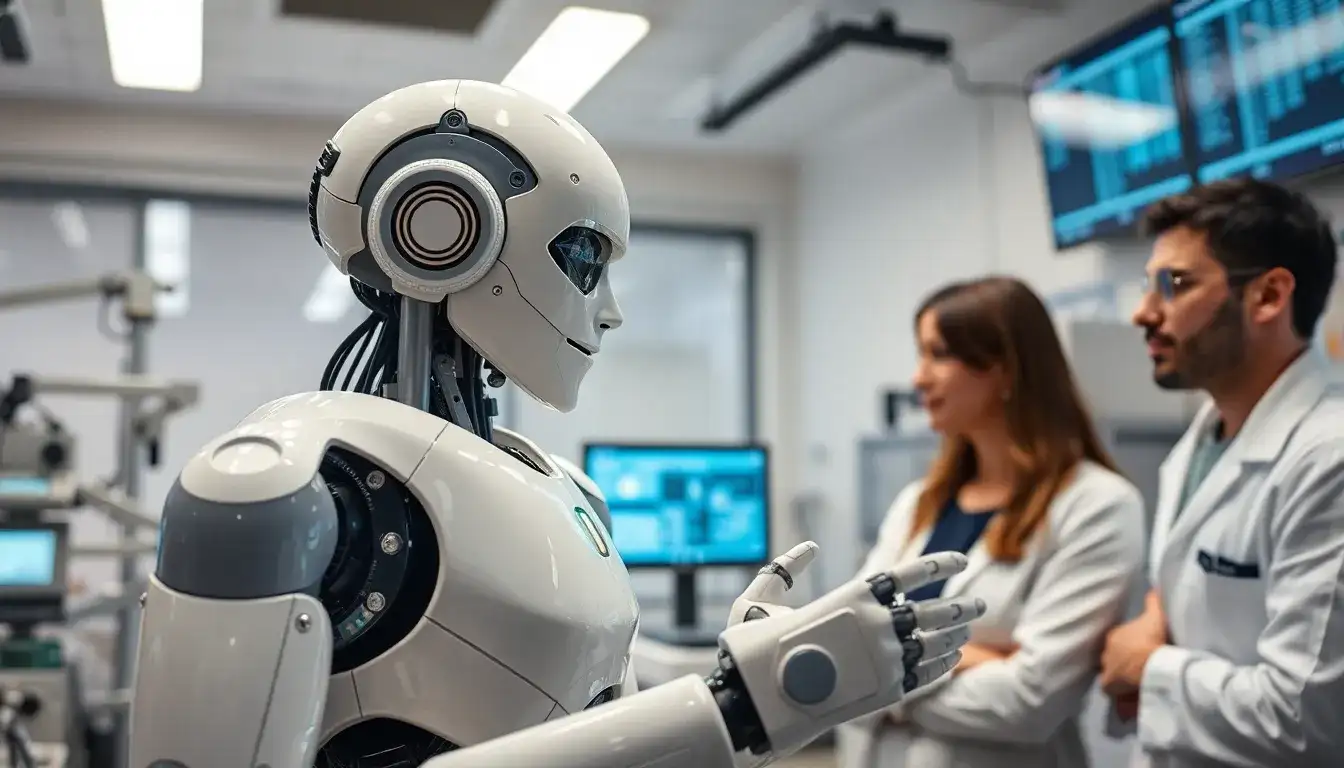
Dialogue with Zhou Jian of UBTECH: “I’m Willing to Bet Everything to Create a True Humanoid Robot”
In the thriving field of humanoid robotics in China, Zhou Jian, the founder of UBTECH, has decided to speak candidly. Known as a controversial figure and one of China’s earliest humanoid robotics entrepreneurs, Zhou refers to himself as the “Robot Dad.” Since its establishment, the company has yet to turn a profit; however, he boldly invests over a third, sometimes even half, of the revenue into research and development for humanoid robots. During the toughest times, he was even labeled a “fraud.” Regardless of the perceptions surrounding him, the fact remains that this year marks the 14th year of UBTECH’s journey into humanoid robotics. Apart from Boston Dynamics, there are hardly any companies in the sector that have lasted as long as UBTECH.
Zhou describes the most absurd aspect he has witnessed as the so-called “hot market”: “Humanoid robots are complex, and many investors do not fully understand this industry. They can easily be misled, leading only to chaos.” He likened some elements of the industry to “The Emperor’s New Clothes,” where everyone knows the reality but no one dares to speak up.
Like the trajectory of China’s robotics industry, Zhou’s life has seen its ups and downs. In 2018, UBTECH secured $820 million in funding led by Tencent. During the peak frenzy, people with bank cards containing $20 million would block Zhou in parking garages, eager to invest. At his lowest point, Zhou sold three houses and three cars. In December 2023, in its 11th year of operation, UBTECH went public on the Hong Kong Stock Exchange, becoming the “first stock of humanoid robots.” The company’s market value has fluctuated drastically, valued at HKD 38 billion at the time of its listing. By March 2024, the market value soared to HKD 130 billion, but in January 2025, it dropped to just over HKD 20 billion due to stock lock-up releases; it has since rebounded, currently standing at approximately HKD 72.5 billion.
A fellow entrepreneur in the robotics industry remarked on Zhou, “He’s a tough guy.” Another analyst noted Zhou’s incredible resilience, stating, “After 13 years in the robotics field, he has faced numerous near-failures but has persisted until now—a remarkable individual.” Zhou Jian was born in 1976 in Ningbo, Zhejiang. He has lived in Chengdu and grew up in Shanghai. He graduated from Nanjing Forestry University and, during his senior year, received a scholarship from Thomas Bach, then President of the International Olympic Committee, to study and work in Germany. He admires Elon Musk and believes he shares Musk’s vision and courage to take risks. Zhou has always envisioned creating humanoid robots, a passion sparked by science fiction series like “Westworld.” Some investors called him a fraud due to his early optimistic projections regarding the company’s valuation and listing schedule. In contrast, many companies that were not labeled as frauds have since failed, with many survivors transforming into vacuum cleaner and logistics firms.
Zhou argues that entrepreneurs lacking an “all-in” mentality often fail. “As long as you can still afford a meal, you should invest everything you have.” UBTECH has been developing its large humanoid robot, Walker, for nearly 10 years. Zhou insists on a full-stack technology approach, having invested tens of billions of RMB in the process. He tells us that had he approached the entrepreneurial process with self-interest, leaving a house or a car for himself, UBTECH wouldn’t exist as it does today. He views this as intertwined with the fate of UBTECH: “If my fate isn’t doomed, then I should continue to do something.” In April and December 2025, Zhou engaged in two extensive conversations with us totaling seven hours. The first half of the article reflects his reflections and observations on the entire robotics industry, while the latter half focuses on Zhou himself—a dreamer with a high-risk appetite willing to bet everything.
Many Create Humanoid Machines, Not Humanoid Robots
LatePost: “In 2025, the industry will undergo significant changes. What is the most noticeable change for you? What do you want to complain about?”
Zhou Jian: “The last time the National Development and Reform Commission mentioned that the robotics industry suffers from duplication in construction. Overnight, two to three hundred companies emerged, making those established in 2023 feel old. Many companies attract attention by showcasing their technology, perhaps just to appeal ‘to VCs.’ I understand that they need attention to attract investment, but I define such robots as ‘humanoid machines’ rather than ‘humanoid robots.’ They are remote-controlled or pre-programmed, merely resembling humans without true intelligence.”
LatePost: “From investors to the public, confidence in China’s humanoid robotics industry has surged. What is the actual situation in the industry? Are people being overly optimistic?”
Zhou Jian: “If someone truly believes we are far ahead, the first thing they need to do is wake up. We are not ahead; in fact, we are behind in some core foundational technologies. Most humanoid robots seen by the public focus on performing actions like punching or dancing, reflecting only partial motion control capabilities, rather than true ’embodied intelligence.’ A complete humanoid robot should not achieve certain motions through remote control, hardware simplification, or reducing joint degrees of freedom and sensors. Such robots cannot perform tasks requiring autonomous perception, intelligent movement, and dexterous operation in the physical world. They can’t even accomplish simple tasks like ‘picking up a cup of water and walking it over.’ I believe that true breakthroughs should demonstrate robots’ high autonomy in physical environments, including perception, decision-making, reasoning, and execution.”
LatePost: “So you think the market bubble has grown larger?”
Zhou Jian: “I believe this irrationality won’t last long. By 2026-2027, when humanoid robots truly enter the market, it will gradually become clear which directions are viable. Robots that can autonomously perform tasks and free humans from repetitive, simple, and tedious labor will become mainstream. At that time, the market and media’s interest in ‘dancing’ will naturally decline—unless there’s something astonishing, like jumping five meters high.”
LatePost: “You seem to have strong opinions about robots dancing.”
Zhou Jian: “Our robots also danced in the past; our small humanoid robot Alpha even appeared on the Spring Festival Gala. However, back in 2016, no one understood humanoid robots, and the traffic it generated was merely temporary.”
LatePost: “But dancing robots are a profitable scenario; robots like Yuzhu can command daily rents close to 10,000 yuan, allowing for quick returns within a week.”
Zhou Jian: “I didn’t anticipate that dancing robots would become popular. However, since there’s a market, we will engage in it. We plan to launch performance robots this year, but we can’t dwell on this too long; everyone in the industry actually understands the situation.”
LatePost: “How long did it take for you to shift from looking down on dancing to choosing to participate?”
Zhou Jian: “It’s not that I looked down on it; I initially didn’t believe it could form a stable, large market. Later, we discovered that in the extensive lower-tier markets, dancing still has immense appeal. However, I still believe it is not a sustainable direction for development.”
LatePost: “Isn’t motion control important? Achieving such smooth dance movements is not a form of advancement?”
Zhou Jian: “Motion control capability is certainly important, but humanoid robots encompass more than just that; they are a whole made up of a brain, cerebellum, and body—none of which can be omitted. A remotely-controlled or pre-programmed robot may operate smoothly, but that’s because a person is ‘seeing the road’ for it. True intelligence means being able to autonomously perceive, decide, and execute. For instance, to ‘pick up a cup of water,’ a robot must first recognize the object’s weight and dimensions, assess its position, and then determine the appropriate grasping method and force. This cannot be solved solely by motion control. Therefore, robots executing functional tasks may appear slow because they are ‘thinking.’ In contrast, the flashy effects gained by simplifying joints and control logic often sacrifice operational precision, making it challenging to enter real work scenarios. The key to humanoid robots lies in embodied intelligence—autonomously completing repetitive, dangerous, and tedious tasks in real environments.”
LatePost: “A significant decrease in costs is also a form of progress. The first-generation humanoid robot Walker you released in 2018 sold for millions, while this year, many companies can price their robots below 100,000 yuan.”
Zhou Jian: “Eight years ago, when we launched the first-generation humanoid robot Walker, the supply chain was non-existent, and the BOM cost was very high. Now, a preliminary humanoid robot supply chain has formed; hardware costs are relatively transparent, and one can easily know the prices of motors, planetary reducers, and sensors. Cutting costs on hardware can indeed lead to lower prices, with applications in performances, educational institutions, and research facilities. But this is not what UBTECH aims to do. We want to create humanoid robots that are both inexpensive and capable of performing tasks, not just humanoid machines.”
LatePost: “He Xiaopeng previously told us that the development from the cerebellum (motion, balance, instinct) to the brain (cognition, reasoning, decision-making) is gradual.”
Zhou Jian: “It’s not as simple as believing that improving the cerebellum leads directly to brain development. Humanoid robots are complete entities, comprising the brain, cerebellum, and embodied intelligence; all three are essential. Take vacuum robots, for instance—previously considered robots, they now appear to be just household appliances that have been equipped with navigation systems.”
LatePost: “How much have you invested in developing the robot’s brain?”
Zhou Jian: “A significant portion of UBTECH’s annual R&D investment goes into developing the robot’s brain, amounting to several hundred million RMB each year, making us one of the highest-investing robotics companies in the country. The Beijing Humanoid Robot Innovation Center is also investing in brain development; we are a majority shareholder, and our CTO serves as the general manager.”
LatePost: “Why is the robotics industry so hot, yet the funds for R&D are relatively low?”
Zhou Jian: “The root of the issue is dispersion; the amount of funding for individual companies is not substantial. In the U.S., there are only a few humanoid robotics startups, and they receive cross-investment from Silicon Valley giants like Microsoft, Google, and Tesla, resulting in significantly higher R&D pressure and a long-term outlook that is not afraid of losses.”
LatePost: “This year, Yuzhu will go public, and many robotics companies are preparing to list on the Hong Kong Stock Exchange or through backdoor listings; will they have more resources?”
Zhou Jian: “That’s a good thing; the market is large enough.”
LatePost: “Now that automotive companies like Xiaopeng and Seres are also venturing into robotics, are you concerned about them?”
Zhou Jian: “The profit margins in the automotive industry are very limited. Although it seems they have substantial revenue, taking out tens of billions in pure profit to invest in humanoid robots is quite challenging. From this perspective, they don’t have much of an advantage over us.”
LatePost: “In the Chinese robotics industry, are there competitors you respect?”
Zhou Jian: “(pausing for five seconds) I respect everyone who has worked hard to advance China’s humanoid robotics industry. However, to be honest, I haven’t seen any other company in China that is as comprehensive, has accumulated full-stack technology, has deep insights and understanding of the industry, and focuses on embodied intelligence as we do.” A journalist previously asked me about UBTECH’s future. I felt confident that we would win (laughs). We’ve overcome the challenges of mass production, and no one is investing more in embodied intelligence than we are; we also have the most orders in hand. Plus, we manufacture ourselves rather than outsourcing.
LatePost: “UBTECH’s industrial humanoid robot Walker S2 has begun mass production and delivery in November 2025.”
LatePost: “Your humanoid robots have entered factories of companies like Foxconn, BYD, and Zeekr, performing tasks including handling, loading and unloading, and sorting. How effective have these robots been in training?”
Zhou Jian: “From the perspective of individual humanoid robots, we have achieved a 99% success rate in tasks such as intelligent handling and loading and unloading. Compared to individual workers, efficiency has improved from about 30% at the beginning of the year to around 45%, and we hope to exceed 60% by 2026, allowing robots to work 12 hours while replacing human labor for 8 hours.”
LatePost: “You previously stated that the showcase of humanoid robots is a bubble; we are concerned that their entry into factories is also a bubble.”
Zhou Jian: “Absolutely not. By 2025, the worker shortage in China’s manufacturing industry will exceed ten million, and the aging society is accelerating. Not to mention the labor costs in Europe and America. Humanoid robots are a key factor in alleviating the labor supply-demand imbalance in manufacturing. From our training results, for instance, in quality inspection, humanoid robots are faster than humans; while humans need to record and upload data after inspections, humanoid robots can directly connect to the system. In handling, humanoid robots currently operate at 30%-40% efficiency compared to human workers, and our goal this year is to reach 60-70%. At this level, clients will be willing to pay.”
LatePost: “You mentioned that you’ve been working on humanoid robots for ten years; why are you just now entering factories?”
Zhou Jian: “We indeed started a bit early. My greatest fortune is that we were not eliminated early on. However, over the years, we have accumulated comprehensive full-stack technology related to humanoid robots, holding the highest number of effective patents in the world related to humanoid robots. We have our own tech pool, which allows us to quickly apply many capabilities. In my view, currently, there is temporarily no one who can compete with us in industrial scenarios.”
LatePost: “If an industry lacks competition, there are two reasons: one is that you have achieved something others cannot; the other is that it is not a good industry at all.”
Zhou Jian: “No one is saying this industry isn’t good. Starting in 2025, both Chinese and foreign giants will not just be looking for UBTECH; they will be testing or learning about humanoid robot products in the market before choosing to cooperate with us.”
LatePost: “Some well-known international companies, such as Texas Instruments and Airbus, have also sought collaboration with you. Why did they choose UBTECH over Tesla or Figure AI?”
Zhou Jian: “They are very pragmatic; they choose whoever can get the job done. Tesla hasn’t begun shipping yet, and Figure has difficulty mass production in the U.S. Only UBTECH can supply products, and we are almost overwhelmed.”
LatePost: “Currently, nearly half of UBTECH’s orders come from data collection centers in second- and third-tier cities in China. What drives this demand?”
Zhou Jian: “Some local governments are leading this initiative. We build embodied intelligence data centers tailored to local business needs, collecting data to train humanoid robots, which can then go to work. Many places are currently establishing data collection centers because it’s clear that robots cannot be well-trained in a fully simulated environment; data must be collected in real scenarios.”
LatePost: “So at this stage, are local governments the customers with the strongest purchasing power in the robotics industry?”
Zhou Jian: “That has been the case, but by 2026, more large manufacturing companies will make bulk purchases. I believe 2026 will mark the first year of marketization for the humanoid robotics industry.”
LatePost: “I previously watched a video of UBTECH robots handling boxes in a factory, where it took 13 seconds to move a box. Can it truly improve factory efficiency?”
Zhou Jian: “That was an early demonstration. Let me emphasize again that our processes are driven by the embodied intelligence technology of humanoid robots, not completed by remote control. We have now reduced that time to four seconds.”
LatePost: “Why should humanoid robots do this work? Can’t wheeled robots handle it?”
Zhou Jian: “We also have wheeled humanoid robots, and depending on the scenario, we use whichever is appropriate. Some factories have tried using wheeled robots, but in certain automotive factories, the distance between material boxes is often too narrow for wheeled chassis to fit. Many areas of factories require humanoid robots that are very flexible and adaptable to human working environments. This task isn’t simply about a delivery robot performing a path navigation plan. A humanoid robot must recognize varying heights of boxes, as each box may have different weights and dimensions. What seems like a simple task for humans requires humanoid robots to excel in object recognition, perception, reasoning, decision-making, and execution—globally, who dares to claim they can execute this task well? At least 300,000 humanoid robots will receive orders next year.”
LatePost: “Humanoid robots can’t even bend down to pick up an item that has fallen to the ground.”
Zhou Jian: “You make an excellent point! We initially didn’t consider this, as we didn’t provide enough freedom of motion in the waist joints. Previously, it was assumed that moving a box meant simply transporting it from one place to another, but we realized that transferring from a stack above to the bottom requires significant bending. Now, our latest humanoid robot Walker S2 can squat down to extreme limits, reach for items from a distance, and transport loads weighing up to 15 kilograms within a range of 0-1.8 meters.”
LatePost: “I feel like you haven’t fully addressed my concern. Moreover, a bipedal robot may cost ten times more than a wheeled robot.”
Zhou Jian: “In a few years, when humanoid robots reach tens or hundreds of thousands on the market, the BOM cost difference between bipedal and wheeled robots will not exceed 10%. For example, the complete automation of a car assembly line is challenging due to the generalized nature of the scenarios and the complex capabilities required. Tasks may include placing a car logo or tightening a screw, and AGV vehicles deliver materials right to the worker’s hands, requiring humans to unload the goods from the AGV. In the past, He Xiaopeng installed car seats in factories, which required bending down to tighten screws. There are tasks that, apart from humans and humanoid robots, no wheeled robot can accomplish.”
LatePost: “Then why not just let humans do it? Many say China has no shortage of labor.”
Zhou Jian: “There is certainly a shortage. The global manufacturing industry, including China, Europe, Japan, and South Korea, is facing a labor shortage. I’ve visited garment and shoe factories in Wenzhou, where many workers are over 50 years old. It is increasingly difficult to find younger people willing to take on such simple, tedious jobs. In the future, repetitive, simple, and tedious tasks will be handled by humanoid robots, eliminating the need for human involvement. For example, a factory worker might spend a decade moving a forklift from one workshop to another, while they might prefer to deliver takeout instead and enjoy the scenery. China’s manufacturing industry is already grappling with labor shortages, and as we enter an aging society, the challenges of labor supply-demand imbalances will only grow. Companies like Tesla, BYD, and Foxconn, which emphasize industrial automation, still need to hire hundreds of thousands of skilled workers. Labor costs are rising globally, and as the costs of humanoid robots decrease, if a company uses them while another company does not, the latter will incur higher costs; if China does not adopt them while Europe does, China’s demographic dividend will vanish. One reason for the hollowing out of manufacturing in Europe and America is the lack of mature industrial workers. If humanoid robots develop, they will compensate for the inadequacies in manufacturing. Therefore, we must develop humanoid robots. The limitations of human labor and the shortage of highly skilled industrial labor are fundamental elements in manufacturing development, and I believe humanoid robots will fill this gap.”
LatePost: “How far are you from achieving a general-purpose humanoid robot that fits your vision for factory scenarios?”
Zhou Jian: “We spent two years conducting proof-of-concept training in tasks like handling, loading and unloading, material sorting, and quality inspection, starting from the electric vehicle manufacturing scene. By 2025, we’ll achieve small-scale mass production and delivery. Between 2026 and 2027, we plan to horizontally expand into other industries, such as consumer electronics manufacturing, aiming for mass production and delivery of over ten thousand units in industrial settings. Starting in 2028, we hope to enable humanoid robots with general skills, preparing for mass production and delivery at the scale of hundreds of thousands in industrial scenarios.”
LatePost: “How is the pricing for humanoid robots in industrial scenarios determined?”
Zhou Jian: “Pricing depends on the specific demands of the client’s scenario, typically calculated based on three years of labor input costs. However, currently, it seems we are the only company capable of meeting these needs with minimal competition.”
LatePost: “Have clients already paid you?”
Zhou Jian: “They pay a portion during the concept verification stage, and some clients have already purchased our robots. By 2025, our accumulated order amount for humanoid robots exceeded 1.4 billion yuan.”
LatePost: “Where does UBTECH rank in global humanoid robot order volumes?”
Zhou Jian: “As a publicly listed company, our data is very rigorous, and we can’t exaggerate. Based on the currently disclosed order and bidding information, we may be the global leader, both in total order value and accumulated amounts.”
LatePost: “When will you be able to reduce costs?”
Zhou Jian: “Costs are already significantly decreasing. You know, in China, the least of our worries is pricing. According to our estimates, the costs for humanoid robots designed for handling will plummet within two to three years, possibly down to a few tens of thousands of yuan—maybe even lower than the annual cost of employing a human. Moreover, robots can work for 15 hours a day, allowing clients to break even within six months.”
LatePost: “Your robots have been working in factories for a year now. What is the most common complaint you’ve received?”
Zhou Jian: “They are slow and clumsy, primarily due to low efficiency. However, compared to humans, we are slower but smarter and faster than our peers.”
LatePost: “What has been the most interesting feedback you’ve received?”
Zhou Jian: “Once, while chatting with someone from Dongfeng Motor, they asked if they could take the humanoid robot home after work to help with chores and even have conversations. This question caught me by surprise because they were viewing the robot as a person—working outside during the day and providing service at home at night.”
LatePost: “AI is not something you can just use; the industry lacks the capability of coupling software and hardware.”
Zhou Jian: “The reason there is no consensus in the industry is that many technologies haven’t converged, including mass production processes, perception, reasoning, decision-making, and data standards. Currently, the consensus in the industry is that in terms of hardware, everyone is similar. The key lies in how to build embodied intelligence and ecosystems.”
LatePost: “We previously spoke with Wang Xing, who mentioned that what everyone is doing now is quite simple: taking AI technology and applying it to robots. He believes the technological threshold for combining AI with robotics hasn’t been reached yet, as the whole technical solution hasn’t been fully realized.”
Zhou Jian: “I believe the core issue is whether the generalization of the VLA (Vision-Language-Action) model can be achieved or if there might be completely different technical routes for embodied intelligence in the future. Today’s robots face challenges in software-hardware integration; they incorporate not just AI algorithms but also motion control algorithms. Their brain, cerebellum, body, and other hardware and software components form a whole. It’s not just about applying someone else’s AI technology; it requires effectively coupling and adapting hardware and software.”
LatePost: “An executive from a robotics startup once said that UBTECH is a first-generation robotics company, and not even at the level of the previous generation, let alone AI.”
Zhou Jian: “It’s true that we are a first-generation company; when we were developing humanoid robots, large models hadn’t appeared. However, the choice to focus on humanoid robots was a strategic decision. Ten years ago, both internal stakeholders and shareholders questioned why we didn’t pursue quadrupedal, wheeled, or tracked robots. I insisted that humanoid robots were the golden path, the best carrier for AI, and could facilitate active interaction in the future. The external impression of UBTECH as a company focusing solely on the robot body is misleading; we began building a full-stack approach quite early. Our research institute now has a ‘brain’ (vision-language model, multi-modal perception and interaction, AIGC simulation platform, semantic SLAM) and a ‘cerebellum’ (reinforcement learning, imitation learning). In 2019, we purchased a significant number of V100 units to build clusters, and last year, we expanded our GPU center, accumulating over a billion multi-modal data points. We have secured seven first-place finishes in internationally recognized benchmark competitions.”
LatePost: “End-to-end VLA is a hot topic in robotics. How do you understand it? What problems can it solve, and what can it not?”
Zhou Jian: “VLA is the integration of vision and large models to understand instructions and directly output actions, eliminating the need for ‘recognition—location—planning—control’ pathways, thus enhancing generalization and deployment efficiency. The challenges lie in real-time performance, safety validation, and data. I believe that while VLA can enable robots to perform autonomously in specific scenarios, achieving a general-purpose robot will require a world model.”
LatePost: “Wang He from Galaxy General mentioned that he believes VLA is constrained by the scale of data, and progress has not been ideal.”
Zhou Jian: “VLA is one of the pathways to achieving embodied intelligence, not the only one. Currently, the data scale is insufficient, limiting us to specific tasks in specific scenarios. Progress will accelerate with increased data scale. Both real-machine data and simulation data are essential.”
LatePost: “However, collecting real machine data is very expensive and does not seem financially feasible.”
Zhou Jian: “Real-machine data is fundamental; simulations can only serve as auxiliary. Pure simulations often lack physical detail, leading to high failure rates that customers cannot accept. We are currently building an embodied intelligence dataset through a combination of real and simulated data to reduce collection costs. However, whether real or simulated, I have yet to see a company that has solved the generalization problem of VLA.”
LatePost: “What changes have large models brought to the logic and thinking behind robot development? What changes has UBTECH made, and how are these reflected in the robots’ performance and forms?”
Zhou Jian: “In industrial scenarios, the value of large models is enhancing the cognitive and decision-making capabilities of humanoid robots. However, large language models cannot be directly applied to robots; they must be adapted for specific tasks and rely on a substantial amount of real industrial data for training. We have developed an industrial humanoid robot collaborative intelligent agent, Co-Agent, on Walker S2, integrating multi-modal reasoning, embodied interaction, and skill models to allow robots to possess closed-loop capabilities for understanding tasks, planning, executing, and handling exceptions. Additionally, multiple robots can collaborate through edge nodes, functioning both independently and in coordination.”
LatePost: “You mentioned that UBTECH is neither a hardware nor software company, but one focused on software-hardware integration. What does software-hardware integration mean? For instance, how do Tesla’s hardware configurations (linear joints, hand tendons) and software routes (end-to-end) relate to each other, and how does hardware influence the choice of software routes?”
Zhou Jian: “Hardware determines the capacity boundaries of software, while software determines whether hardware can be effectively utilized. They are highly interconnected, and their iteration rhythms differ—hardware evolves slowly, while software progresses quickly. For example, in enhancing handling capabilities, we repeatedly verified that increasing forward bending and circumferential rotation freedom in the waist is the most cost-effective solution meeting industrial needs. Walker S2 adopts a high-power, high-torque waist joint design, synchronously adjusting algorithms and training methods, allowing the robot to touch the ground, squat, and reach for items from a distance, significantly expanding its operational space. This exemplifies our understanding of software-hardware integration: it is not about setting the hardware first and then complementing it with software or vice versa, but optimizing both around real scenarios. In my view, this is the most scarce capability in the current humanoid robotics industry—just as in humans, the body and mind must match.”
LatePost: “Did UBTECH start developing humanoid robots early because it’s a more compelling story and resonates better with the capital market?”
Zhou Jian: “I have always believed that humanoid robots are the best carriers for artificial intelligence, representing the ultimate form of the future. Many have criticized me, saying, ‘Why do you insist on building a humanoid robot when wheels can suffice?’ I believe they focus too much on the functional attributes of robots and overlook their emotional attributes. Would you want to date a robot with just two wheels? I envision that in ten to twenty years, our next generation may very well date humanoid robots.”
LatePost: “So, your answer to why you’re pursuing humanoid robots is that people will prefer to date humanoid robots over wheeled ones?”
Zhou Jian: “I believe humanoid robots embody emotional attributes. In all sci-fi movies, whether ‘Westworld’ or ‘Blade Runner,’ humanoid robots are depicted as both capable workers and emotional companions offering emotional value in the future.”
LatePost: “Embodied intelligence is the future, but that doesn’t necessarily mean humanoid robots are the future. Some argue that embodied intelligence can take various forms, including wheeled, bipedal, arm-type, composite, and bionic types coexisting, thus humanoid unity isn’t achievable.”
Zhou Jian: “That’s true; the embodiment of intelligence can take diverse forms. However, humanoid robots have the advantage of meeting both rational and emotional needs of humans. In the future, technologies like AIGC, large models, and embodied intelligence will genuinely empower humanoid robots. People may want to own three to five humanoid robots—one for work, one at home for chores, and another to accompany them while exploring the world.”
LatePost: “When will humanoid robots truly enter homes to walk dogs, make coffee, and do laundry? What technological and engineering challenges need to be overcome for this to happen? Must they be humanoid? Some argue placing a humanoid robot in the home is already a challenge.”
Zhou Jian: “Humanoid robots must address problems that washing machines and coffee machines cannot solve; they are not just machines but closer to family members. Under today’s technological conditions, humanoid robots need to first establish companionship functions before performing a variety of personalized services in unstructured home environments.”
LatePost: “What will be the first real, commercially viable scenario for humanoid robots in homes?”
Zhou Jian: “I believe it will be emotional companionship robots. We’ve developed a few, and I find them quite promising.”
LatePost: “What functions must companionship robots possess for commercialization? What will they look like?”
Zhou Jian: “They should have an appearance you like; humans are visual creatures. They should also possess personality traits and knowledge that resonate with you, along with short-term and long-term memory, enabling pleasant interactions and emotional value.”
LatePost: “Is this robot mainly for chatting?”
Zhou Jian: “It would also engage you in games and watch shows together, providing significant emotional value. In the future, people may even choose to date it.”
LatePost: “So, it’s more like a toy or a sex robot?”
Zhou Jian: “What we’re developing is different; our robots will have more complex movements, interactions, and facial expressions. I have no intention of simply creating a sex robot.”
LatePost: “Who do you think would buy them?”
Zhou Jian: “If they look human and interact naturally, everyone would want one. Families who have lost loved ones would certainly need them.”
LatePost: “If that day comes, do you think robots will possess self-awareness?”
Zhou Jian: “At least in the current context, robots do not need to possess general awareness. This poses a technological and social ethical dilemma. For example, if a piece of paper falls on the ground, I can instruct the robot to pick it up, but there’s no need for it to understand why. Making it aware of the concept of cleanliness presents a tremendous challenge to humanity.”
LatePost: “If humans no longer need to date each other but rather robots, do you think that would create a better or worse world?”
Zhou Jian: “Personally, if my next generation chooses to be with robots, I completely understand. This is an inevitable trend. Just like how we can’t resist trends in technology development and the changing pace of human life.”
LatePost: “So you don’t make judgments about right or wrong; you simply adapt to it?”
Zhou Jian: “It’s not just about adapting; I believe it’s inevitable. In human development, desires are infinite. We wish for a robot that is beautiful and charming, one that doesn’t bring negativity or consume our energy. They exist to fulfill our emotional needs; being catered to is a lifestyle we cannot escape.”
LatePost: “How long do you envision
Original article by NenPower, If reposted, please credit the source: https://nenpower.com/blog/pushing-the-boundaries-of-humanoid-robotics-a-conversation-with-ubiquitous-robotics-founder-zhou-jian/

