

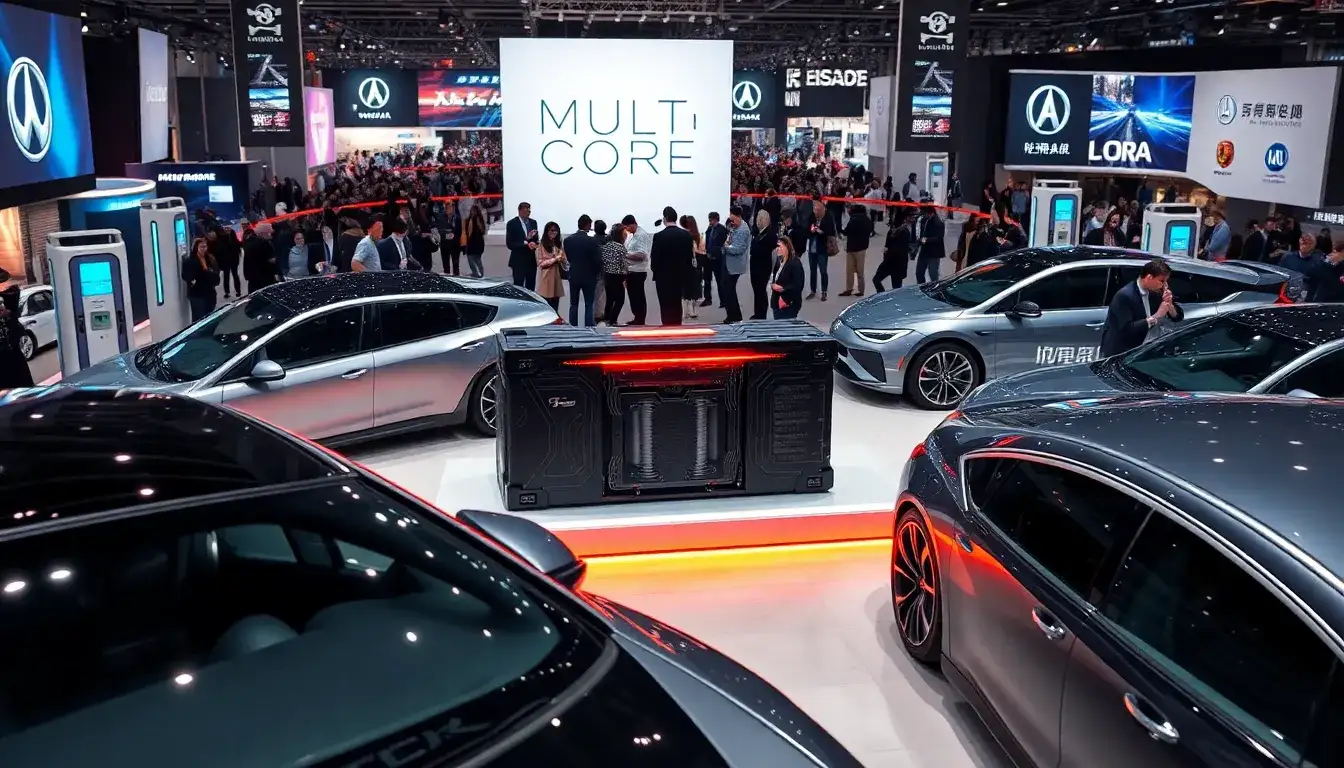
At the 21st Shanghai International Automobile Industry Exhibition (referred to as the “2025 Shanghai Auto Show”), both complete vehicles and component manufacturers showcased their latest power system technologies and products, marking the beginning of a new round of competition in power systems. Zhang Xiang, a visiting professor at Huanghe Science and Technology College, stated in an interview with Shenzhen Securities Daily that under the drive of the “dual-carbon” goals, the competition in power systems has entered a complex phase involving the entire industry chain and various scenarios, from the commercialization of solid-state batteries to innovations in multi-core batteries, and from optimizing traditional internal combustion engines to exploring diversified options such as hydrogen and methanol fuels.
The exhibition featured numerous power battery companies displaying their cutting-edge technologies and products. Huizhou EVE Energy Co., Ltd. showcased its patent layout in large cylindrical batteries, including the OMNI all-purpose battery, open-source battery, aircraft battery, robot battery, and automotive electronic battery. Meanwhile, Honeycomb Energy Technology Co., Ltd. introduced its fortress off-road battery designed for new energy off-road vehicles, which attracted widespread attention due to its “bulletproof-level” safety performance. Additionally, Zhongchuang Innovation Technology Group Co., Ltd. presented its top-tier batteries and comprehensive system solutions, while BYD Co., Ltd. unveiled its sulfide all-solid-state battery models, the “Hai Lion 07EV” and “Starship.”
From a technological perspective, power battery companies are actively working on solid-state batteries, high-nickel ternary batteries, and lithium iron phosphate batteries. High-nickel ternary batteries are widely used in high-end models due to their high energy density advantage, while lithium iron phosphate batteries are favored for their safety and cost benefits in mid-range and low-end vehicles, as well as in energy storage applications. Solid-state batteries are viewed as the next-generation power battery development direction, with several companies achieving significant breakthroughs. As leading enterprises compete to advance solid-state battery technology, Contemporary Amperex Technology Co., Limited (CATL) presented a differentiated new technology at the auto show, launching multiple new products, with the “Xiao Yao Dual-Core Battery” being the highlight. This product is centered around a “dual-core architecture” breakthrough. According to CATL Chairman Zeng Yuqun, “Solid-state batteries are not the ultimate solution; dual-core and multi-core technologies are the future.”
A representative from CATL explained to Shenzhen Securities Daily that the dual-core battery combines different chemical systems (such as sodium-ion, lithium iron phosphate, and ternary lithium) through a dual-core architecture, balancing low-temperature performance, range, fast charging, and safety. For instance, the sodium-iron dual-core battery can maintain over 80% energy output at extreme low temperatures (-30°C), while the “iron-iron dual-core battery” enhances energy density to 280Wh/kg through structural optimization, meeting stringent standards for “no fire, no explosion” after high-speed collisions. The “dual ternary” combination can even enable a sedan with a wheelbase of 3 meters to achieve a range of 1500 kilometers. An anonymous industry insider remarked that the entry of power batteries into the “multi-core era” signifies a shift from single-material competition to a collaborative stage of diverse systems, with the core logic of multi-core technology being “scenario adaptation.” This transition allows new energy vehicles to evolve from “functional homogenization” to “scenario personalization.” The innovative architecture from dual-core to multi-core will extend beyond the new energy passenger car sector into electric buses, heavy-duty trucks, aircraft, and ships, accelerating the industrialization of new energy across all scenarios.
Jixuehong, director of the Automotive Industry Innovation Research Center at Northern Industrial University, told Shenzhen Securities Daily that with the development of various power technologies, each will have its advantages in different application scenarios, leading to a diversified market landscape in the future.
The market competition is becoming increasingly intense. While lithium power batteries continue to evolve, sodium-ion batteries, hydrogen fuel cells, and alcohol fuel technologies are also advancing rapidly. At this auto show, CATL officially launched its sodium new battery. This sodium-ion battery has broken through the performance limits of its materials, pushing sodium-ion technology towards mass production for the first time, effectively reducing dependence on lithium resources thanks to sodium’s inherent safety and abundant reserves. The sodium new battery can operate within a temperature range of -40°C to 70°C, redefining the limits of battery temperature adaptability.
Currently, hydrogen fuel cell vehicles are primarily used in commercial vehicles, but with advancements in technology and cost reductions, their widespread application in passenger vehicles is also anticipated. At the auto show, China’s first fuel cell passenger vehicle equipped with a low-pressure, ambient-temperature solid-state hydrogen storage device made its debut. This model, jointly developed by SAIC Motor Corporation Limited and Shanghai Jie Hydrogen Technology Co., Ltd., features a low-power fuel cell system specifically designed for passenger vehicles with a rated power of 50kw and an energy conversion efficiency of 50%. It efficiently coordinates heating for the passenger cabin and the thermal supply required during the hydrogen release process from the solid-state hydrogen storage device, meeting long-range demands while providing an environmentally friendly and comfortable driving experience.
Methanol, as a liquid energy source, can be safely stored and transported at ambient temperature and pressure, boasting green, low-carbon, and clean renewable characteristics. The Remote New Energy Commercial Vehicle Group showcased a triad of methanol-related technologies at the Shanghai Auto Show, including green methanol production, methanol refueling, and methanol-electric vehicles. They also introduced the world’s first methanol-hydrogen electric super VAN and a star model, the Remote Xinghan H methanol-hydrogen electric heavy truck. Currently, methanol energy applications in vehicles have reached nearly 40,000 units, with a cumulative mileage exceeding 20 billion kilometers.
Ji Xuehong noted that in 2025, competition in automotive power systems will intensify, and the arrival of a technological race will provide consumers with more choices while promoting the automotive industry towards a greener, smarter, and more efficient future. “In the fierce competition of power systems, the company that can achieve the scene-based implementation of technology at lower costs and faster speeds will define the future game rules,” said Lin Shi, secretary-general of the Intelligent Connected Vehicle Committee of the China-Europe Economic and Technical Cooperation Association. He emphasized that “in the face of intense market competition, automobile manufacturers and component companies need to enhance technological research and development, improve product performance and quality, and reduce costs to meet market demand. Additionally, companies must strengthen collaboration to collectively advance the development and application of power system technologies and refine the industrial ecosystem.”
Original article by NenPower, If reposted, please credit the source: https://nenpower.com/blog/power-battery-enters-multi-core-era-amidst-intensifying-technology-competition-at-shanghai-auto-show-2025/

