

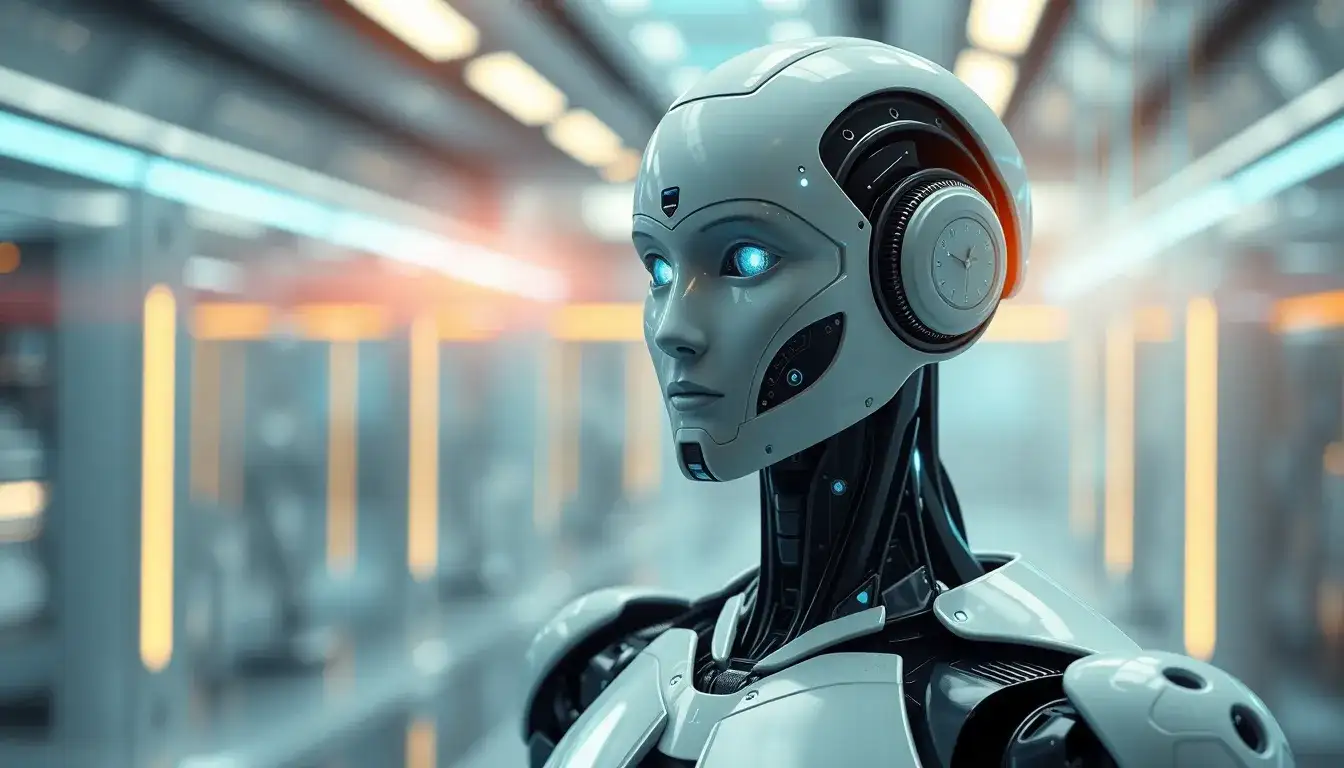
Peng Zhihui, co-founder, president, and CTO of ZhiYuan Robotics, spoke at the 2026 Annual Conference on Human-shaped Robots and Embodied Intelligence Standardization (HEIS) held on February 28 in Beijing. He asserted that the embodied intelligence industry is entering its second phase, with 2026 marking the “deployment” year for humanoid robots. “The entire embodied intelligence sector is still in exploration mode, and no single company can claim to have all the answers,” he stated. “We need to work together to overcome bottlenecks and take the right steps at the right time.”
Discussing the current state of the industry, Peng referenced data from the Ministry of Industry and Information Technology, noting that there are now over 140 humanoid robot manufacturers in China, with a total of 330 products launched. He highlighted the shift from showcasing technological prowess in laboratories to engaging in engineering and scenario-based competition. “Between 2024 and early 2025, the focus was on whether robots could walk naturally. Now they can perform complex movements like ‘walking on the walls,'” he recalled. “The flexibility of the robots has reached a practical level, and the next competition will be about who can perform tasks more effectively, not only domestically but also against leading international companies, to see who can truly achieve ‘deployment’.”
Peng believes that the optimal entry point for humanoid robots lies in “performing complex tasks in simple scenarios,” such as executing high-dimensional, flexible operations in structured factory environments. He explained that while autonomous driving focuses on simple tasks in complex environments, humanoid robots aim to accomplish complex tasks in similar conditions. “Currently, we are applying this technology in eight typical scenarios, including entertainment performances, industrial manufacturing, logistics sorting, and security inspections. Real scenarios are the most effective way to validate reliability and iterate systems.”
When discussing the rationale for sticking to a humanoid design, Peng used a vivid analogy: “Computer Use is the humanoid interface of the digital world, while humanoid robots serve as the universal interface of the physical world.” He elaborated that just as software systems are designed for mouse and keyboard interactions, the entire physical world—from doorknob height to tool shapes—is designed for human use. “Since the environment is built around humans, for AI to achieve maximum universality and compatibility, its end form is likely to resemble a human. It may not be the most efficient, but it will certainly be the most compatible,” he predicted. He anticipates that when humanoid robots enter households, the industry scale will equate to “the number of mobile phones multiplied by car prices.”
As the vice-chairman of the standardization committee, Peng called for the industry to collaboratively establish a standard system. “The ultimate goal of embodied intelligence is infrastructure, not isolated products,” he stated. “The key to scaling physical AI lies in data loops, reliability engineering, and the standardization of operational capabilities. We need to run fast but also steady. ZhiYuan is willing to share our frontline practices in data governance, evaluation systems, and operational experience with the industry to accelerate the systematic integration of physical AI. The breakthrough in general capabilities will surely come from industry migration and ecosystem building, and standardization will serve as an accelerator in this process.”
Peng’s insights were part of his speech at the 2026 HEIS Annual Conference, where he shared his thoughts as a practitioner after three years of exploration in the field. He emphasized that the embodied intelligence could be a key engine for the next industrial revolution, with success depending on taking the right actions at the right times. He explained the current surge in humanoid robot interest is fundamentally driven by advancements in AI technology. Since 2015, deep learning has enabled perceptual intelligence, and by 2022, generative AI has led to cognitive intelligence, paving the way for a new era where AI and robots are driving the physical intelligent world.
Reflecting on the past few years, Peng noted the rapid evolution of AI, with significant advances occurring nearly every month. He highlighted the emergence of large language models and their impact on expanding perspectives. The challenge for the next decade will be the large-scale realization of physical AI, transitioning from digital AI. He pointed out that general-purpose robots, unlike previous specialized robots, are not limited to single tasks but can adapt to various working scenarios.
Peng also illustrated how the thriving development of the computing industry is supported by national policies. He noted that humanoid robots are now recognized as a key direction for future industrial innovation. The Ministry of Industry and Information Technology has articulated clear goals for the sector, including achieving mass production by 2025 and creating a competitive international ecosystem by 2027.
In practical terms, ZhiYuan has developed a viable engineering paradigm known as “One Body, Three Intelligences.” The ‘one body’ refers to the physical robot, which must navigate the complexities of the real world, where physical costs and failures exist. The design of the robot is not merely a matter of stacking hardware but involves reliability engineering, supply chain engineering, and safety engineering.
He added that the two most critical components of the robot are its joints, which determine its movement capabilities, and its dexterous hands, which define its operational abilities. These elements represent a significant portion of the overall cost. In the early stages of the industry, various actuator technologies were explored, but there has been a convergence towards new joint designs since 2023, paralleling advancements in electric vehicles.
Peng emphasized the importance of developing standardized and serialized joint designs to avoid production challenges. He explained that achieving a balance in actuator specifications is vital to meet the diverse demands of different joints. The dexterous hand, being a highly complex component, also requires sophisticated design to accommodate numerous degrees of freedom in a compact space.
He elaborated on the significance of tactile feedback in industrial tasks, pointing out that tactile sensors are still underdeveloped, lacking standardization, which presents a bottleneck. In contrast, visual technology has benefited from established standards and data formats, enabling the rapid growth of various deep learning models.
Peng identified three domains of AI that serve as the “soul” of robots: motion intelligence, interactive intelligence, and operational intelligence. Since 2024, significant progress has been made in motion control, driven by algorithm paradigm shifts and the proliferation of simulation frameworks.
The integration of motion intelligence provides the foundation for both interactive and operational intelligence, enhancing the robot’s ability to move freely and perform complex actions. Peng noted that the complexity of achieving these tasks necessitates a high level of expertise in AI and practical training.
To address the challenges of training models, ZhiYuan has developed user-friendly toolchains to streamline the process. For instance, the LingChuang platform simplifies motion training by allowing users to upload videos, automatically completing the necessary steps for action recognition and training.
He also discussed the importance of interactive intelligence, which goes beyond understanding voice commands to incorporating multimodal perception and collaboration. The goal is to create robots that can communicate and establish trust with users, adding emotional value that users are willing to pay for.
Peng believes in building a collaborative ecosystem, emphasizing that the ultimate goal of technology should be openness and shared advancement. He highlighted the need for standards that ensure safety, privacy, and ethical governance in the deployment of physical AI.
In conclusion, Peng summarized his vision for the future: the infrastructure of embodied intelligence will not be isolated products but a scalable system. The key to scaling physical AI lies in establishing data loops, reliability standards, and operational capabilities. The breakthrough in general capabilities will stem from collaborative efforts across the industry.
Original article by NenPower, If reposted, please credit the source: https://nenpower.com/blog/pioneering-the-future-insights-on-the-emergence-of-embodied-intelligence-and-humanoid-robotics-by-peng-zhihui/

