

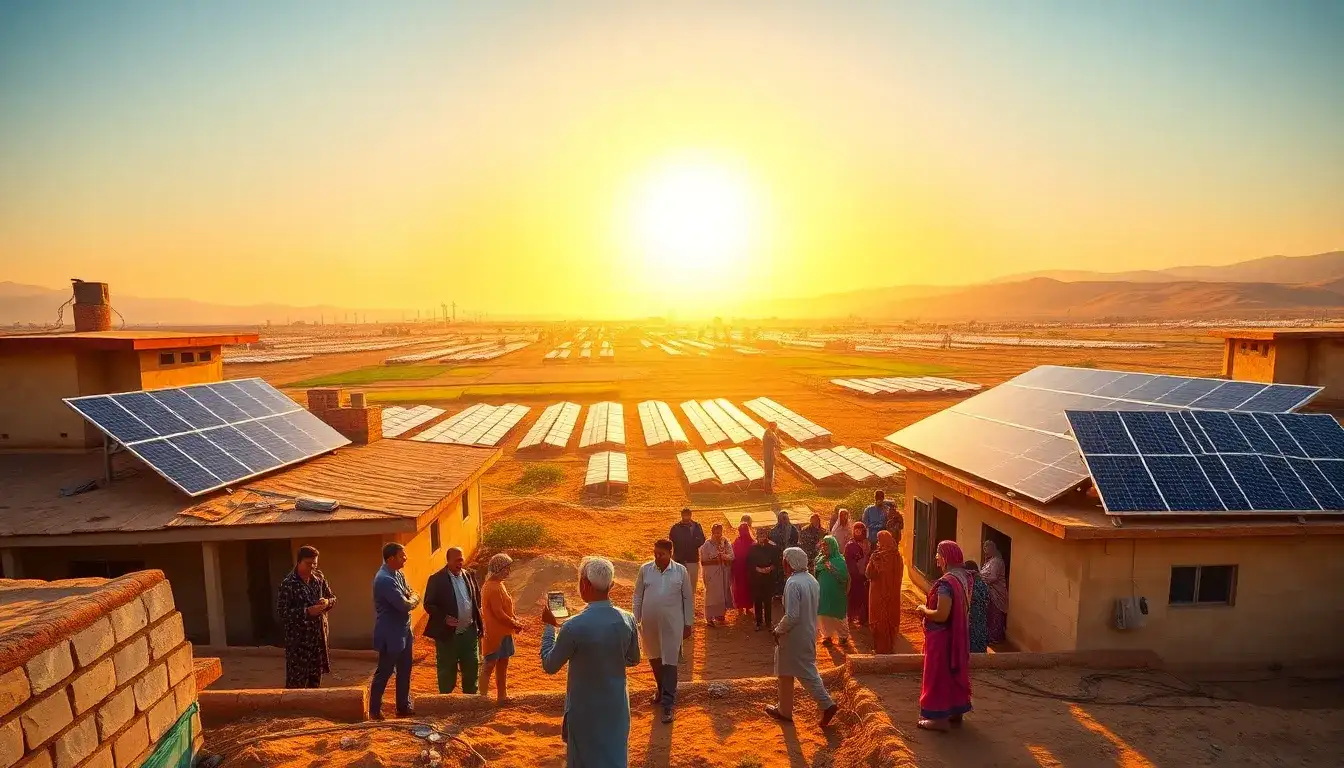
How Pakistan is Crowdfunding an Energy Revolution
==================================================
A personal tragedy sparked a solar energy revolution in Pakistan, as citizens and businesses turn to solar power due to the high cost of grid electricity. This shift, primarily motivated by financial savings, presents a potential model for other developing nations grappling with energy crises. However, challenges in grid management and equitable energy access still loom large.
Najam Fasihi, a 47-year-old surgeon based in Virginia, experienced a life-altering event during a visit to northern Pakistan in 2023. While driving along the Karakoram Highway, a landslide struck their vehicle, resulting in the tragic death of his sister-in-law and leaving her six-year-old daughter with a severe head injury. After ensuring his niece was safe back in Atlanta, Fasihi chose to honor his sister-in-law’s memory by funding solar systems for two clinics that had been without power during their urgent trip to the provincial capital of Gilgit.
“We wanted to give them something that can’t be taken away,” he stated. A fundraising campaign on GoFundMe successfully raised $45,710 in just a few months. He is not alone in this endeavor; across Pakistan, a grassroots energy revolution is reshaping the energy landscape, providing a potential blueprint for other rapidly growing, energy-strapped countries in Asia and Africa. In the previous year, approximately 16.6 gigawatts of solar panels were imported, enough to supply about 13% of the country’s grid power. This surge in solar energy came as a surprise, as the latest system plan from Pakistan’s electricity regulator had anticipated installing less than a third of that amount by 2034.
Solar panels are now being installed on rooftops of schools, orphanages, mosques, medical clinics, and homes. In even the smallest towns, vendors offer solar systems capable of powering three fans, six lights, and a mobile phone charger for as little as $600. Such systems have become almost essential in a country where rolling blackouts can last up to 15 hours, and summer temperatures exceed 50 degrees Celsius (122 degrees Fahrenheit). The driving force behind this adoption is cost rather than environmental concerns. A small solar system can provide electricity for as little as 8 rupees (3 cents) per kilowatt hour, in stark contrast to the grid power rate of 70 rupees per kilowatt hour.
“The grid is currently unaffordable for most people,” said Khurram Lalani, founder of Resources Future, an energy advisory firm in Islamabad. “Consumers are connected out of necessity, but given the choice, they would disconnect from the grid.”
The current energy crisis in Pakistan is the result of decades of mismanagement and unfortunate circumstances. Since gaining independence in 1947, energy issues have hindered the country’s development due to limited domestic power sources. Each time growth has surged, a more energy-intensive economy has begun consuming more imported coal, oil, and gas, draining Pakistan’s foreign reserves and causing the rupee to plummet. The country has required 24 bailouts from the International Monetary Fund, more than any other nation.
Efforts to resolve these issues have often led to more complications. In the 1960s and 1970s, hopes rested on hydroelectric power from the Indus River and its tributaries, with dams like Tarbela and Mangla generating over a third of the country’s electricity in the 1980s. However, these dams have been silting up for decades and now frequently hit “dead level,” the point where water levels are insufficient for irrigation or significant power generation.
In the 2010s, former Prime Minister Nawaz Sharif turned to Chinese-financed coal power plants, which ultimately created more problems. Pakistan now faces over $15 billion in debt to Chinese developers, which the government struggles to manage as the rupee has lost about two-thirds of its value since the agreements were made. With unpaid bills, Chinese plant owners have threatened to halt electricity supplies unless payments are made, and attempts to restructure these loans have only prolonged the crisis. Local media recently reported that addressing legacy debts would add at least another 3.23 rupees per kilowatt hour to consumers’ bills.
To avoid default, the government has increased electricity prices, which rose 155% from 2021 to 2024, leading many households to spend more on electricity than on rent. Local industries are facing energy costs that are about twice those of competitors in the U.S. and India. Protests against rising power prices have erupted, with demonstrators attacking the offices of privately-owned utility K-Electric Ltd.
However, the recent solar boom is bypassing this troubled system altogether, with both households and commercial users, including the textile sector, increasingly adopting solar energy. Notably, Nishat Mills Ltd., which supplies Gap Inc. and Hennes & Mauritz AB, has connected over 35 megawatts of solar power, significantly outpacing Tesla’s operations at its Nevada Gigafactory. Other companies, such as Interloop Ltd., which provides activewear for Adidas and Nike, and Lucky Cement Ltd., are also tapping into solar energy to bolster their operations and improve profit margins.
This shift toward solar energy is positively impacting the economy, as evidenced by the benchmark KSE-100 Karachi stock index, which emerged as the world’s best performer last year. The decline in energy costs has eased inflation, facilitating economic recovery.
This trend offers lessons for other developing countries. Energy is essential for economic growth, yet many nations with rapidly growing populations face severe energy shortages. Solar energy provides a potential shortcut. For instance, South Africa has successfully addressed a similar energy crisis in recent years, aided by a surge in imported solar panels. The introduction of battery systems could further enhance this progress, allowing consumers to utilize the electricity generated by their solar panels during the evening. In Pakistan, combined solar-battery systems are expected to pay for themselves within three to six years.
However, a significant downside looms: those who can afford the initial investment are increasingly disconnecting from the grid to generate their own power, while those unable to do so bear the brunt of the mounting costs associated with Pakistan’s failed coal power experiment. The government will need a functioning electricity network, particularly as future developments will impose greater demands on the system. Electrifying millions of vehicles currently reliant on imported gas and oil will necessitate a robust grid, yet Pakistan currently has only eight public charging stations for its 248 million residents.
Achieving this will require a clear vision. The Ministry of Energy and the electricity regulator must devise more ambitious plans for renewable energy deployment and abandon counterproductive measures, such as the proposed 18% tax on imported solar panels.
International organizations also need to play a pivotal role. The IMF has blocked proposed sales tax exemptions for electric vehicles, and should instead focus on how clean energy can alleviate the country’s dependency on imports that perpetuate the need for bailouts. China, a key ally of Pakistan, has much to gain from transforming Pakistan into a market for its solar industry rather than continuing to pressure the country to bail out failing coal projects.
The remarkable growth of Pakistan’s solar sector demonstrates that many technological and economic barriers to renewable energy have already been overcome. What is now required is a similar revolution in mindset.
Original article by NenPower, If reposted, please credit the source: https://nenpower.com/blog/pakistans-solar-energy-revolution-how-crowdfunding-is-transforming-the-energy-landscape/

