

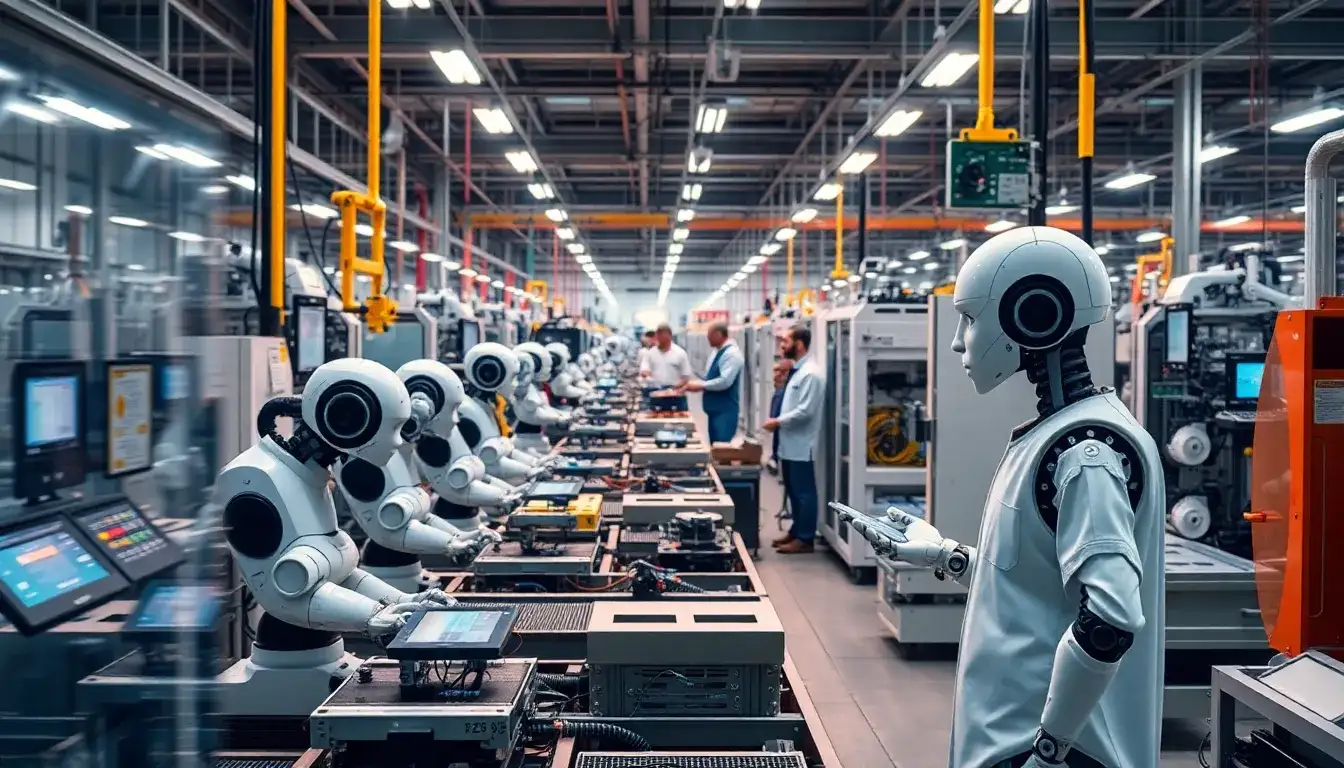
Embodied intelligence is rapidly progressing from laboratory research to mass production, with the Chinese supply chain overcoming key technical bottlenecks. By 2026, it is expected to reach a critical window for large-scale implementation.
1. Breakthroughs in Core Technologies: Advancements in Hardware Precision and Algorithm Generalization
Localization of Core Components and Cost Optimization
- Joint Modules: The world’s first automated joint production line has been launched in Pudong, achieving full automation in precision assembly, calibration, and testing, with an annual production capacity of 100,000 units, planned to expand to 300,000 units.
- Domestic Harmonic Reducers: Companies like Lvyen have achieved internationally competitive precision in harmonic reducers, reducing costs by 40% and breaking the overseas monopoly.
- Dexterous Hands and Actuators: Zhaowei Electromechanical has commenced mass production of a 17-degree-of-freedom dexterous hand, while the joint modules produced by Lens Technology have become lighter (reducing weight by 30%), enhancing movement flexibility.
- Chip Energy Efficiency: Qualcomm’s “Dragon Wing™ IQ10” processor is specifically designed for humanoid robots to address high power consumption issues, while domestic edge computing chips (such as those from Amlogic) are adapted for low-orbit satellite communication needs.
Algorithm Generalization and Data Bottleneck Breakthroughs
- Multimodal Perception Integration: Industrial embodied intelligence labs have successfully developed tactile-visual fusion technology, achieving millimeter-level environmental perception and dynamic path planning. Huawei Cloud’s CloudRobo platform has increased sorting success rates to over 90% using synthetic data combined with real-world validation.
- Cross-Scenario Transfer Capability: Open-source models, such as Ant Group’s LingBot-VLA, require only 80 demonstration data points to complete task transfers, achieving training efficiency 1.5-2.8 times that of mainstream frameworks. Xiaomi’s cross-domain base model MIMO-Embodied enables seamless integration of autonomous driving and home scenario perception.
2. Industry Chain Collaboration: Policy Drivers and Manufacturing Ecosystem Upgrades
Testing Platforms Accelerating Technology Transformation
- The Beijing humanoid robot testing platform has achieved a closed loop of “trial production-validation-mass production,” with an annual capacity of 5,000 units and the ability to assemble a complete machine in just one hour.
- Hefei Zero’s monthly production capacity has surpassed 100 units, facilitating commercialization in retail and cleaning scenarios.
Policy and Capital Dual-Drive
- Shanghai offers subsidies of up to 50 million yuan per project and explores equity stakes based on computing power and data resources.
- A national AI fund of 60 billion yuan is directed towards cutting-edge technologies, while central and state-owned enterprises are opening over 1,000 high-risk data collection points.
- Leading enterprises are actively seeking financing (for instance, Self-Variable Robotics secured 1 billion yuan in funding), focusing on hardware cost control and scene implementation capabilities.
3. Scene Implementation: Penetrating from Industrial to Multiple Fields
Industrial Priority: Companies like UBTECH and Zhiyuan Robotics are executing handling and assembly tasks at BYD and Foxconn factories, replacing human labor in welding and hazardous rescue scenarios.
Emerging Field Breakthroughs: The humanoid robot “Tiangong” has achieved the world’s first low-orbit satellite connection for outdoor operational communication; swarm drones are collaboratively building temporary communication networks, enhancing rescue efficiency.
4. Challenges Ahead: Durability, Costs, and Ecological Collaboration
Hardware Durability Issues: The lifespan of dexterous hands is currently only 1-3 months, and the durability of high-load joints needs improvement.
Commercialization Rhythm Risks: Caution is advised to avoid mismatches between capacity expansion and market demand (for example, Hyundai’s Atlas plans to produce 30,000 units by 2028).
Ecological Standardization Needs: The fragmented technology routes lead to insufficient interoperability, prompting the Ministry of Industry and Information Technology to promote the establishment of standards across the entire industry chain.
In summary, the Chinese supply chain is overcoming mass production bottlenecks through a pathway of hardware cost reduction → algorithm open-sourcing → scene feedback. However, attention must be paid to the longevity of core components and the long-term challenges posed by international algorithm competition.
Original article by NenPower, If reposted, please credit the source: https://nenpower.com/blog/overcoming-technical-hurdles-chinas-supply-chain-advances-in-mass-production-of-embodied-intelligence/

