

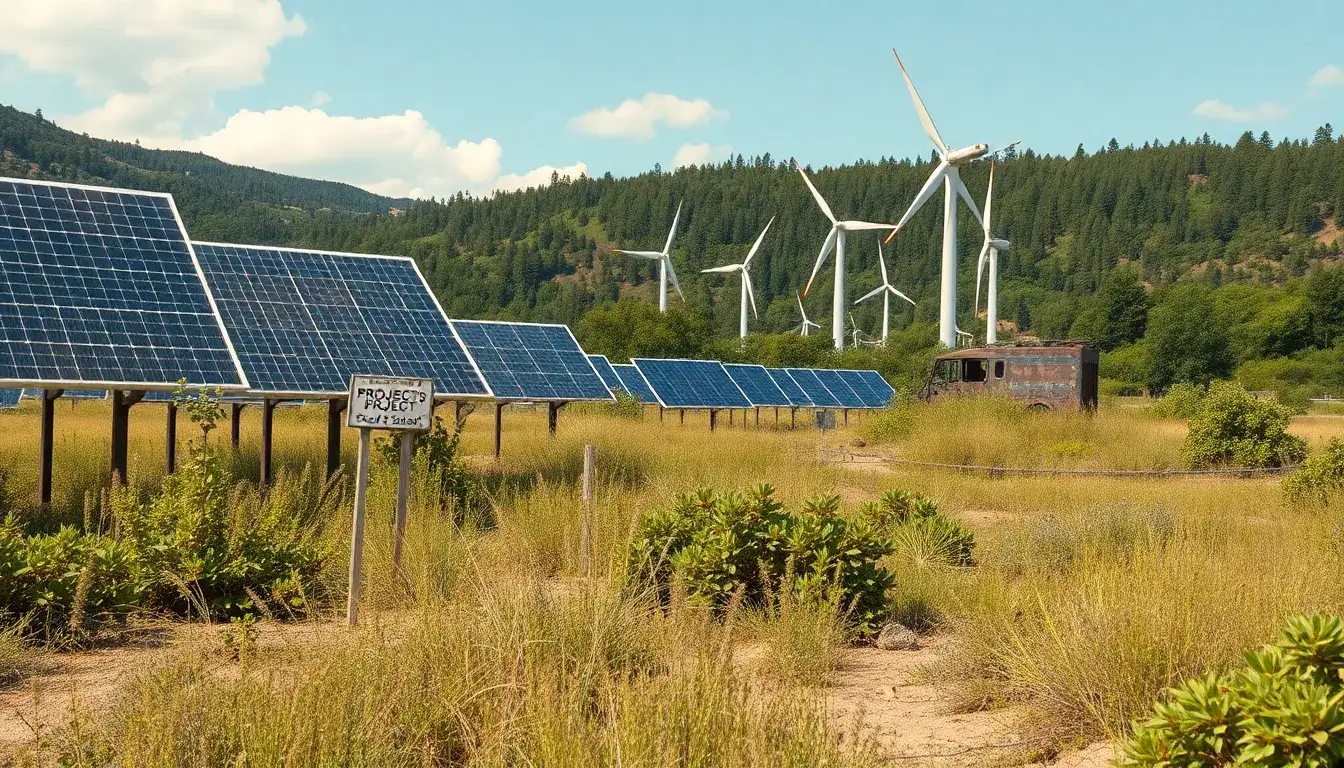
Over 90GW of wind and solar projects have been canceled, prompting a significant shift in the development of new energy projects. Since the second half of 2024, state-owned enterprises have begun to sell off photovoltaic power stations discreetly. As we entered 2025, a wave of project cancellations has swept across various regions, particularly affecting wind and solar initiatives.
On May 12, the Shanxi Provincial Energy Bureau announced the first batch of canceled wind and photovoltaic projects for 2025, which included 14 projects such as the integrated power generation project in Wangjiaya Village, Taichidian Township. The total capacity of these projects amounts to 591,947 kilowatts, comprising 10 photovoltaic projects with a combined capacity of 487.95MW and 4 wind projects totaling 104MW. The main developers of these projects include major state-owned enterprises like Jineng Holdings Group, State Power Investment Corporation, Datang Group, China Electric Power Construction, and Jingneng Group.
This set of cancellations is merely the latest instance in a broader trend across the country. According to incomplete statistics, over 50GW of newly proposed renewable energy projects have been canceled this year alone in regions such as Fujian, Shaanxi, Inner Mongolia, Ningxia, and Shanxi.
The initial wave of cancellations began in the southeastern coastal province of Fujian. On February 20, the Fujian Development and Reform Commission issued a notice to cancel a batch of photovoltaic projects that were no longer viable, which included 10 projects with a capacity of approximately 1.143GW, all of which were floating photovoltaic installations. On March 8, the Ningxia Development and Reform Commission announced the cancellation of several renewable energy projects that lacked construction conditions. A month later, the Wuzhong City Development and Reform Commission in Ningxia released a notice regarding the cancellation of 4 projects totaling 117.3MW, including 2 wind projects and 2 photovoltaic projects, with the latter accounting for 100MW.
On April 21, the Shaanxi Development and Reform Commission announced the cancellation of some renewable energy projects that were initially guaranteed for grid connection in 2022, including the Datang Changwu 150MW photovoltaic project and the Datang Yaochi Binzhou 100,000 kilowatts composite photovoltaic project, totaling 250MW. Other incomplete statistics show that from January to April 2025, several cities in Shaanxi canceled a total of 1.83GW of renewable energy guaranteed grid connection projects.
Among the regions affected, Inner Mongolia has seen the largest scale of project cancellations. To date, the Inner Mongolia Energy Bureau has announced three batches of cancellations involving 37 projects that were previously approved but could not be implemented, totaling 12.65293GW. This includes 12 hydrogen production projects with a renewable energy capacity of 6.316MW, 7 self-consumption projects with 7.093MW, and 14 industrial park green power supply projects totaling 529.5MW.
The ongoing cancellations have also impacted the procurement phase for photovoltaic modules. On April 9, China Power Construction Group announced the termination of its framework tender for centralized procurement of photovoltaic modules for 2025, which was originally set at a scale of 51GW, making it the largest module procurement plan in history. The announcement cited policy adjustments as the primary reason for the change in procurement needs.
Analyzing the reasons behind this wave of cancellations reveals a variety of factors, including projects that have not started construction, those lacking the conditions for continued implementation, missed deadlines for grid connection, and regulatory delays. Some projects were also affected by adjustments in national land policies for photovoltaic projects, leading to their cancellation. A significant factor influencing cancellations is the willingness of project owners to proceed. Many of these projects were initially pursued with great effort and received substantial support from local governments. Thus, it raises questions as to why they are now being abandoned.
The shift in attitude among state-owned enterprises is particularly notable, with many of the canceled projects originating from major players like China Three Gorges Corporation, State Power Investment Corporation, Huaneng Group, Datang Group, Huadian Group, State Energy Investment Corporation, Southern Power Grid, and others. The primary reason for their withdrawal is the significant changes in the economic environment for renewable energy, necessitating a focus on ensuring project profitability.
In March, an investor inquired about the internal rate of return (IRR) for photovoltaic investment projects on an interactive platform, specifically asking if there is a difference in yield between commercial projects and those connected to the grid. The response indicated that the company maintains a minimum return rate of 7% during project feasibility studies.
On October 24, 2024, State Power Investment Corporation’s Inner Mongolia Electric Power Company announced the cancellation of the 40MW distributed photovoltaic project in Chifeng City, which had an investment of 163 million yuan. The project, initiated in September 2022, was found to no longer meet the requirements for further development as its financial IRR was found to be 8.53%.
The current cautious stance among state-owned enterprises marks a stark contrast to their previous aggressive pursuit of wind and solar projects. Just a couple of years ago, these companies were willing to invest significantly to address challenges like voltage instability or to meet local government demands for community projects. However, the landscape has changed, and now they are prioritizing careful financial assessments.
The recent shift in policies regarding renewable energy, especially photovoltaic initiatives, has also contributed to this cautious approach. Newly issued regulations, such as the “Management Measures for the Development and Construction of Distributed Photovoltaic Power Generation” and the “Document No. 136”, have had unprecedented impacts on the development of photovoltaic power stations. The new regulations have removed guaranteed grid connections for commercial distributed photovoltaic systems, significantly affecting their viability. Projects unable to meet installation deadlines are now opting for cancellation as a more rational course of action.
The rationale behind these policy changes lies in the increased capacity of photovoltaic installations, which has led to difficulties in assimilating excess midday generation into the power system. The situation has resulted in widespread restrictions on distributed photovoltaic projects in over 10 provinces, with more than 400 counties experiencing issues with low voltage capacity.
Furthermore, the issuance of Document No. 136 has replaced previous guaranteed purchasing policies with a mechanism for market-based electricity and pricing. This shift has raised concerns about the future viability of subsidies as the scale of renewable installations continues to grow, leading to uncertainty in market confidence.
In summary, the era of blindly chasing projects is over. As the renewable energy sector adjusts to the new consumption environment and policy guidelines, stakeholders are becoming increasingly cautious. The result is a more calculated approach to launching new projects, leading to the abandonment of those that cannot prove economically viable. The focus has shifted towards sustainable and rational market practices.
Original article by NenPower, If reposted, please credit the source: https://nenpower.com/blog/over-90gw-of-wind-and-solar-projects-canceled-whats-behind-the-shift-in-new-energy-development/

