

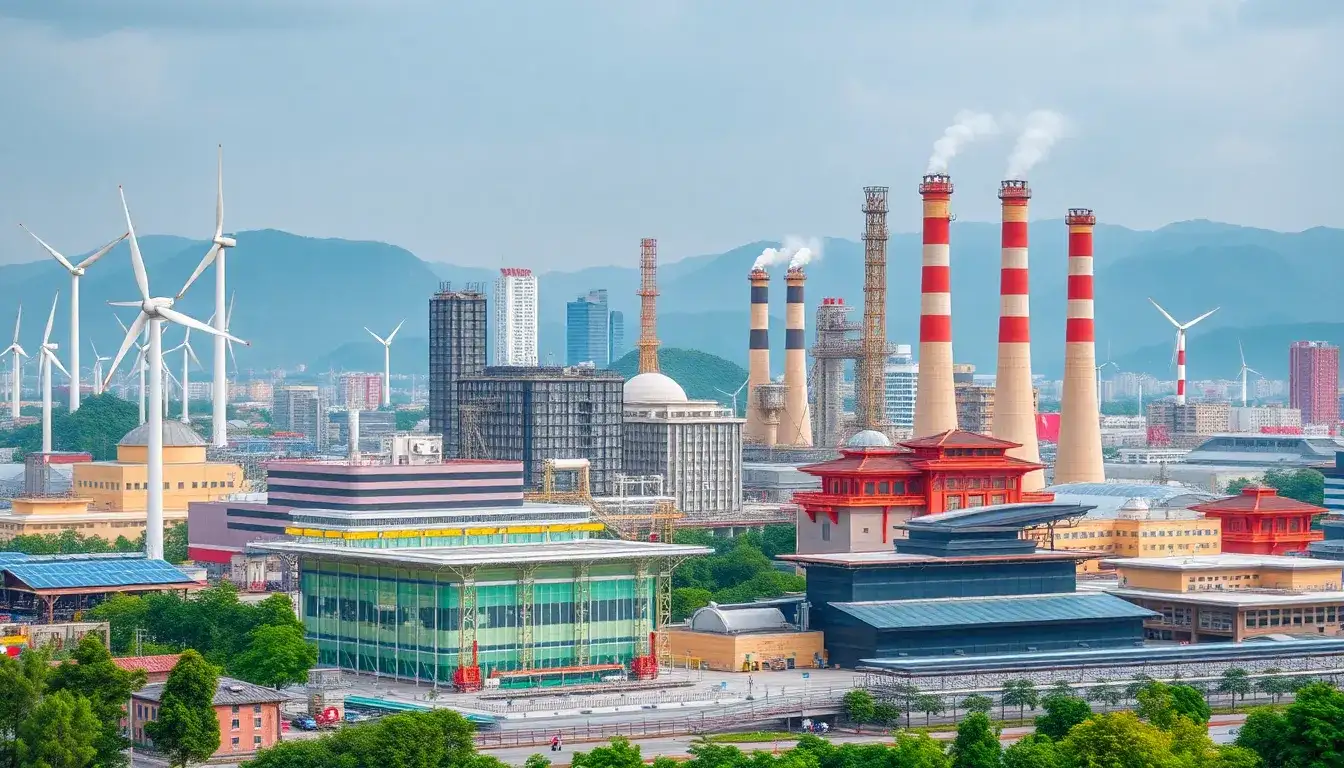
Launch of the Report on Industrial Low-Carbon Technologies Under China’s Carbon Neutrality Goals
On May 28, 2025, the report titled “Outlook on Industrial Low-Carbon Technologies Under China’s Carbon Neutrality Goals” was successfully launched at the Tsinghua University Carbon Neutrality Research Institute. This report was initiated by the Tsinghua University Carbon Neutrality Research Institute, supported by the Energy Foundation, and led by the Environmental Planning Institute of the Ministry of Ecology and Environment. Over twenty experts from more than ten organizations attended the release event to discuss the key issues and future pathways for the development of industrial low-carbon technologies necessary for achieving China’s carbon neutrality goals.
The event was co-hosted by Fu Sha, Strategic Planning Director of the Energy Foundation, and Professor Zhang Qiang, Deputy Director of the Department of Earth Sciences at Tsinghua University. Distinguished speakers included He Kebin, Academician of the Chinese Academy of Engineering and Dean of the Tsinghua University Carbon Neutrality Research Institute, Wang Jinnan, Academician of the Chinese Academy of Engineering and Honorary Dean of the Environmental Planning Institute, and Zou Ji, CEO and President of the Energy Foundation China. They emphasized that achieving carbon peak and carbon neutrality is an inherent requirement for high-quality development in China and is a significant national strategy for promoting harmony between humans and nature. The industrial sector plays a crucial role in the deep low-carbon transformation necessary to meet these goals.
The speakers further highlighted that technological innovation and advancement are the driving forces behind the transformation of various industrial sectors. In this context, it is essential to focus on the strategic needs for carbon neutrality in Chinese industries, systematically deploy cutting-edge low-carbon technologies, clarify key technological pathways, and build comprehensive solutions to support the cultivation of new productive forces and promote high-quality industrial development.
During the report presentation, Yan Gang, Deputy Director of the Environmental Planning Institute, introduced the main content and key conclusions of the report. The report systematically outlines the critical technological pathways for achieving carbon neutrality in the industrial sector and creates a technology map covering major industries and emission reduction stages. It forecasts the future technological evolution, indicating that under a carbon-neutral scenario, China’s industrial carbon emissions could drop to 450 million tons by 2060, representing a reduction of approximately 95% from 2025 levels.
Furthermore, the report identifies four common technologies—raw material substitution and waste recovery, electrification and clean power substitution, hydrogen substitution, and CCUS—that collectively contribute to nearly 80% of the emission reduction potential in industrial technologies. The technological evolution timeline indicates that from 2025 to 2035, there will be a large-scale application of low-carbon process technologies in the industrial sector, with energy efficiency enhancement technologies and raw material substitution driving significant reductions in carbon emissions. The period from 2035 to 2050 will see the explosive application of disruptive process technologies, with accelerated development of electrification and clean power substitution technologies, and the scaling up of hydrogen (green hydrogen) substitution technologies due to declining costs and improved technological maturity. The years 2050 to 2060 will mark a deep application phase for carbon removal supporting technologies, with mature CCUS technologies contributing an estimated 24% to emission reductions by 2060.
Based on the research results, the report proposes a series of policy recommendations, including planning and deploying major projects for key industrial carbon neutrality technologies, continuously strengthening the incentivizing role of the carbon market for such technologies, accelerating breakthroughs and demonstration promotion of common technologies through specialized R&D initiatives, and establishing a supportive tax policy framework for the development of carbon neutrality technologies. This aims to expedite the deployment of common technologies with clear industrialization pathways and significant emission reduction potential, facilitating the transition of China’s industrial sector towards high-quality and sustainable green development.
In the subsequent roundtable discussion, notable participants included He Kebin, Wang Jinnan, Liu Bingjiang, former Chief Engineer of the Ministry of Ecology and Environment, Liu Yang, Deputy Director of the Climate Change Department at the Ministry, and many other experts from various sectors. The discussion, moderated by Professor Zhang Qiang, focused on the collaborative efforts needed to advance low-carbon technologies within industries.
The report was compiled with the collaboration of over 40 experts from 24 organizations, including the Metallurgical Industry Planning and Research Institute, the China Academy of Building Materials Science, and the China Nonferrous Metals Industry Technology Development Exchange Center. Throughout the report’s preparation, a series of technical forums and academic salons were organized to foster collaboration among industry, academia, and research institutions, ensuring a comprehensive understanding of the practices and technological needs in the low-carbon transition across sectors such as steel, cement, nonferrous metals, petrochemicals, and coal.
Original article by NenPower, If reposted, please credit the source: https://nenpower.com/blog/outlook-on-industrial-low-carbon-technologies-in-china-under-carbon-neutrality-goals-unveiled/

