

Optimizing Highway Electric Vehicle Scheduling and Battery Swapping Station Management for Enhanced Renewable Energy Utilization
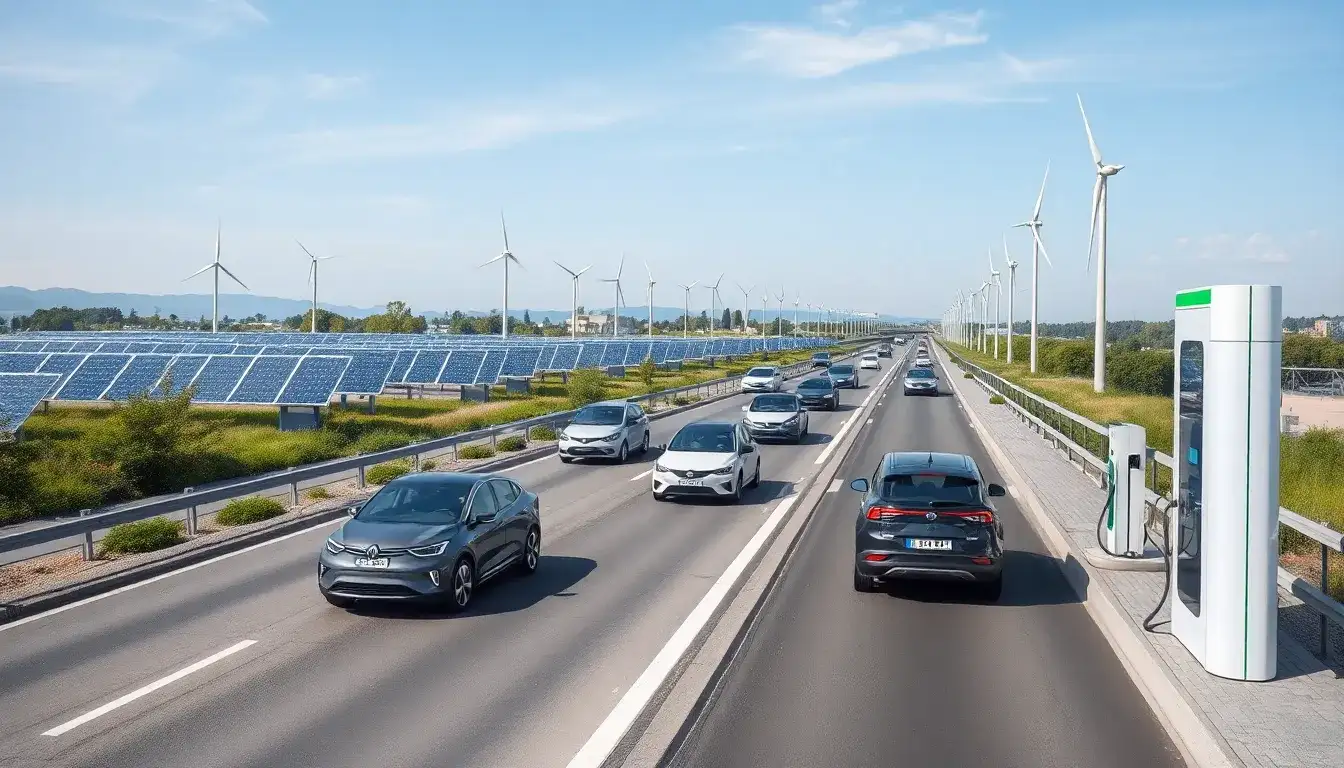
The separation of battery charging and swapping processes allows highway operators greater flexibility in managing the recharging of depleted batteries at battery swapping stations (BSSs) while utilizing renewable energy (RE) resources to reduce electricity costs. However, previous research has not sufficiently explored the connection between BSS recharging strategies and the demand for fully charged batteries, which is influenced by electric vehicle (EV) swapping schemes. To fill this gap, this paper suggests a joint optimization approach for scheduling EVs and managing BSSs with consideration for RE generation along highways.
A spatial-temporal network model is introduced to represent the transportation-energy characteristics of EVs, incorporating BSS selection and battery swapping processes. Additionally, a BSS management model is developed to oversee the recharging of depleted batteries, ensuring the availability of fully charged batteries to meet the swapping needs of EVs. The Lagrange relaxation algorithm is applied to manage the interactions between EV scheduling and BSS operations. A case study demonstrates that this method effectively coordinates EV swapping schemes with BSS recharging strategies, leading to a 17.3% improvement in RE generation utilization and a reduction in grid electricity consumption amounting to RMB 1753.8.
Keywords: electric vehicle swapping; battery swapping station; joint optimization; highway renewable energy generation; spatial-temporal network
1. Introduction
The rising demand for energy replenishment in electric vehicles (EVs) has prompted the integration of renewable energy (RE) resources into highway power systems in recent years. RE resources, known for their sustainability and cost-effectiveness, can be converted into electrical energy using green power generation equipment such as photovoltaic (PV) devices and wind turbines (WT). Compared to traditional grid-connected power systems, utilizing RE generation for EV energy needs can significantly decrease carbon emissions and enhance the economic efficiency of highway systems.
In conventional charging scenarios, lengthy charging times present challenges in scheduling EVs to efficiently consume RE generation. However, advancements in automation and battery technology have made the EV battery swapping mode a more advantageous option for leveraging RE resources. The battery swapping mode involves replacing depleted batteries in EVs with fully charged batteries stored at BSSs. Since recharging batteries and swapping them for EVs do not need to occur simultaneously, BSS owners have greater flexibility in developing recharging strategies without lengthy charging times for drivers. This avoids unreasonable concentrated charging and allows for optimal utilization of RE sources.
Despite the advantages, the swapping mode has its challenges. Firstly, the provision of depleted batteries by EVs affects recharging strategies at BSSs, complicating the utilization of RE generation. Secondly, due to the uncertainties surrounding EV swapping demand, BSS owners struggle to accurately plan the number of fully charged batteries required at different time slots. These factors underscore the interconnectedness between EV swapping plans and BSS management, a relationship that existing research has overlooked.
To bridge this gap, it is essential to resolve several challenges:
- Highway EV swapping scheduling involves key factors such as battery level changes during travel, selecting suitable BSSs, and service capacity at BSSs. The demand for battery swapping varies significantly by location and time, affecting recharging strategies at different BSSs.
- BSS management encompasses RE generation, EV swapping demands, and recharging depleted batteries. The goal is to optimize BSS management strategies for effectively utilizing RE generation to recharge depleted batteries and meet swapping demands. Thus, a joint optimization framework is necessary for optimizing both EV swapping schemes and BSS management strategies.
The battery swapping mode presents significant flexibility and optimization potential for effectively utilizing RE generation to recharge depleted batteries at BSSs. Although previous research on recharging BSS depleted batteries has focused on urban road contexts, a comprehensive study of battery swapping in highway transportation scenarios remains unaddressed.
This paper introduces a method for jointly optimizing EV swapping schemes and BSS management strategies to enhance RE utilization along highways, reshaping EV swapping demands at BSSs and optimizing BSS recharging strategies to reduce operational costs. The primary contributions of this study include:
- A joint optimization approach that coordinates highway EV swapping scheduling and BSS management, accounting for RE generation.
- The development of a spatial-temporal network model for EV scheduling that depicts BSS selection and battery swapping processes.
- The formulation of a BSS management model that manages depleted battery recharging, ensuring battery inventory meets the demand for fully charged batteries from EVs.
2. Problem Description
The highway operator is depicted as a cross-regional operation company managing PV devices, wind turbines, highway entrances and exits, HWSAs, and BSSs. The operator benefits from both consuming RE generation and providing battery-swapping services for EVs. BSSs not only supply fully charged batteries but also manage the recharging of depleted batteries.
For the study, the highway is segmented into equidistant sections, with an index set defined for the highway segment (HS). We simulate the driving of an EV in one direction with an entrance in the first HS and an exit in the last HS.
3. Methodology
This section outlines the proposed joint optimization approach and details the spatial-temporal network model for EV swapping scheduling. The BSS management model is considered, focusing on recharging depleted batteries and maintaining adequate fully charged battery levels. The joint optimization model is established as a mixed-integer quadratic constraint programming (MIQCP) model to maximize the highway operator’s profit.
4. Case Study and Results
A highway system was established for experimental analysis, comprising one highway entrance, three HWSAs, and one exit. The research included RE generation profiles and basic parameter settings for EVs and BSSs.
The results demonstrated that the proposed joint optimization approach effectively maximizes RE generation utilization, reduces operational costs, and ensures an adequate supply of fully charged batteries to meet EV swapping demands. Furthermore, the study highlighted the advantages of the proposed method in enhancing operational efficiency and reducing reliance on grid electricity.
5. Conclusions
This study presents a joint optimization model that aligns EV swapping schemes with BSS management strategies to improve RE generation utilization along highways. The model aims to maximize profits while ensuring the availability of fully charged batteries at BSSs to meet EV demands. The findings indicate that the proposed method not only lowers electricity costs for highway operators but also enhances operational efficiency, benefiting both the economy and the environment of the highway system.
Future research could expand the model to encompass diverse geographic regions, varying RE generation potentials, and different types of EVs, aiming for broader applicability and effectiveness.
Original article by NenPower, If reposted, please credit the source: https://nenpower.com/blog/optimizing-electric-vehicle-scheduling-and-battery-swapping-stations-for-enhanced-renewable-energy-usage-on-highways/

