

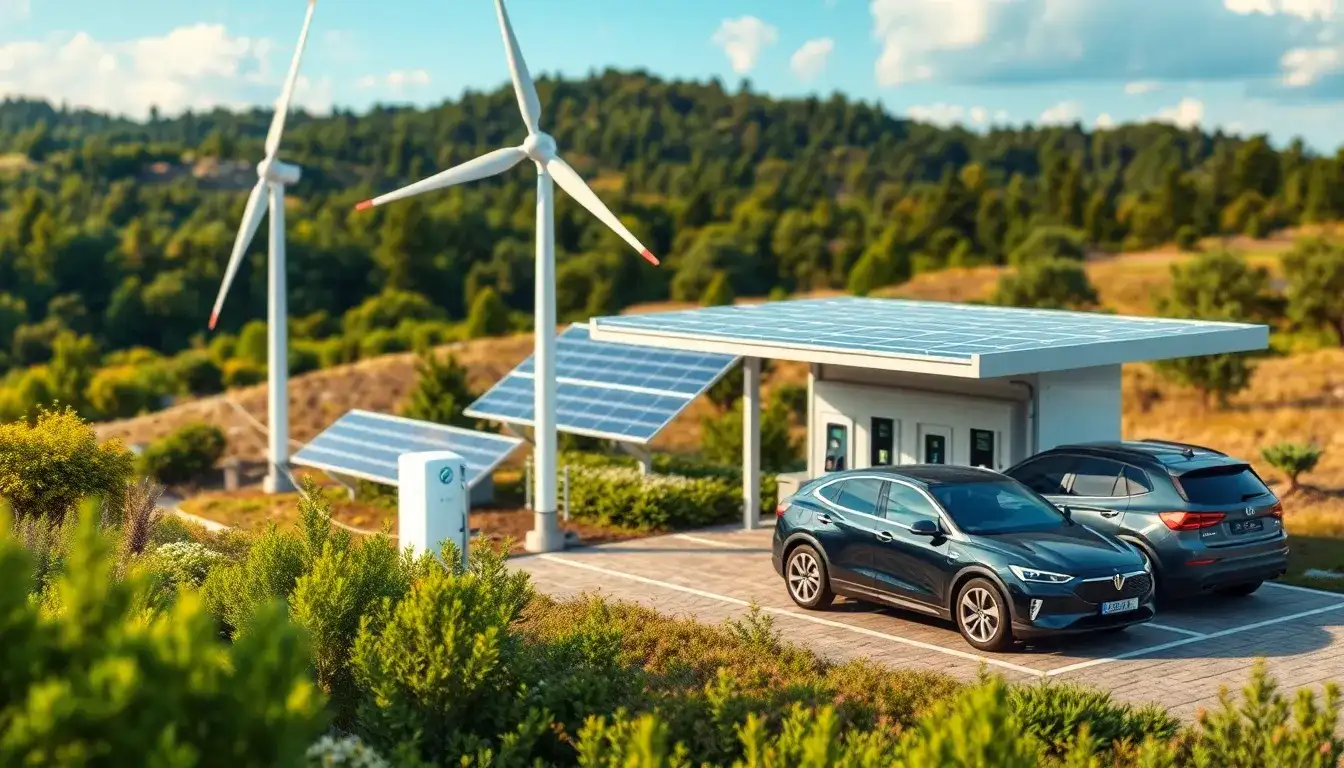
Research on the Location and Capacity Determination Strategy of Off-Grid Wind–Solar Storage Charging Stations Based on Path Demand
Abstract: This paper addresses the challenges of cross-city travel for electric vehicles (EVs) and the need for rapid charging solutions in areas with underdeveloped power grids. We propose a strategic approach for the location and sizing of highway charging stations that accommodates these grid limitations. Initially, we develop a path-demand-based model to optimize the number and allocation of charging stations, taking into account the initial state of charge of EVs and their flow rates. Additionally, we create a capacity configuration model that integrates wind, photovoltaic, storage, and diesel generators to manage the load at these stations. This model introduces a novel objective function, the annual comprehensive cost, which includes installation, operation, maintenance, wind and solar curtailment, and diesel generation costs. Simulations conducted on north-western cross-city highways validate the effectiveness of our approach, demonstrating that the proposed model can meet diverse EV charging demands with a 90% operational self-consistency rate across various daily scenarios.
Keywords: off-grid microgrid; EV charging station; flow-refueling location; capacity configuration
Introduction
The goal of achieving carbon neutrality has made the widespread adoption of electric vehicles (EVs) a pivotal strategy for decarbonizing transportation. However, EVs still face challenges compared to traditional fuel vehicles, particularly concerning long-distance travel and rapid charging capabilities. This is especially true in the western regions of China, where sparse road networks and weak power grids hinder the expansion of electric vehicles. Given the region’s abundant wind and solar resources, establishing wind-solar storage charging stations is a crucial solution. This initiative not only meets the energy needs of charging stations in areas with weak power grids but also aligns with the national “14th Five-Year Plan for Renewable Energy Development,” addressing the strategic need for renewable energy advancement.
Significant scholarly attention has been directed toward the site selection and capacity planning of EV charging stations, with various strategies proposed that consider road conditions, load demands, grid impacts, and costs. For instance, Dong Xiaohong et al. developed a model utilizing the SNN clustering algorithm for site selection and capacity determination of fast charging stations on circular highways. Jia Long et al. employed a two-stage planning approach to identify potential site locations based on EV charging demands on high-speed road networks and subsequently optimize station locations and capacities with cost considerations. Similarly, Zhao Feng et al. addressed the uncertainties associated with photovoltaic and load at grid-connected highway solar energy storage charging stations through a distributed robust optimization method.
Existing research predominantly focuses on grid-connected charging stations reliant on the main power grid, resulting in a relatively low adoption of new energy sources. In regions lacking robust grid support, new energy sources are essential for supplying electricity to charging stations. Mostata F. Shaaban et al. aimed to minimize operational costs and carbon emissions by employing a mixed-integer two-level planning model for off-grid charging station site selection and capacity determination. However, despite addressing off-grid operations, most studies have focused on individual charging stations with point demands for capacity planning, neglecting comprehensive capacity planning for multiple stations based on route demands. The placement of varying numbers and locations of charging stations can lead to fluctuations in daily load demands, significantly impacting capacity planning, particularly for off-grid stations with strict requirements for load-source matching.
This paper explores the location and capacity planning of EV charging stations in areas without robust grid support. The main innovations include enhancing the flow-refueling location model to cater to diverse EV charging needs along routes with varying city-to-city distances and battery capacities. Additionally, a wind-solar storage charging station model is proposed to maintain power balance without depending on the main power grid, ensuring consistent operation across different scenarios.
EV Charging Station Site Planning
The planning process for charging station sites is divided into three steps. The first step involves establishing distinct models for electric vehicle travel. The second step creates a charging station site selection model based on route demands using electric vehicle travel data. The third step utilizes NSGA-II optimization algorithms to solve the site selection objectives, ultimately providing suitable site selection results for long-distance intercity travel by different types of electric vehicles.
2.1. Electric Vehicle Model
To enhance the diversity of different EV samples, we employed the Monte Carlo method. After a thorough investigation of the global automotive battery markets, four distinct types of EVs were identified: light four-wheel vehicles (L), passenger vehicles (M), light-duty trucks (N1), and heavy-duty trucks (N2). The probability density function for the maximum battery capacity was established for each type.
2.2. Traffic Flow Model
Utilizing historical traffic flow data from the planned road area, a probability distribution model was established. The Monte Carlo simulation estimated traffic flow during various time periods throughout the year, calculating the daily average traffic flow index.
2.3. Site Selection Planning Model
This study employed the Flow Refueling Location Model (FRLM) to identify the optimal combination of charging stations along a specified route. The model captures traffic flow along the route, enabling EVs to charge and complete their journeys within their driving ranges.
2.4. Solution Process
The charging station siting model was solved using NSGA-II. The process involved encoding charging station combinations using binary representation, with each gene indicating the presence or absence of a charging station at a given location.
EV Charging Station Capacity Planning
This paper focuses on the self-consistency of wind-solar storage charging stations for remote road sections. Based on the site selection results, a strategy for off-grid source storage configuration is proposed, optimizing the operation of wind-solar storage charging stations.
3.1. System Structure
The system structure of the wind-solar storage charging station was designed for independent operation from the main power grid, utilizing wind and solar power as primary energy sources. Given the variability of wind-solar generation, energy storage systems and diesel generators were integrated to ensure reliability.
3.2. Energy Storage Model
The energy storage system plays a critical role in balancing fluctuations in power generation and offsets imbalances between supply and demand. The state of charge (SOC) of the energy storage system indicates its operational status.
3.3. Diesel Generator Model
The diesel generator serves as a backup for wind-solar storage charging stations, covering power shortages during extreme conditions.
3.4. Wind-Solar Storage Charging Station Model
The optimization process includes operating costs of diesel generators and costs associated with curtailed wind and solar power as objective functions. The comprehensive annual cost is formulated, balancing economic indicators and self-consistency indicators.
Simulation and Results
The proposed model was validated through simulations on a 500 km route from Yumen, Gansu, to Hami, Xinjiang. The simulation parameters included various types of EVs, wind power, and photovoltaic systems. The results showcased effective site selection and capacity planning, with detailed evaluations of the charging stations’ performance under different scenarios.
Conclusion
This research presents a comprehensive strategy for the location and capacity determination of off-grid wind-solar storage charging stations, addressing the challenges of EV charging in areas with weak power grids. The proposed model demonstrates high operational self-consistency and offers valuable insights for future infrastructure planning. Future considerations include developing operational strategies tailored for off-grid highway fast charging station clusters to enhance self-consistency while reducing costs.
Original article by NenPower, If reposted, please credit the source: https://nenpower.com/blog/optimization-strategy-for-locating-and-sizing-off-grid-wind-solar-storage-charging-stations-based-on-electric-vehicle-path-demand/

