

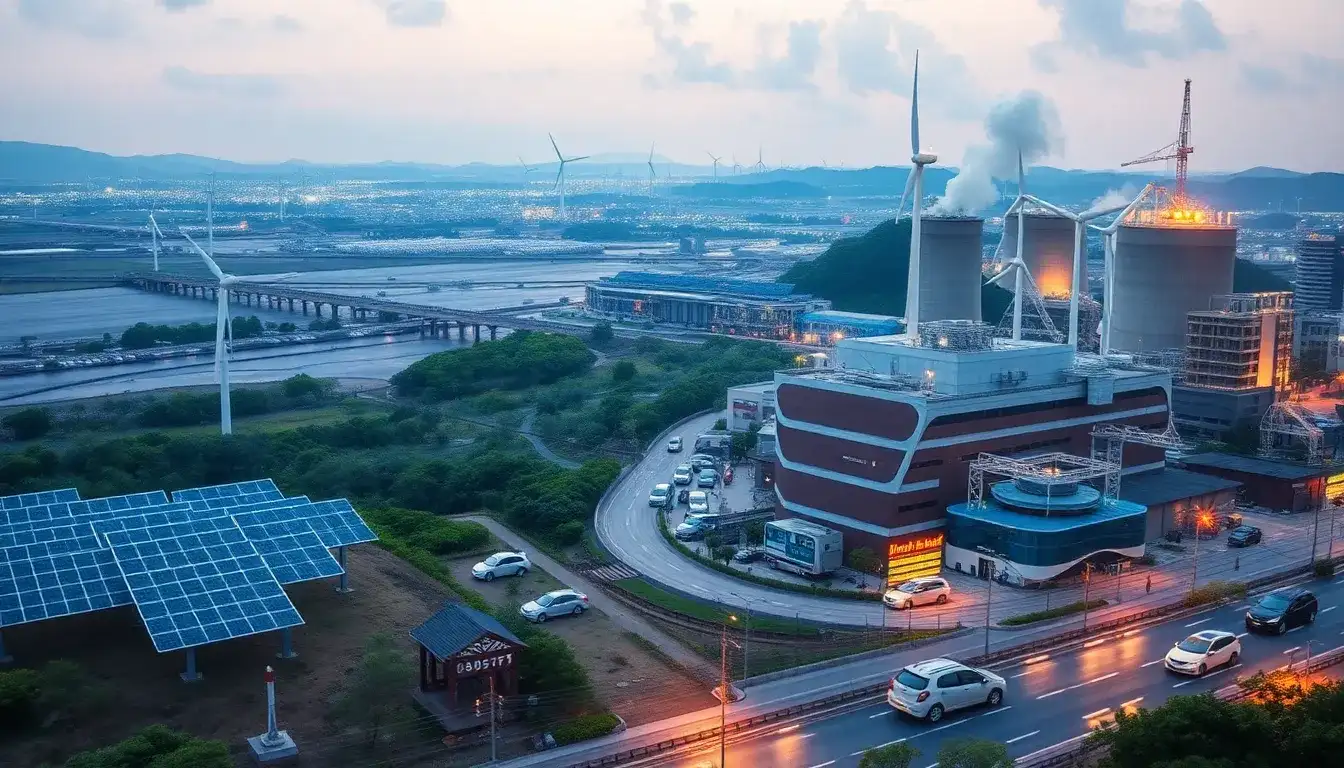
The opportunity and challenges of the full entry of new energy into the market have become increasingly prominent. China’s new energy sector has evolved from non-existence to a robust presence, transitioning from being a supplementary power source to a primary one. On January 27, the National Development and Reform Commission and the National Energy Administration jointly issued the document titled “Notice on Deepening Market-Oriented Reform of New Energy Grid Connection Prices to Promote High-Quality Development of New Energy” (Document No. 136, 2025). This document clearly states the intention to shift the pricing of new energy grid connections to a market-driven model, marking a significant transition from policy-driven growth to market-driven development. This shift is crucial for advancing the marketization of electricity and promoting high-quality growth. For stakeholders in the new energy market, it is essential to thoroughly understand the evolving policy landscape and market dynamics.
China’s new energy sector has reached a new milestone. The installed capacity of new energy has transitioned from being primarily incremental to a focus on existing capacity. By the end of 2024, the total installed power generation capacity in the country reached 3.35 billion kilowatts, with new energy accounting for 1.41 billion kilowatts, which is over 40% (42%) of the total, making it the largest power source. The new energy sector saw an additional installed capacity of 360 million kilowatts, representing 83% of all newly installed capacity, thus surpassing the total installed capacity of new energy in the United States by the end of 2024.
The development models for new energy have diversified, leading to ongoing optimization of scale and layout. The proportion of wind power generation in the total new energy capacity has decreased from 80% in 2014 to 37% in 2024, while solar power’s share has increased from 20% to 63%. Additionally, the share of distributed solar power in total solar generation has risen from 19% to 42%. This has resulted in a new paradigm characterized by the coexistence of centralized and distributed generation, onshore and offshore resources, local consumption and transmission, single and multiple energy sources, as well as integrated and standalone applications.
The contribution of new energy to overall electricity generation has consistently increased. In 2024, the total electricity generation in the country reached 9.9 trillion kilowatt-hours, with new energy accounting for 1.8 trillion kilowatt-hours, marking a year-on-year growth of 24.9% and contributing 18.5% to the total generation—a 2.7% increase from the previous year. New energy contributed to 60% of the growth in electricity generation. Market-oriented trading has become the primary method for integrating new energy into the grid. For example, in the National Grid’s operational area, new energy market transactions amounted to 769.9 billion kilowatt-hours in 2024, representing 52% of total new energy generation for the first time. Green electricity transactions reached 135.8 billion kilowatt-hours, a 122% increase year-on-year, while green certificate transactions exceeded 176 million, growing more than sixfold.
Overall, new energy maintains a high utilization rate, with utilization levels exceeding 95% for six consecutive years. According to data from the National New Energy Consumption Monitoring and Early Warning Center, wind power utilization stood at 95.9% and solar power utilization at 96.8% in 2024. These figures reflect the effective interplay of policy support, market mechanisms, and upgrades in grid infrastructure.
New business models and formats are expected to be the driving force behind future development. Given the acceleration of energy transition, the full release of industry capacity, rising local development demands, and increasing international trade barriers, it is anticipated that the scale of new energy development will continue to grow rapidly during the 14th Five-Year Plan period. By 2030, the total installed capacity of new energy is projected to double from current levels. Integrated projects, representing the “New Energy +” model, are poised to become the mainstay of new energy development.
In recent years, new elements such as distributed energy, novel energy storage solutions, and flexible loads have rapidly emerged, fostering new forms of energy consumption and generation. With support from national and local government policies, the “New Energy +” integrated model has gained momentum, leading to a swift increase in project numbers and installed capacity, becoming a new growth point for the new energy sector. The underlying logic driving integrated projects is the economic understanding from different perspectives. From a user perspective, the electricity cost of integrated projects is essentially the cost of wind and solar, whereas from a system perspective, these projects must also account for social responsibilities like policy-based cross-subsidies, risks associated with market price fluctuations, and the responsibility of self-consumption and peak-shaving.
In the foreseeable future, integrated projects are expected to develop rapidly and diversify, with various stakeholders driving their implementation. In the medium to long term, as a unified national electricity market is established, all types of stakeholders in the integrated projects will fairly share economic, social, green, and safety responsibilities. The diverse electricity demands from integrated projects will be met through market mechanisms, allowing projects with strong technical capabilities, high operational efficiency, and innovative business models to stand out.
However, as new energy fully enters the market, there is a growing need for greater focus on the statistical issues surrounding curtailment of electricity generation. It is increasingly challenging to maintain high utilization rates, necessitating a closer examination of economic curtailment. On one hand, the continuous increase in installed capacity and generation ratio of new energy raises demands on load-side consumption capacity, grid-side adjustment capacity, and cross-regional transmission capabilities, putting pressure on utilization metrics. It is expected that the contradictions related to new energy consumption will continue to emerge in certain regions. On the other hand, under the market-oriented trends, new energy is facing new challenges, including rising economic curtailment.
In 2022, the National Development and Reform Commission and the National Energy Administration issued a notice to accelerate the development of the electricity spot market, clarifying that electricity not included in the bidding due to pricing reasons would not be counted in the statistics of new energy curtailment. However, at that time, the main focus remained on guaranteed purchasing, resulting in limited impact on the curtailment statistics framework. The “Document No. 136” further specifies that electricity not connected to the grid due to pricing factors will not be included in the utilization rate statistics and assessments for new energy.
With the full entry of new energy into the market, especially for photovoltaic investments, it is crucial to pay attention to economic curtailment resulting from market factors. Lessons can be drawn from the curtailment statistical rules in California, where the Independent System Operator (CAISO) provides detailed statistics on curtailment types and volumes. CAISO classifies curtailment into economic, self-induced, and scheduling types, with economic curtailment representing 99% of the total. In contrast, most European countries only track scheduling curtailment. China could adopt CAISO’s statistical framework, refining categories to differentiate between market price-related curtailment, grid constraints, and self-induced curtailment, thereby guiding investment in new energy within a rational market environment.
Original article by NenPower, If reposted, please credit the source: https://nenpower.com/blog/opportunities-and-challenges-of-the-new-energy-market-in-china-transitioning-to-a-market-driven-model/

