

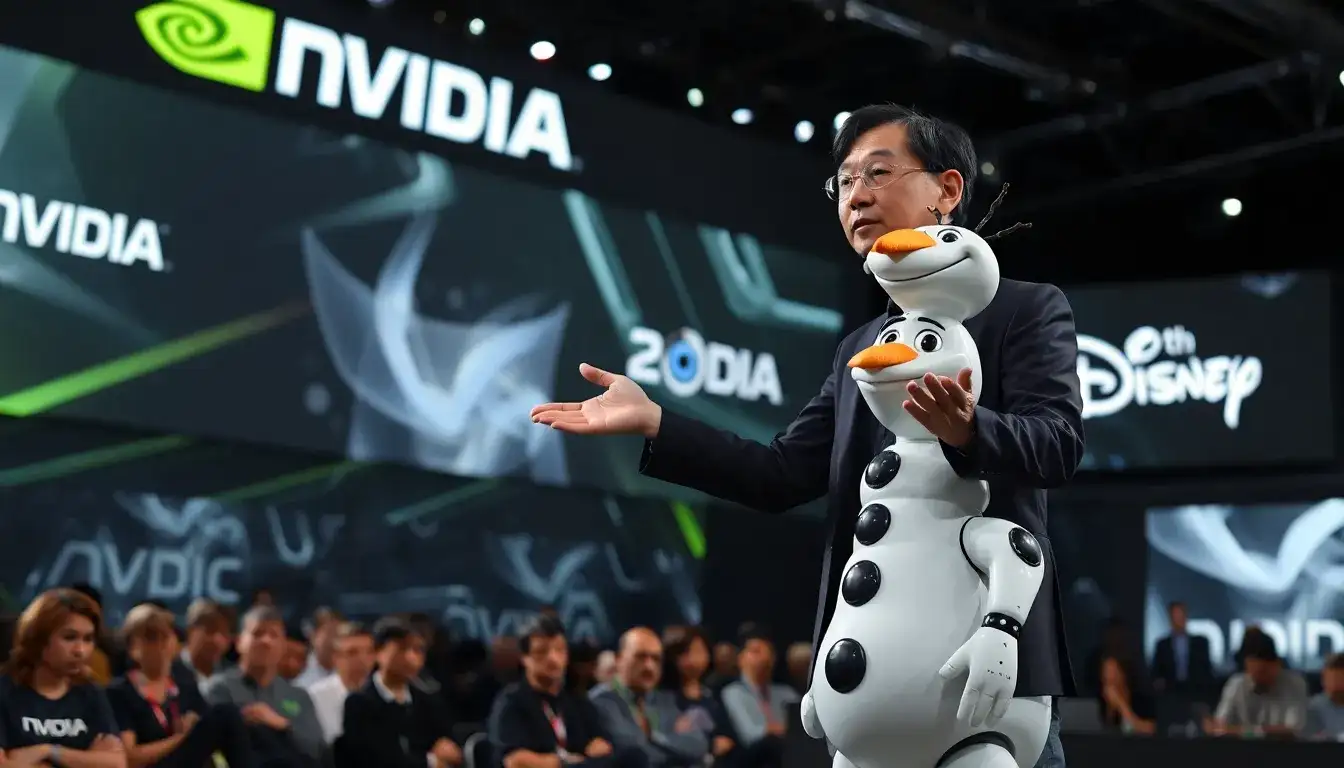
GTC 2026: Huang Renxun’s New Companion! A Surprise Appearance
At the GTC 2026 event, Huang Renxun partnered with Disney to unveil the AI robot Olaf. This innovative robot combines the Newton engine with reinforcement learning, allowing it to walk stably despite its asymmetrical physical structure. This development signifies a shift in physical AI from industrial applications to emotional interactions, with plans for Olaf to debut at Disney parks globally in 2026.
Robot enthusiasts are in for a treat! During the keynote speech at NVIDIA’s GTC 2026, CEO Huang Renxun introduced a highly popular new friend from Disney—Olaf from Frozen. This appearance highlighted NVIDIA’s ambitions in the robotics sector. While the world focuses on computational power growth, Huang showcased Olaf, an AI-driven physical robot that embodies the playful spirit of its animated counterpart.
Standing at about waist height, Olaf walked naturally towards Huang, creating a memorable highlight of the presentation. This demonstration not only provided a visual spectacle but also revealed the deep technical integration between NVIDIA, Disney, and Google DeepMind in the realm of physical AI.
Overcoming Physical Challenges: Teaching Olaf to Walk
Huang provided insights into the engineering challenges behind Olaf. Unlike traditional robots with well-defined support points, Olaf’s round snowball body and slender twig arms create an inherently unstable structure. To enable it to walk playfully as seen in the film, the development team utilized the Newton open-source physics engine, created in collaboration with Google DeepMind. A significant breakthrough came from Disney’s Imagineering team, which contributed the Kamino simulator. This tool allowed Olaf to undergo millions of reinforcement learning trials in a digital twin environment before its real-world debut. It can adjust its center of gravity in real-time using sensors, maintaining an endearing clumsiness as it moves.
Digitizing Character Souls: Emotions in a Carrot Nose
One of the most astonishing features of Olaf is its ability to replicate classic scenes from the movie perfectly. In a recent demonstration video, the removal of Olaf’s iconic carrot nose prompted the robot to respond with humor and exaggerated expressions, showcasing its embodied intelligence. This immediate feedback mechanism relies on NVIDIA’s powerful edge computing capabilities, enabling real-time processing of visual recognition, semantic understanding, and subtle facial expression control.
Huang emphasized that this represents a shift in AI from rigid logical commands to an ability to integrate with artistic interfaces, digitally infusing the character’s spirit back into physical hardware.
A Transition from Industry to Everyday Life: The Emotional Transformation of Embodied Intelligence
This presentation marks NVIDIA’s new interpretation of robotics, moving from mere industrial labor to emotionally connected companions. Olaf is expected to officially debut in early 2026 at Disneyland Paris and Hong Kong Disneyland, becoming one of the first characters capable of learning autonomously and interacting with visitors. Huang stated that when technology advances to a point where guests no longer perceive the mechanical nature of robots, technology transforms into real magic. This achievement, which perfectly blends complex physical simulations, neural network training, and artistic dynamics, not only establishes a new paradigm for the development of character robots but also foreshadows that physical AI will become an indispensable intelligent presence in the real world over the next decade.
Original article by NenPower, If reposted, please credit the source: https://nenpower.com/blog/nvidias-jensen-huang-unveils-ai-robot-olaf-at-gtc-2026-in-collaboration-with-disney/

