

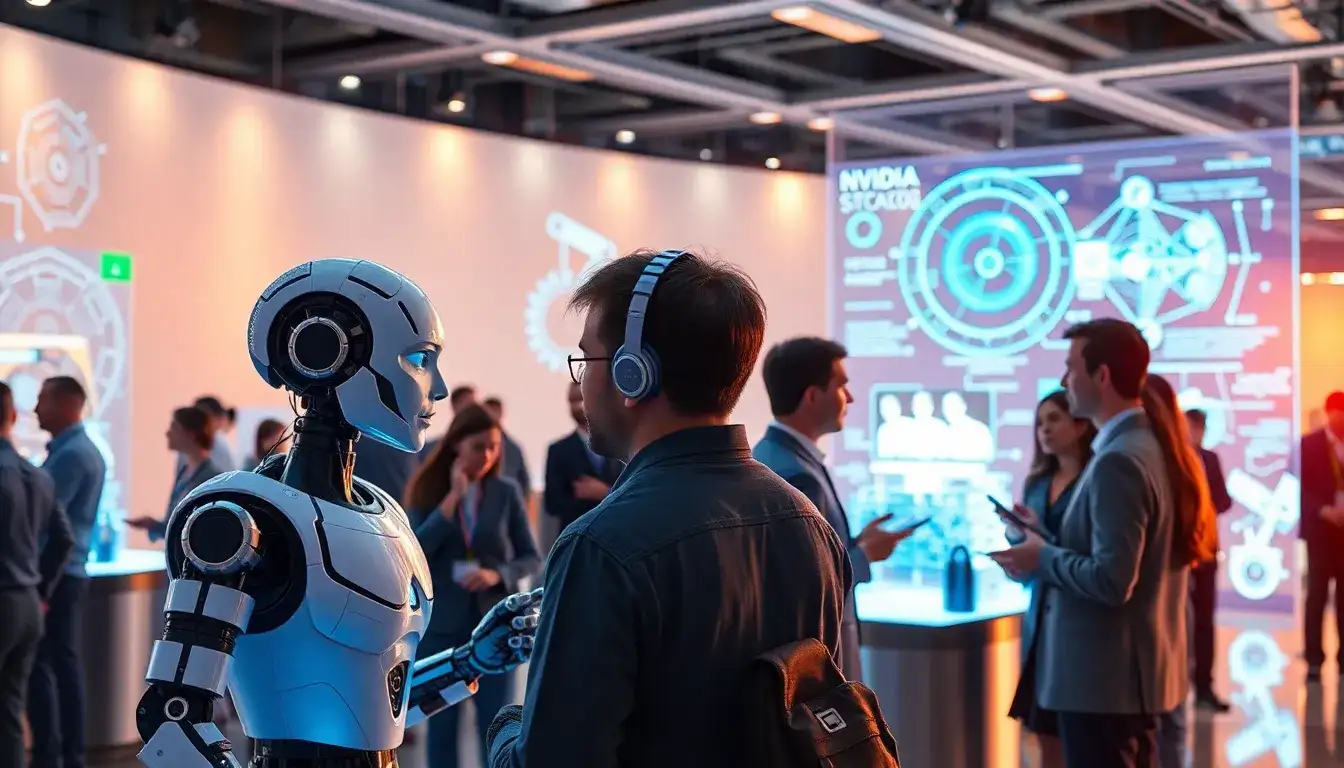
NVIDIA GTC 2026: Real-Time Insights into the Future of AI Development
Join us for live coverage from the NVIDIA GTC conference in San Jose, featuring a keynote by NVIDIA CEO Jensen Huang, highlights from the conference, live demonstrations, and firsthand observations, continuing until March 19, 2026.
March 16, 2026 by NVIDIA China
NVIDIA is providing real-time updates, news, and background information directly from the GTC conference. Use the menu below to check the latest developments:
- Keynotes and Special Events
- Workstations
- Research and Open Source
- Cloud
- Healthcare
- Physics
- AI
- Quantum Computing
- Media and Entertainment
- Retail
- GTC Keynote Live Updates
Welcome to GTC 2026!
The SAP Center is packed, with everyone eagerly awaiting the keynote. This year’s presentation opened with a video defining tokens as the fundamental units of modern AI. Tokens serve as the foundation for scientific exploration, virtual worlds, and machines operating in the physical realm.
Following the video, NVIDIA founder and CEO Jensen Huang took the stage to a warm welcome from the audience. He first expressed gratitude to the hosts who warmed up the crowd and highlighted the partners participating in this GTC, along with over 450 sponsors, 1,000 sessions, and 2,000 speakers. “This conference will cover every layer of the AI cake,” Huang stated. He noted the 20th anniversary of CUDA, referring to it as a “flywheel” driving the development of accelerated computing, supporting “every stage of the AI lifecycle.”
Huang then shifted the focus to GeForce, stating that NVIDIA is a “company built by GeForce,” which has brought CUDA to the world. He reviewed the evolution of GeForce, linking it to the overall development of AI, and introduced DLSS 5, showcasing a video demonstration of how 3D-guided neural network rendering achieves real-time, photo-realistic 4K performance on local hardware. More details can be found in the press release.
Next, Huang discussed the field of data processing and how it has accelerated in the AI era. He elaborated on NVIDIA’s collaborations with IBM, Dell, Google Cloud, AWS, Microsoft Azure, Oracle, and CoreWeave to better serve customers. Huang emphasized the depth of the accelerated computing ecosystem, covering automotive, financial services, healthcare, industry, media, quantum computing, retail, robotics, and telecommunications. “All these different AI fields have platform support from NVIDIA,” Huang stated. He also highlighted NVIDIA’s rich CUDA-X library, calling it the “pearl in NVIDIA’s palm.”
Huang emphasized the rise of “AI-native companies,” including well-known firms like OpenAI and Anthropic, as well as emerging new players. “This trend has exploded over the past year,” Huang remarked, noting that venture capital investments in startups reached $150 billion and reminiscing about the technological developments that triggered the latest wave of innovation. He stated that the demand for computing powered by NVIDIA GPUs has “skyrocketed.” “I believe that in the past few years, computing demand has increased by a million times,” he noted. Huang forecasts that this demand growth will generate at least $1 trillion in revenue for the company between 2025 and 2027.
From Vera Rubin to the Future – Generational Leap in Computing
Huang mentioned that, with extreme hardware-software co-design, NVIDIA has achieved the world’s optimal token cost. An analyst has described NVIDIA as the “king of inference.” “This illustrates the remarkable power of extreme co-design,” Huang explained, referring to the process of co-designing software and chips. The next core layout is the NVIDIA Vera Rubin platform – a new full-stack computing platform featuring seven groundbreaking chips, five rack-level systems, and a supercomputer designed for agent-based AI. This platform also includes the new NVIDIA Vera CPU and BlueField-4 STX storage architecture.
Huang detailed the core architecture of the new systems built on these technologies, stating, “When we talk about Vera Rubin, we envision a vertically integrated complete system. It comes with software to achieve end-to-end extension and is optimized as a giant system.” Looking beyond Vera Rubin, NVIDIA’s next significant architecture is Feynman. Huang revealed that this architecture will include a new CPU: NVIDIA Rosa, named after Rosalind Franklin, whose X-ray crystallography revealed the structure of DNA, reshaping modern biology. Just as Franklin unveiled the hidden architecture of life, Rosa aims to efficiently move data, tools, and tokens across the full-stack agent-based AI infrastructure.
Huang announced the launch of NVIDIA Vera Rubin DSX AI Factory reference design and NVIDIA Omniverse DSX Blueprint to help accelerate the horizontal scaling of new AI capabilities. DSX Air is part of the broader DSX platform, allowing enterprises to simulate AI factories in software before building them in the physical world. Finally, Huang announced that NVIDIA will venture into space, naming the new Vera Rubin architecture after the astronomer who discovered dark matter, with future systems like NVIDIA Space-1 Vera Rubin aimed at launching AI data centers into orbit, extending accelerated computing from Earth to space.
NVIDIA NemoClaw and Nemotron Alliance for OpenClaw
Huang spotlighted OpenClaw, an open-source project initiated by developer Peter Steinberger, which he referred to as “the most popular open-source project in human history.” Huang stated, “OpenClaw has opened up the operating system for intelligent agent computers. Now, OpenClaw allows us to create personal agents.” Developers can download OpenClaw with a single command to build AI agents and start expanding them using tools and context. NVIDIA announced support for OpenClaw across its entire platform, enabling developers to build, deploy, and accelerate AI agents safely on NVIDIA-powered infrastructure.
Huang asserted, “Every company in today’s world must formulate an OpenClaw strategy.” To ensure that this technology can be securely deployed within enterprises, he introduced NVIDIA OpenShell runtime and NVIDIA NemoClaw stack, combining policy enforcement, network guardrails, and privacy routing. Huang noted that these technologies can serve as “the strategy engine for all SaaS companies globally.” Furthermore, NVIDIA is expanding its open model ecosystem through the new Nemotron alliance, focusing on six cutting-edge model series, including NVIDIA Nemotron (language and reasoning), NVIDIA Cosmos (world models and vision), NVIDIA Isaac GR00T (general robotics), NVIDIA Alpamayo (assisted driving), NVIDIA BioNeMo (biology and chemistry), and NVIDIA Earth-2 (weather and climate).
Physical AI
NVIDIA is expanding AI from digital agents to physical AI, supporting AI navigation in the real world. Huang noted that NVIDIA’s autonomous taxi-ready platform is attracting more new automotive manufacturer partners, including BYD, Hyundai, Nissan, and Geely. He also mentioned a collaboration with Uber to deploy these vehicles in its ridesharing network. In addition to automotive manufacturers, NVIDIA is collaborating with industrial software giants and leaders in robotics, such as ABB, Universal Robots, and KUKA, to integrate its physical AI models and simulation tools, deploying smarter robots on production lines. At the same time, NVIDIA is working with telecom operators like T-Mobile to gradually evolve base stations into edge AI platforms.
Conclusion
At the end of the keynote, Huang welcomed a surprise guest from Disney’s Frozen—Olaf, who appeared as if stepping off a digital screen directly onto the stage. “Ladies and gentlemen, here is Olaf,” Huang announced, as the animated character waddled onto the stage. This demonstration was powered by NVIDIA’s physical AI stack, Newton physics engine, and the NVIDIA Omniverse-supported simulation. Huang playfully remarked, “Olaf, how are you? I installed a computer in you—Jetson.” When Olaf inquired about this, Huang replied, “It’s right in your tummy. You learned to walk in the Omniverse.”
This demonstration underscored Huang’s point that all showcased content, from humanoid robots to animated characters, was simulated rather than pre-rendered. Huang concluded by reflecting on themes of inference, AI factories, OpenClaw, physical AI, and robotics before handing the stage over to a musical group featuring singing robots, a digital version of Huang, and an animated lobster performing a campfire song. “Well, I wish everyone a fun GTC,” Huang said as he exited stage left, while Olaf remained on stage to entertain the audience before slowly disappearing down a trapdoor.
Original article by NenPower, If reposted, please credit the source: https://nenpower.com/blog/nvidia-gtc-2026-insights-into-the-future-of-ai-development/

