

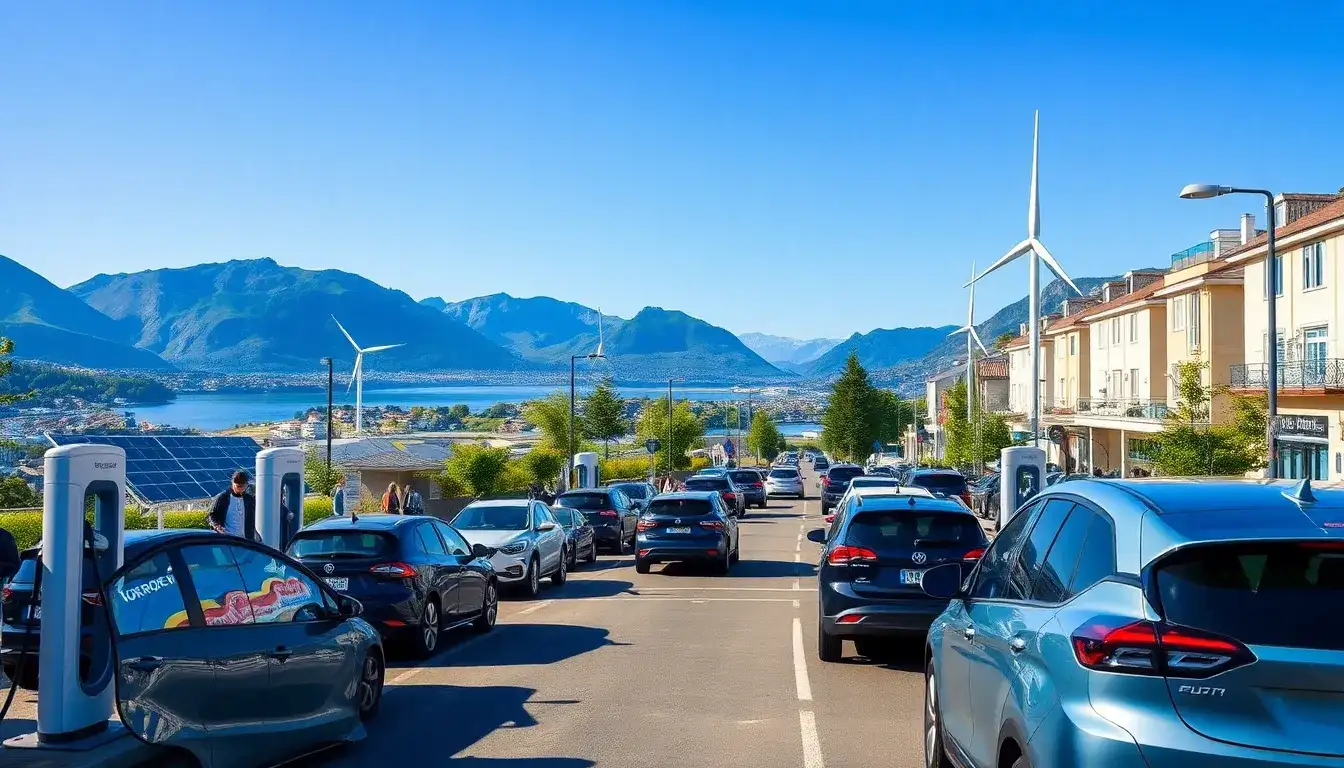
Why Does Norway, Where 97% of New Cars Are Electric, Not Experience Range Anxiety?
According to a report by The Washington Post published on May 31, 2025, range anxiety, the concern over how far an electric vehicle can travel on a single charge, is a significant issue, particularly in cold climates. However, in Norway, where nearly all new cars sold are electric, the question arises: how do they manage to overcome this anxiety?
Just a few years ago, electric vehicles (EVs) were a rarity in Norway. In the remote areas north of the Arctic Circle, the population of reindeer even surpasses that of humans. With winter avalanches capable of burying roads and weeks of darkness, range anxiety was even more pronounced.
97% of New Cars Are Electric
Today, however, nearly all new cars sold in Norway are electric, including in the northernmost county of Finnmark. Christina Bu, head of the Norwegian Electric Vehicle Association, admits that Norway “does not seem like a place where a transportation revolution would happen.”
In Alta, the largest city in Finnmark, Orjan Dragland, a sales representative at a Škoda dealership, is amazed by this transformation. Five years ago, every car in the showroom was powered by an internal combustion engine, but now the entire inventory consists of electric vehicles. In 2024, nearly 90% of the new passenger cars sold in Norway are expected to be fully electric, with the figure reaching 97% just last month. In contrast, electric vehicles accounted for only 8% of new car sales in the U.S. last year, 13% in the Eurozone, and 27% in China.
How to Alleviate Journey Anxiety?
Gjermund Pleym Wik, an electric vehicle advocate, has even organized EV caravans to traverse the remote northern mountains to ease concerns about range. “Yes, you do need to stop to charge, but it’s manageable,” he said while pointing to a blue display board map at Alta’s largest charging station.
Norway is a long, narrow country with approximately 60,000 miles of roads winding through fjords and mountainous terrain. Wik, who currently works in public health, admits he once miscalculated a trip distance and had to borrow a stranger’s Christmas lights to charge his EV. However, EV supporters argue that this worry is not greater than the fear of running out of fuel in a gasoline-powered car.
To ensure drivers are never too far from a charging point, Norway has made significant efforts. Most people charge their EVs at home, and a legal “right to charge” ensures that residents in apartments can meet their charging needs. Norway has also built an extensive charging network, which is almost entirely powered by renewable energy. According to Lars Lund Godbolt, who manages the government database, there are currently 9,771 fast-charging stations distributed across 1,684 locations nationwide. He noted that the farthest distance between two fast-charging stations in Finnmark is about 80 miles. Government officials claim that Norway has easily surpassed the EU’s target of having a fast-charging station every 60 kilometers (approximately 37 miles) along major roads.
In terms of population size, Norway is comparable to South Carolina in the U.S. However, the density of fast-charging stations differs dramatically. U.S. federal data indicates that South Carolina has only 633 fast-charging stations, or about 11 per 100,000 people, while Norway boasts 174 fast-charging stations per 100,000 people.
The Role of Government
“How did Norway achieve this?” Dragland asked. “It was the government that drove it all.” The Norwegian government played a crucial role in the early development of the charging network. To ensure reasonable spacing of charging stations along major roads, the government provided up to 100% subsidies for the construction costs of certain sites through a competitive bidding process for “charging operators.” Since June 2022, new passenger EV charging stations have transitioned entirely to commercial construction, although the government continues to support charging infrastructure for heavy vehicles.
As the number of charging stations has increased, consumer confidence has grown. With a rising number of electric vehicles on the road, more private companies are willing to take on the risks of building new stations, ensuring stable profits for charging operators due to the large user base.
During a visit to Oslo, a reporter from The Washington Post found that some charging stations even offer Wi-Fi and small cafes serving hot food, providing a comfortable place for users to rest while their vehicles charge.
Barriers to 100% Adoption
In 2017, Norway set a goal to achieve 100% zero emissions for all new cars sold by 2025. This target is now within reach but still falls a few percentage points short. Interviews with locals revealed additional concerns, such as issues with charging apps, long wait times at charging stations, and reduced range in winter conditions. The Norwegian Automobile Federation notes that electric vehicles experience an average range loss of about 20% in cold weather. Using a heat pump for heating the cabin instead of relying directly on the battery can mitigate this issue. One car owner mentioned wearing a full-body snowsuit in extreme cold to conserve power for cabin heating.
21-year-old carpenter Tormod Simonsen expressed hesitation about using his electric vehicle for trips to the mountains. “I’ve been stuck many times—due to road closures and avalanches,” he said while refueling his Volvo at a gas station in Alta. “If it’s just driving around town, that’s fine. But going up the mountain? You need to trust your vehicle.”
Original article by NenPower, If reposted, please credit the source: https://nenpower.com/blog/norways-electric-vehicle-revolution-how-97-of-new-cars-overcome-range-anxiety/

