

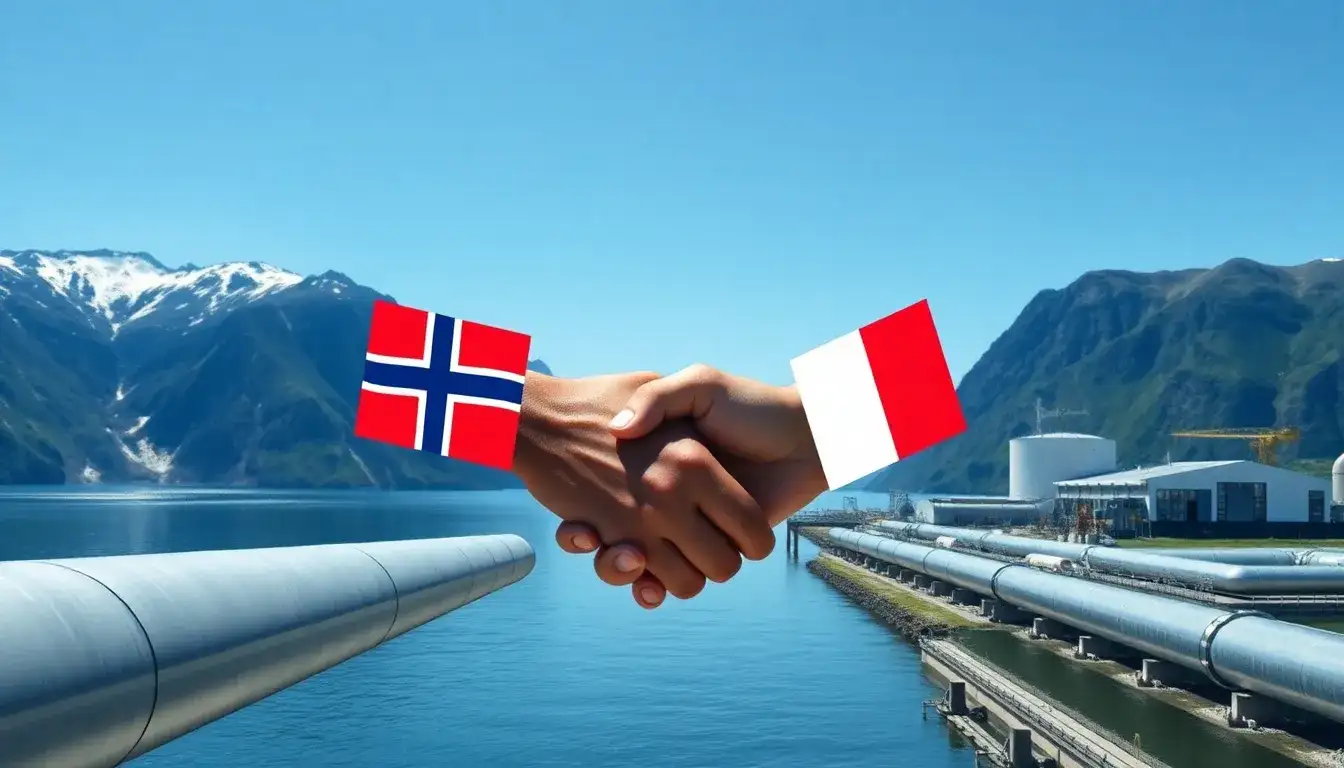
Norway and France Establish Arrangement for Cross-Border CO₂ Transport and Storage
—
On June 23, 2025, Norway and France signed a pivotal arrangement to facilitate the transport of CO₂ from French industrial emission sources to secure storage beneath the North Sea seabed. This agreement represents a significant advancement toward creating a unified European market for carbon management.
Minister of Energy, Terje Aasland, emphasized the importance of this initiative, stating, “This arrangement is a breakthrough for European climate cooperation. It demonstrates how we can work together to find practical solutions for cutting emissions and securing the future of industry in a low-carbon society.”
### Strengthening Bilateral Cooperation
The agreement was formalized in Oslo by Minister Aasland and Éric Lombard, France’s Minister of Economy and Finance. It will enable the transport of CO₂ from major French industrial hubs, including Le Havre, Dunkirk, and Saint-Nazaire, to designated storage sites on the Norwegian continental shelf.
This arrangement adheres to the London Protocol and European Union regulations regarding carbon storage and emissions trading systems (ETS). Recently, France enacted necessary legislative changes in its National Assembly to support cross-border CO₂ transport, highlighting its significance as a priority for President Emmanuel Macron.
The agreement builds upon the 2022 Letter of Intent between the two nations and is part of a broader green industrial partnership. The written arrangement is accessible in both English and French.
### Boosting the European CCS Market
This collaboration enhances the management of French emissions through permanent offshore storage in the North Sea and fosters the development of an integrated European market for carbon capture and storage (CCS). The agreement offers predictability for the future expansion of storage capacity on the Norwegian continental shelf.
### Background
To date, the Ministry of Energy has issued 12 exploration licenses and one exploitation license (held by Northern Lights) for CO₂ storage on the Norwegian continental shelf, with an additional exploration license also offered. The realization of these projects presents opportunities for major CO₂ emitters to invest in carbon management.
The Longship project, initiated on September 21, 2020, is the Norwegian government’s flagship initiative for carbon management. It illustrates how CO₂ can be captured from industrial sources, transported, and securely stored beneath the seabed. CO₂ is captured at the Heidelberg Materials’ cement plant in Brevik and Hafslund Celsio’s waste-to-energy facility in Oslo. Once captured, the CO₂ is liquefied and transported via specialized ships to the Northern Lights facility in Øygarden, near Bergen. There, it is injected and permanently stored 2,600 meters below the seabed in the North Sea.
Northern Lights JV DA—a joint venture involving Equinor, Shell, and TotalEnergies—manages the transport and storage operations. The Longship project is now operational, with the first shipment of CO₂ transported from Brevik to Øygarden in June 2025. Injection into the subsea reservoirs is expected to commence in August 2025.
In its initial phase, Northern Lights has the capacity to store 1.5 million tons of CO₂ annually, and the Ministry has approved a development plan for a second phase that will boost this capacity to over 5 million tons per year.
Original article by NenPower, If reposted, please credit the source: https://nenpower.com/blog/norway-and-france-launch-agreement-for-cross-border-co2-transport-and-storage/

