

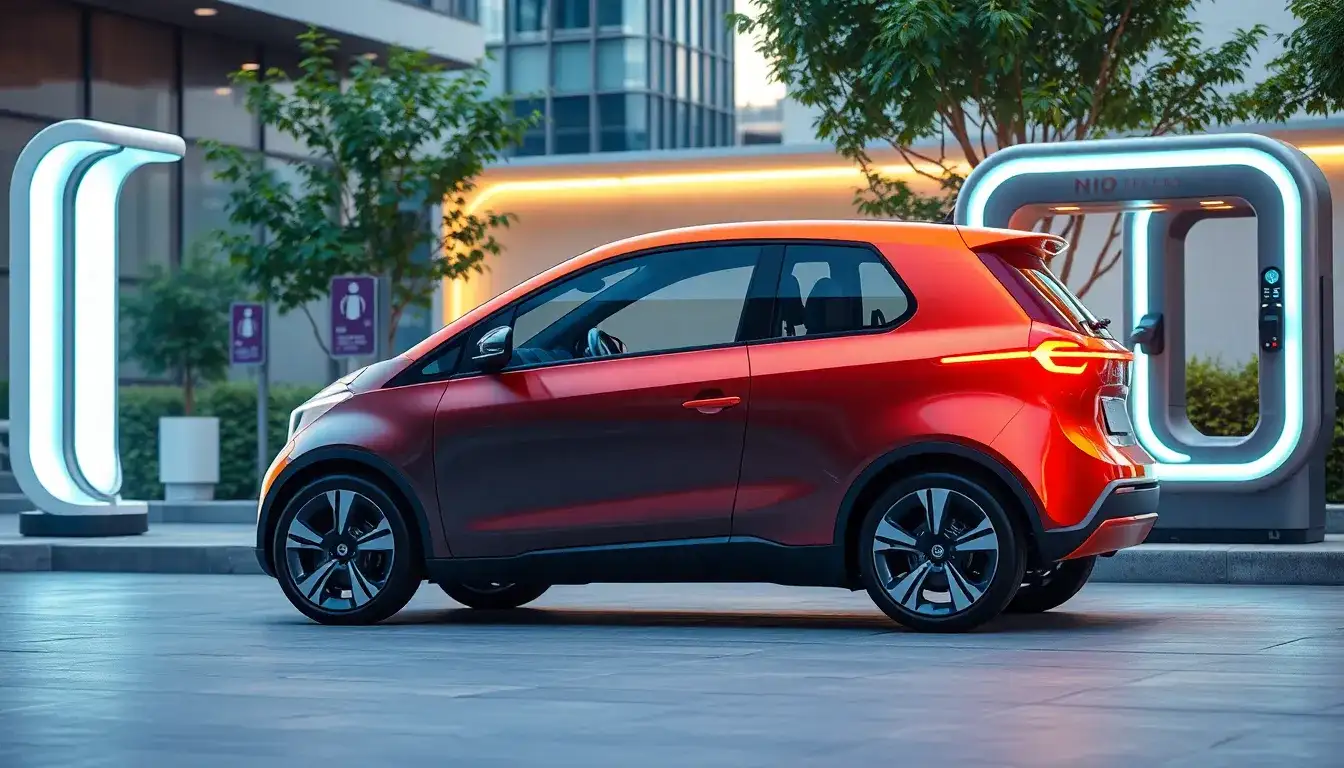
On April 19, 2025, NIO launched its new brand, Firefly, with the release of its first model of the same name. The new vehicle is available in two design styles: the “Free” version priced at 119,800 yuan and the “Glow” version at 125,800 yuan, reflecting a price reduction of up to 29,000 yuan compared to the previously announced figures. According to official sources, Firefly has established a presence in over 300 NIO stores across the country, with deliveries set to commence on April 29.
Firefly marks the third brand introduced by NIO, following NIO and the more affordable Lado brand. It is positioned as a key player in NIO’s strategy to expand its market share. Jin Ge, the president of Firefly, stated that the brand will fully integrate into NIO’s service system, supporting a model that is “chargeable, swappable, and upgradeable.” The Battery-as-a-Service (BaaS) rental program will launch on August 1, and Firefly plans to connect to NIO’s fifth-generation battery swap stations by early next year.
The announcement indicates a new direction for Firefly’s battery swap services. A month ago, NIO Chairman Li Bin stated that Firefly would establish its own battery swap stations, which would not share facilities with NIO or Lado models, but instead create a dedicated system that is smaller and more cost-effective. In March, NIO signed a strategic cooperation agreement with CATL, indicating that future Firefly models would adopt CATL’s chocolate battery swap standards and network.
Last year, NIO launched the Lado brand to penetrate the market with lower-priced offerings, but Lado’s sales have been gradually increasing. In the first quarter of this year, Lado delivered 5,912, 4,049, and 4,820 vehicles, falling short of the 20,000 target. Consequently, NIO has recently made adjustments to Lado’s management team. The launch of Firefly is seen as a new opportunity for NIO to boost its sales figures significantly. Compared to Lado, Firefly’s positioning and pricing aim to attract an even broader customer base.
Li Bin previously likened Firefly’s positioning within NIO to that of BMW’s MINI brand or Mercedes-Benz’s smart brand, stating that “Firefly is smarter than MINI and more compact than smart.” The domestic electric vehicle market shows significant potential for small electric vehicles. According to the China Passenger Car Association, the penetration rate of new energy in the A0 segment is expected to reach 68.7% by 2024. In March alone, A0 pure electric vehicle sales reached 177,000, capturing 25% of the pure electric market.
In light of the opportunities in the small electric vehicle segment, several car manufacturers, including BYD, Geely, Wuling, Chery, Aion, and Dongfeng, have introduced corresponding products. Models like the BYD Seagull, Geely Xingyuan, and Wuling Bingo have shown strong market performance, with both Seagull and Xingyuan selling over 30,000 units in March. Most of these vehicles are priced below 100,000 yuan, with some starting around 60,000 yuan.
Firefly aims to sell only one model in the domestic market, which will face stiff competition upon its launch. Its strengths compared to competitors include providing Firefly owners with the same sales services as NIO owners, along with the option to experience battery swapping. Additionally, Firefly boasts advanced intelligent driving capabilities, featuring 128 TOPS of computing power and 24 high-performance perception hardware components. The intelligent navigation assistance system covers 99% of highways and urban expressways.
Furthermore, Firefly plans to expand into international markets, with aspirations to become a global brand representing NIO. Li Bin noted that due to limited domestic market capacity, achieving monthly sales of 50,000 to 60,000 units may be challenging, but in Europe, the annual demand for small vehicles is as high as 4 million, offering substantial growth potential for Firefly.
Firefly aims to enter 25 countries by 2025, contributing to NIO’s sales and profits through international expansion. Jin Ge emphasized that Firefly will not negatively impact NIO’s gross profit; rather, it aims to make a positive contribution. According to the latest plans, NIO is targeting profitability by the fourth quarter of 2025, with a delivery goal of approximately 440,000 vehicles for that year.
Recently, NIO announced its financial performance for the fourth quarter and full year of 2024, projecting revenues of 65.73 billion yuan, a year-on-year increase of 18.2%. Of this, the automotive revenue is expected to reach 58.2341 billion yuan, with a gross profit of 6.493 billion yuan and a gross margin of 9.9%. In the first quarter of this year, NIO delivered 42,000 new vehicles, a 40.1% increase year-on-year. Alongside Firefly, NIO will also introduce several new models, including the ET9, throughout the year.
Original article by NenPower, If reposted, please credit the source: https://nenpower.com/blog/nio-launches-firefly-brand-targeting-compact-electric-vehicle-market-with-new-model-and-battery-swap-integration/

