

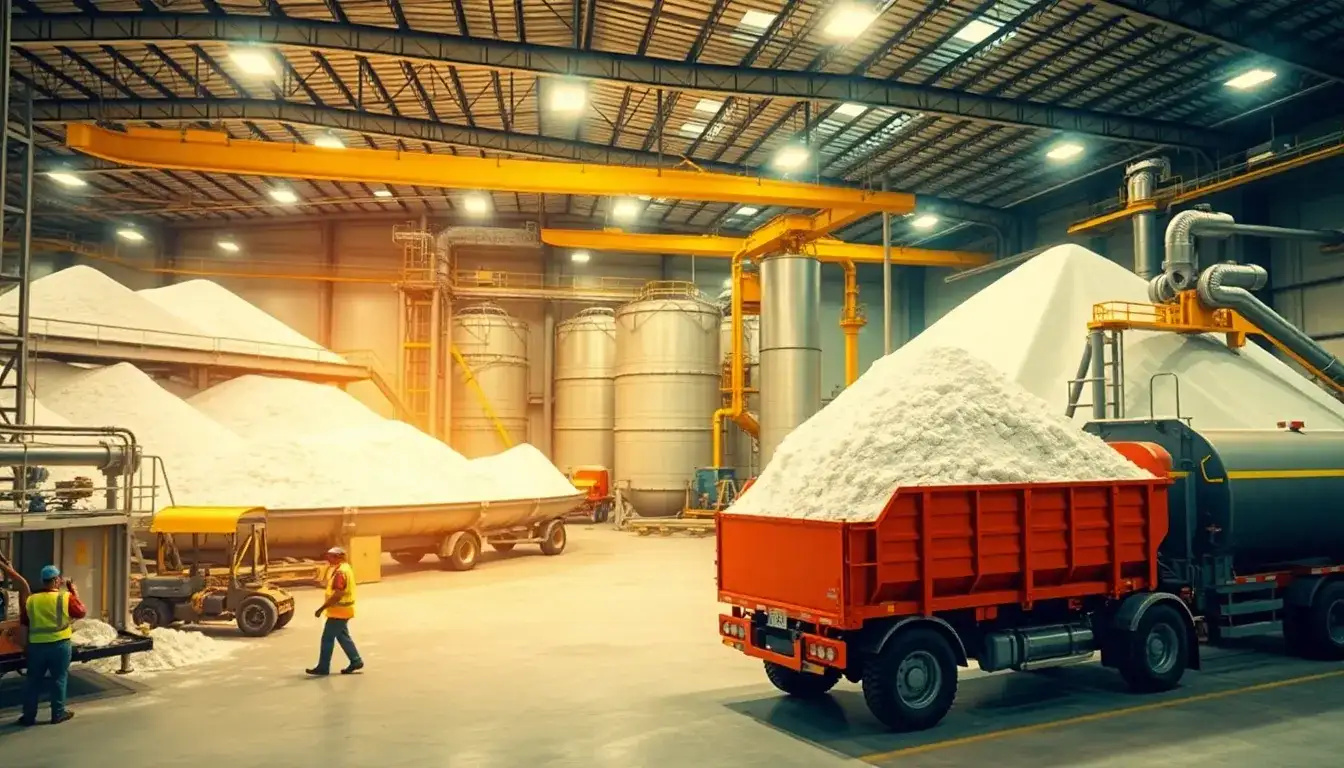
Ningde Times’ Phosphate Lithium Production Reaches Explosive Growth, Approaching 1 Million Tons
On April 8, 2025, Ningde Times announced that its phosphate lithium production capacity has entered an explosive growth phase. Recently, a significant project launch event was held in Yichang City, marking the commencement of the Bangpu Next-Generation Battery Cathode Material Project. This project has a total investment of 5.6 billion yuan and employs industry-leading fourth-generation phosphate lithium technology. It plans to establish three workshops for phosphate lithium with the largest single-unit capacity in the country. Once fully operational, this facility is expected to generate an annual output value of 14.5 billion yuan, which will further enhance Ningde Times’ self-sufficiency in phosphate lithium and secure its supply of battery materials, thereby supporting the development of a full-cycle battery industry chain.
1. Ningde Times’ Phosphate Lithium Capacity Surges
Driven by the rapid growth of global new energy vehicles and energy storage markets, phosphate lithium has emerged as a central player in the global new energy sector. As a leader in the lithium battery industry, Ningde Times’ layout of phosphate lithium materials is crucial not only for its competitive edge but also for the overall dynamics of the global power battery industry. Currently, Ningde Times has three major phosphate lithium projects in operation, totaling a capacity of 770,000 tons.
The first project is a phosphate lithium production base established in Jintang County, Chengdu in 2021, with an annual production capacity of 100,000 tons. This base serves as a primary supply source for phosphate lithium battery raw materials for Ningde Times’ Sichuan operations.
The second project, launched in Yichang in 2021, is the Bangpu Integrated New Energy Industrial Project. This expansive facility is set to produce 360,000 tons of phosphate iron, 220,000 tons of phosphate lithium, 180,000 tons of ternary precursors and materials, 40,000 tons of lithium cobalt oxide, 40,000 tons of recycled graphite, and 300,000 tons of battery recycling capacity, with full production expected by 2025.
The third project, the new-generation phosphate lithium project, was initiated following an investment agreement signed by the Yichang municipal government and Yichang Bangpu Times New Energy Co., Ltd. in January 2025. This project aims to produce 450,000 tons of new-generation phosphate lithium products, with production scheduled to commence in 2026.
However, for Ningde Times, which is aggressively promoting phosphate lithium batteries, this capacity is still insufficient. An announcement from Longpan Technology earlier this year indicated that it expects to engage in sales transactions with Ningde Times worth up to 7 billion yuan and procurement transactions not exceeding 1.32 billion yuan in 2025. Based on the current price of phosphate lithium at 33,400 yuan/ton, these orders could correspond to approximately 210,000 tons of phosphate lithium. Additionally, according to a cooperation agreement with Fulin Precision, Ningde Times has committed to purchasing at least 140,000 tons of phosphate lithium materials annually from Jiangxi Shenghua between 2025 and 2027, with Jiangxi Shenghua promising to achieve an annual production capacity of 75,000 tons of phosphate lithium cathode materials. As a result, Ningde Times’ total “self-built + ordered” phosphate lithium capacity is now approaching 1 million tons.
What Does 1 Million Tons Represent?
Calculating that 1 GWh of battery cells requires between 2,200 to 2,500 tons of phosphate lithium cathode material, this capacity can support the production of between 400 GWh and 454 GWh of phosphate lithium batteries. This not only strengthens Ningde Times’ influence in the lithium material sector but also helps the company maintain a high gross margin on battery sales. According to annual reports, Ningde Times expects a 5.8 percentage point increase in gross margin for power batteries to 23.9% and an 8.2 percentage point rise for energy storage batteries to 26.8%, resulting in an overall sales gross margin of 24.4%, a year-on-year increase of 1.5 percentage points.
2. High-Density Products Facing Supply Shortages
It is noteworthy that, unlike the Chengdu Jintang base and Yichang industrial park projects, Ningde Times’ latest project focuses on fourth-generation phosphate lithium products, also known as high-density phosphate lithium. Agreements made with Longpan Technology and Fulin Precision are likely related to high-density phosphate lithium. While high-density phosphate lithium is not a completely new concept, it represents an evolved form of phosphate lithium. Generally, higher pressed density in cathode materials leads to increased energy density without changing the volume. Currently, mainstream phosphate lithium products are classified into second, third, and fourth generations, with corresponding pressed densities of 2.4 g/cm³, 2.5 g/cm³, and 2.6 g/cm³. Products with a pressed density of 2.6 g/cm³ or above are defined as high-density products in the market.
High-density products enhance both energy density and charging rates by increasing the packing amount of active materials within a unit volume. They are primarily used in mid- to high-end power and energy storage battery products, including ultra-fast charging batteries and energy storage batteries with capacities exceeding 300 Ah. Currently, demand for fourth-generation high-density phosphate lithium mainly stems from ultra-fast charging battery products. Following Ningde Times’ plans, the proportion of fast-charging battery products, including the Shunxing ultra-fast charging battery, is expected to exceed 70% in 2025, indicating a significant increase in demand for high-density phosphate lithium.
However, high-density phosphate lithium products impose higher requirements for the preparation of precursor phosphate iron and the particle size ratios of materials, resulting in a sustained tight supply-demand relationship. Industry reports predict that demand for high-density phosphate lithium products will reach 730,000 tons in 2025, with supply estimated at 780,000 tons. Some industry insiders have humorously noted that “the fourth-generation phosphate lithium production line of a leading enterprise in Central China is already ‘smoking’.” High-density products have become a battleground for competition. Currently, Fulin Precision has publicly stated that its high-density phosphate lithium products have gained recognition from core customers and leading manufacturers. Longpan Technology’s Changzhou Lithium Source has launched a fourth-generation high-density phosphate lithium product, S501, with a powder pressed density of 2.65 g/cm³, accounting for 30% to 40% of all its phosphate lithium cathode materials. As supply-demand relationships improve and new products continue to evolve, the profitability of relevant companies is expected to optimize, allowing phosphate lithium batteries to find applications in more areas and further expand their market share.
Conclusion
Amid the rapid growth in the new energy sector, each iteration of lithium battery technology resonates with the pulse of the global energy revolution. As the lithium battery technology path undergoes diversification and deep innovation, the upgrading and modification of key cathode and anode materials will be the driving force behind this evolution. The competition for high-density phosphate lithium represents a crucial battle, and Ningde Times is laying the groundwork for its competitive edge in the coming decade through its grasp of next-generation materials.
Original article by NenPower, If reposted, please credit the source: https://nenpower.com/blog/ningde-times-lithium-iron-phosphate-production-surges-towards-1-million-tons-by-2025/

