

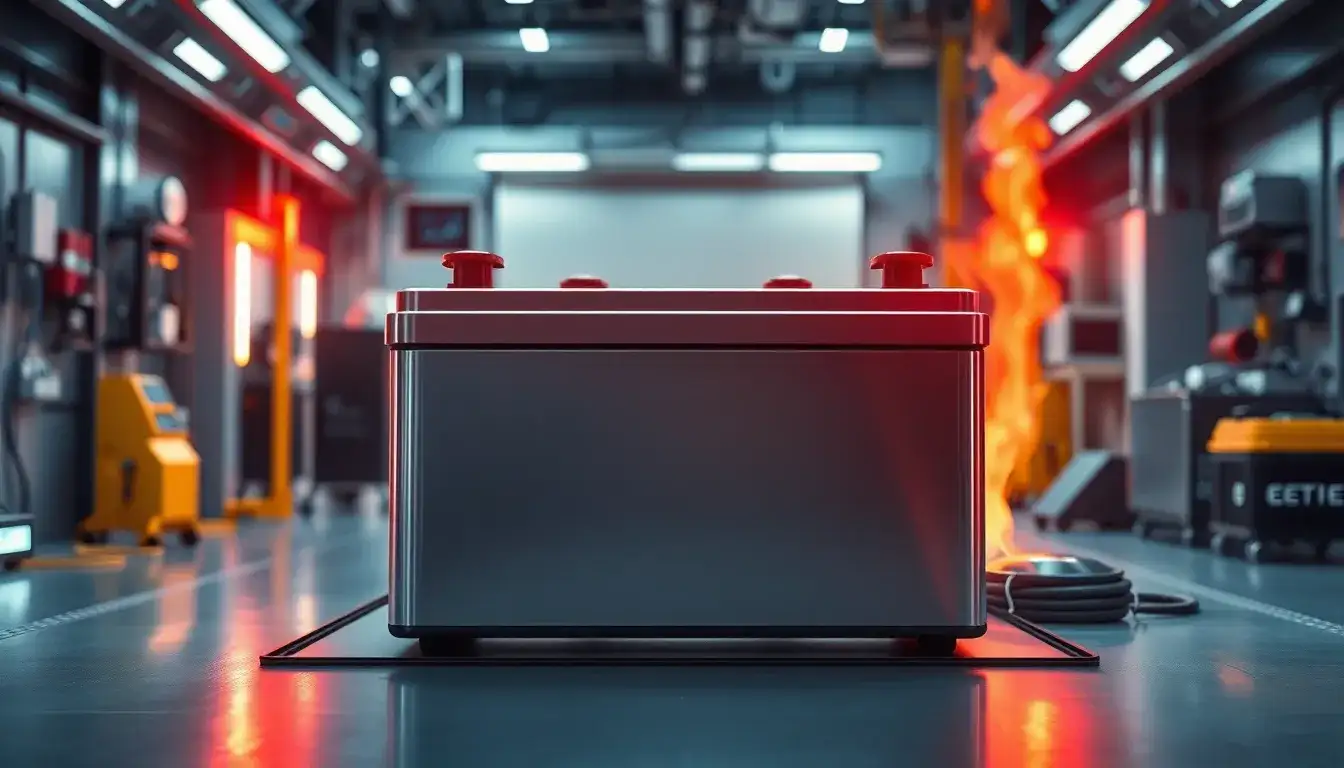
Self-Extinguishing Electric Vehicle Batteries on the Horizon?
Date: April 17, 2025
Views: 4,843
Automotive Business Review – The leading publication for automotive insights.
By: Carla Westerheide, Max McDee, and Zhao Haoran
Thermal runaway—a chain reaction triggered by internal short circuits, overcharging, or mechanical damage to batteries—has long been regarded as the “Achilles’ heel” of electric vehicle safety. According to data from the National Emergency Management Agency, in 2024, battery damage due to chassis impacts accounted for 37% of electric vehicle fire incidents, while fast charging was responsible for 21%. Several serious accidents involving explosive fires after collisions have heightened public anxiety regarding electric vehicle safety.
This week, Hyundai Mobis, South Korea’s largest automotive parts manufacturer, announced the development of a new technology designed to automatically extinguish fires within electric vehicle batteries. This system works by preventing heat transfer to adjacent batteries, thereby helping to avoid thermal runaway. Last year, South Korea witnessed numerous electric vehicle fires, making battery safety a primary concern. In August, a fire in an apartment parking lot in Incheon lasted for eight hours and destroyed over 100 vehicles.
The new system from Hyundai Mobis releases fire extinguishing agents when a battery unit catches fire. The company states that the design aims not only to delay thermal runaway through heat-resistant materials, but also to comply with stricter safety regulations by preventing heat transfer between battery units from the outset. Major global markets, including Europe, China, and India, now mandate that thermal runaway in electric vehicle batteries must be delayed by at least five minutes after the initial ignition of a battery unit. Some countries are strengthening regulations to prioritize the prevention of thermal runaway, ensuring that passengers have ample time to exit the vehicle safely after a collision.
Hyundai Mobis claims that its new Battery System Component (BSA) possesses single-cell fire suppression capabilities that meet the aforementioned standards and is expected to be integrated into the next generation of BSAs for the global market. This new BSA is equipped with a battery management system (BMS), fire extinguishing device, and hardware for the battery casing.
The system analyzes real-time data collected from sensors, including the battery’s temperature, voltage, and internal pressure, to detect any anomalies. It then determines the optimal location for spraying the extinguishing agent and activates the fire suppression device, as explained by Hyundai Mobis. Additionally, the software is designed to address changes within the battery system, making “rapid and accurate decisions.” To prevent costly false activations, it employs multiple safety mechanisms and redundant algorithm architectures. The company has applied for three domestic and international patents for the components of this system, including the fire suppression device.
Currently, Hyundai Mobis has not detailed how this system will be integrated into the battery casing, nor has it disclosed the additional weight or space required for the suppressant tank and delivery system. A news image shows the fire suppression device installed above a module containing square batteries, but it remains unclear whether this aligns with the final design. The specific composition of the extinguishing agent has not been revealed, although the company notes that it possesses “excellent cooling, insulation, and penetration properties,” and is safe for both human health and the environment. The quantity of onboard extinguishing agents has also not been disclosed, but Hyundai Mobis claims its extinguishing capacity is five times that of a standard 3.3 kg household fire extinguisher.
Park Yong-jun, Vice President of Hyundai Mobis’s Battery System R&D Group, stated, “As larger electric vehicles with extending ranges emerge, the safety standards for battery systems are becoming increasingly stringent. We will integrate hardware and software to develop advanced battery systems that meet or even exceed global standards, launching them into the global market.” The company also mentioned that it has recently developed a new material designed to prevent battery overheating, which is currently in the process of commercialization. This material, named “Pulsating Heat Pipe,” consists of aluminum alloy and refrigerant, and placing it between battery units can lower the internal temperature of the battery system. It is expected to be used as a thermal management system, which will help maintain battery cooling during fast charging, thereby extending battery life and enhancing performance.
Original article by NenPower, If reposted, please credit the source: https://nenpower.com/blog/new-self-extinguishing-electric-vehicle-battery-technology-set-to-revolutionize-safety-standards/

