

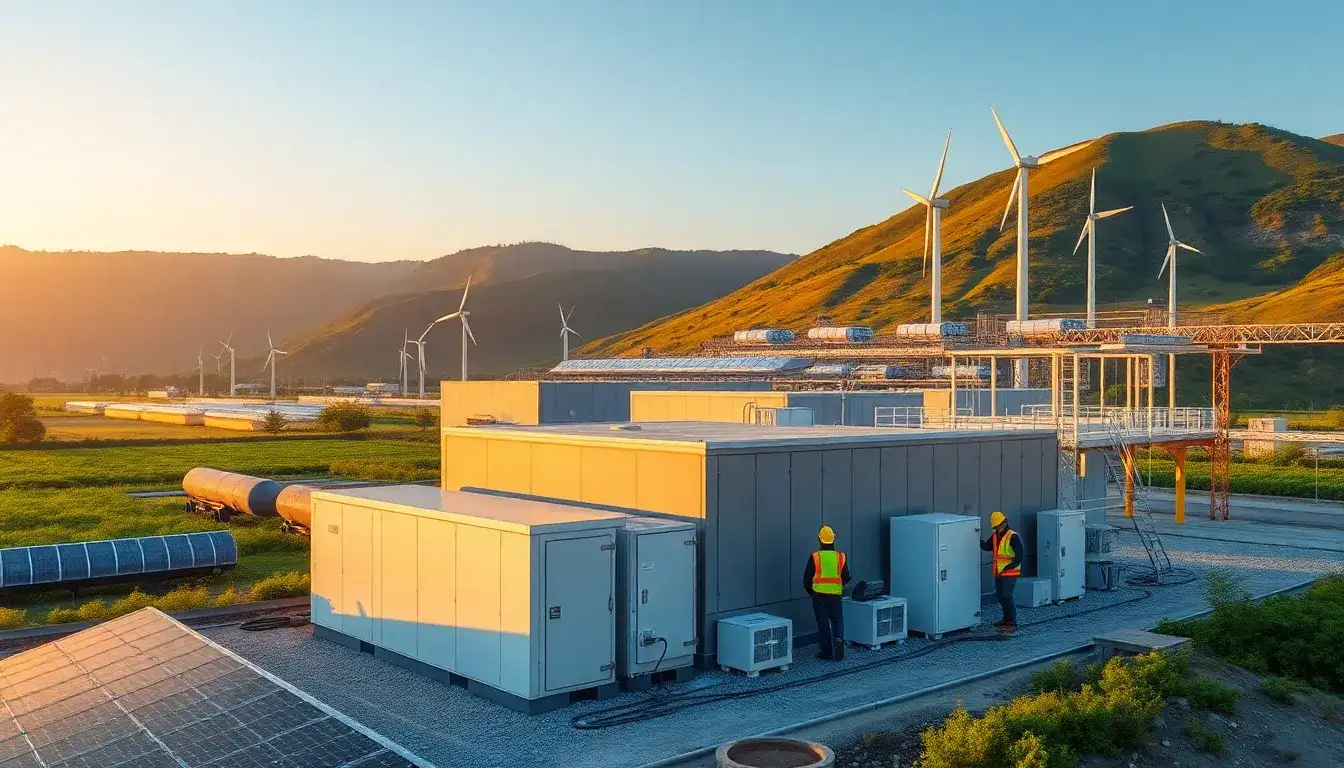
Recently, the National Development and Reform Commission and the National Energy Administration jointly issued the “Action Plan for the Scaled Development of New Energy Storage (2025-2027)” (hereinafter referred to as the “Action Plan”). This plan aims for new energy storage to achieve basic scaled and market-oriented development by 2027. It emphasizes that the level of technological innovation and equipment manufacturing capabilities should remain at the forefront globally. The market mechanisms, business models, and standards system should be well-established and mature, leading to the initial formation of a diverse energy storage system that supports the stable operation of the new power system. This initiative will provide strong support for the green transformation of energy.
Since the beginning of the 14th Five-Year Plan, new energy storage has been developing rapidly. By the end of 2024, the total installed capacity of new energy storage in the country reached 73.76 million kilowatts. With the fast development of new energy sources, the pressure for system peak regulation and power supply assurance is continuously increasing. As an important resource for flexibility adjustment, the role of new energy storage is becoming increasingly prominent.
On September 15, China’s first regional energy storage peak regulation system was established in Jiangsu. This system integrates various forms of energy storage peak regulation technologies, including centralized new energy storage, scientifically coordinated pumped storage, and backup from electric vehicles, effectively stabilizing fluctuations in grid load. Jiangsu, as an economic powerhouse and major energy consumer, has a maximum electricity load that has exceeded 156 million kilowatts. With over 100 million kilowatts of new energy connected to the grid, electricity pressure is low during the day when solar generation is high, but it surges dramatically in the evening when solar output drops.
“This sharp rise and fall in load characteristics poses significant challenges to the safe operation of the power grid,” said Qiu Chengguang, Director of the Dispatch Control Department at the State Grid Jiangsu Electric Power Company. “Building a large-scale, multi-faceted energy storage peak regulation system is of great significance for Jiangsu.”
Even before the full completion of this regional energy storage peak regulation system, it has already demonstrated significant capabilities. During this summer’s peak season, the State Grid Jiangsu Electric Power utilized this system to call on various energy storage resources over 14,000 times, with a total charging and discharging volume exceeding 2.5 billion kilowatt-hours. The maximum peak regulation power exceeded 10 million kilowatts, equivalent to adding ten new 1 million kilowatt coal-fired power units, capable of meeting the grid’s peak regulation requirements at different times and for varying demands. It is predicted that this system could facilitate the consumption of over 3.8 billion kilowatt-hours of new energy annually, equating to a reduction of 1.11 million tons of standard coal consumption and a decrease of 2.78 million tons of carbon dioxide emissions.
To promote the high-quality development of the new energy storage industry, there is an urgent need to further clarify measures related to the expansion of new energy storage applications, innovation integration, and market mechanisms. According to relevant officials from the National Energy Administration, while ensuring effective alignment with the 15th Five-Year Plan for energy, it is essential to coordinate the planning and construction of new energy consumption, power supply assurance needs, and various regulatory resources. The development targets for new energy storage from 2025 to 2027 are being researched, with expectations for an additional installed capacity of over 100 million kilowatts nationwide within three years, reaching over 180 million kilowatts by the end of 2027. The technology routes and application scenarios for new energy storage will be further enriched, fostering a number of pilot application projects and establishing typical application scenarios to robustly support the green and low-carbon transformation of energy and the high-quality development of the economy and society.
To better adapt new energy storage to the construction of a unified national electricity market, the “Action Plan” proposes accelerating the improvement of market mechanisms. This includes promoting the integration of “new energy + storage” as a joint bidding entity in electricity market transactions, encouraging regions to research and explore auxiliary service varieties such as ramp-up and inertia based on local conditions, and improving the pricing mechanisms for the capacity of regulatory resources like new energy storage.
Original article by NenPower, If reposted, please credit the source: https://nenpower.com/blog/new-phase-in-the-large-scale-development-of-advanced-energy-storage-in-china/

