

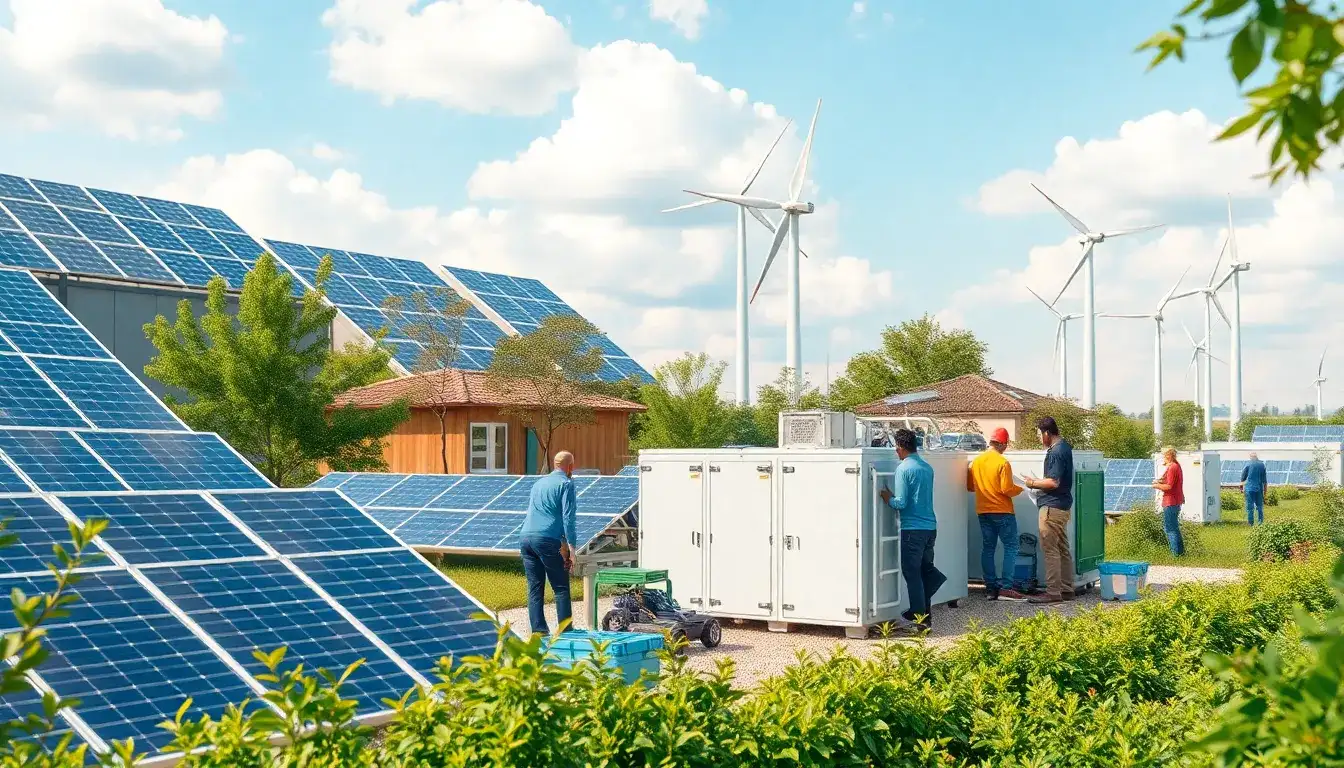
Recently, two regions have taken steps to reduce the burden on new energy projects by explicitly encouraging and allowing voluntary energy storage solutions. The Management Committee of the New Station High-tech Industrial Development Zone in Hefei, Anhui Province, issued a notice seeking public feedback on the “Implementation Opinions for Promoting High-Quality Development of New Energy Storage” (hereinafter referred to as “Opinions”). By 2025, the new energy storage industry is expected to generate revenue of no less than 30 billion yuan, with a cumulative installed capacity of at least 80,000 kilowatts. By 2028, revenue is projected to reach 50 billion yuan and the cumulative installed capacity should not be less than 100,000 kilowatts.
The Opinions focus on three key areas: the power source side, the grid side, and the user side. On the power source side, the New Station High-tech Zone will coordinate gas-fired power generation and “integrated wind-solar-storage” projects to enhance the utilization of renewable energy and the grid’s capacity to accommodate it. New energy projects that meet certain conditions are encouraged to build their own storage facilities, while those that do not can fulfill their storage requirements through purchasing or leasing arrangements.
On the grid side, priority will be given to constructing large independent storage power stations at hub nodes where there is a significant electricity gap, noticeable load fluctuations, and insufficient power support. In key sections of the grid where renewable energy is concentrated, appropriate and reasonable storage capacity will be configured. Independent storage entities are encouraged to participate in spot market trading and provide ancillary services for peak shaving and frequency regulation.
On the user side, businesses and industrial parks that have high electricity demand and require reliable power supply, such as large data centers, are encouraged to build user-side energy storage systems as needed to manage peak loads and energy consumption. Support will also be provided for large parking lots and logistics parks to develop operational models such as “distributed + storage,” “microgrid + storage,” and “solar-storage-charging integration.”
In Inner Mongolia, the Wuhai Energy Bureau recently issued a notice regarding the development and construction plan for decentralized wind and distributed solar projects for 2025. The notice states that the development of distributed renewable energy projects will adhere to the principles of “local adaptation, proximity to consumption, and integrated development,” giving priority to applications in rural revitalization, industrial parks, and public facilities.
Distributed renewable energy projects are to be prioritized in areas with mature access conditions and strong consumption capacity, and should connect to the grid at voltage levels of 110 kV or below, without stepping up for external delivery. Additionally, storage capacity should be configured on a voluntary basis, allowing for flexible selection of storage ratios, and encouraging the adoption of shared storage models.
The plan indicates that distributed solar projects for non-natural persons, general commercial entities, and large commercial enterprises must undergo third-party assessments of rooftop load capacity before implementation. Furthermore, projects must commence construction within six months after approval, and the construction period should be less than twelve months. After being connected to the grid, project information must be recorded on the National Renewable Energy Information Management Platform. Projects that fail to connect to the grid within the stipulated time will be subject to timely cancellation by the respective district energy bureaus.
Original article by NenPower, If reposted, please credit the source: https://nenpower.com/blog/new-initiatives-in-two-regions-to-support-renewable-energy-projects-with-encouraged-and-voluntary-energy-storage-solutions/

