

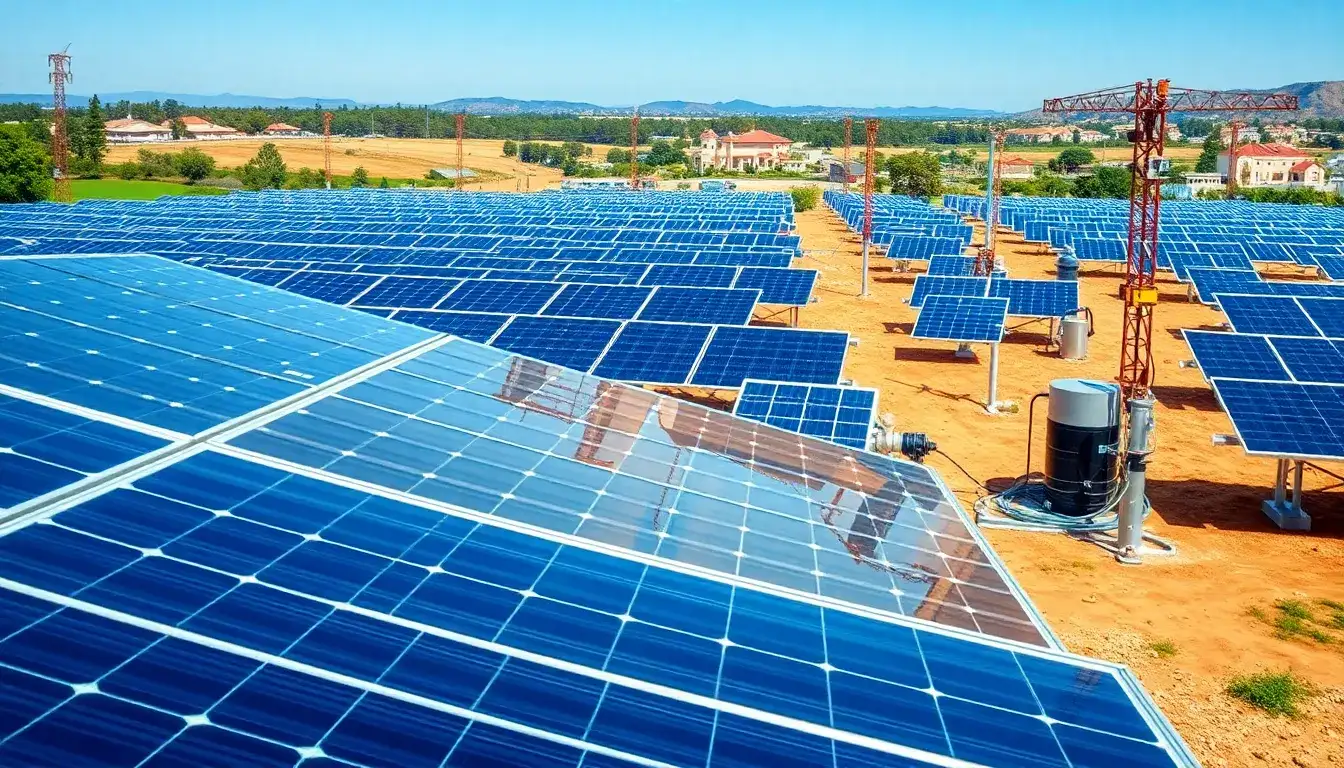
The solar market is in urgent need of new industry standards to foster technological innovation, according to Marcel Suri, CEO of Solargis. As the solar industry has experienced a significant technological and financial transformation in recent years, the introduction of advanced technologies—including bifacial modules, intelligent trackers, and battery storage systems—has marked a new global era of solar market innovation. However, this advancement requires greater precision in photovoltaic (PV) simulations, which is often hindered by outdated datasets.
To address these challenges, Suri identifies three critical areas where new standards could enhance efficiency, accuracy, and market resilience.
### 1. New Data Standards to Address Extreme Weather and Variability
Currently, most PV project developers rely on Typical Meteorological Year (TMY) data for simulations and system design. TMY data aggregates historical data into a “typical” year, which represents average patterns of solar radiation, air temperature, and wind speed. However, it fails to consider extreme weather events and the three significant types of variability: short-term (intra-hourly), interannual (seasonal), and long-term cycles, including climate change.
TMY datasets typically have an hourly resolution, which can lead to inaccurate performance estimates. While TMY data may be useful for preliminary calculations, its shortcomings become apparent during more advanced evaluations. High-resolution Time Series data should be adopted as the new standard to understand these variabilities better.
For instance, short-term variability refers to rapid changes in solar radiation and environmental conditions that can occur within minutes or hours. High-resolution Time Series data breaks down each year into 15-minute intervals, providing over 1 million data points per parameter, as opposed to the mere 8,760 data points used in hourly TMY models. This level of granularity allows for more accurate PV designs and performance evaluations, enabling developers to create bankable and resilient projects in an increasingly unpredictable climate.
### 2. New Modelling Standards to Optimize Bifacial Systems
Bifacial PV modules, which capture sunlight on both sides of the cells, have gained popularity due to their higher energy yields and reduced costs. To fully realize the potential of bifacial technology, the industry must transition from traditional modeling standards to physically based tools that accurately simulate their performance.
Many PV simulation tools currently rely on simplified models that struggle to accurately simulate rear-side solar radiation for bifacial modules. These models often produce inaccurate energy yield estimates, leading to sub-optimal system designs. To address this issue, the industry should adopt new standards that utilize ray tracing and anisotropic sky models, which accurately account for the dynamic behavior of the sky and surrounding surfaces.
By employing accurate site-specific ground albedo data and sub-hourly time series data, developers can gain nuanced insights into energy yields, enabling them to design bifacial systems that meet performance expectations and deliver reliable financial returns.
### 3. Addressing Outdated Component Data Standards
The persistent challenges of outdated approaches, lack of standardization, and unverified technical specifications of PV components are affecting the accuracy of simulations and the overall success of solar projects.
Currently, PV module specifications are stored in PAN files, while inverter specifications are found in OND files. These specifications often lack the depth required for advanced energy simulation software, leading to confusion, inefficiencies, and disputes. Unverified data can skew energy yield estimates and result in flawed designs and financial risks.
To tackle these issues, the industry must implement a verified, standardized PV component database. This database should include validated specifications for PV modules, inverters, and other components, thus supporting modern PV energy simulation approaches. It should also provide a component confidence class, indicating the reliability of the data, and simplify the work for developers, investors, and auditors by offering a trusted source of information.
In conclusion, as the solar industry continues to evolve, embracing new standards in data, modeling, and component specifications is crucial for driving innovation and ensuring the long-term viability of solar projects. By adopting these changes, the industry can enhance its efficiency and resilience in the face of an unpredictable climate and increasing market demands.
Original article by NenPower, If reposted, please credit the source: https://nenpower.com/blog/new-industry-standards-in-solar-energy-to-enhance-technological-innovation-and-efficiency/

