

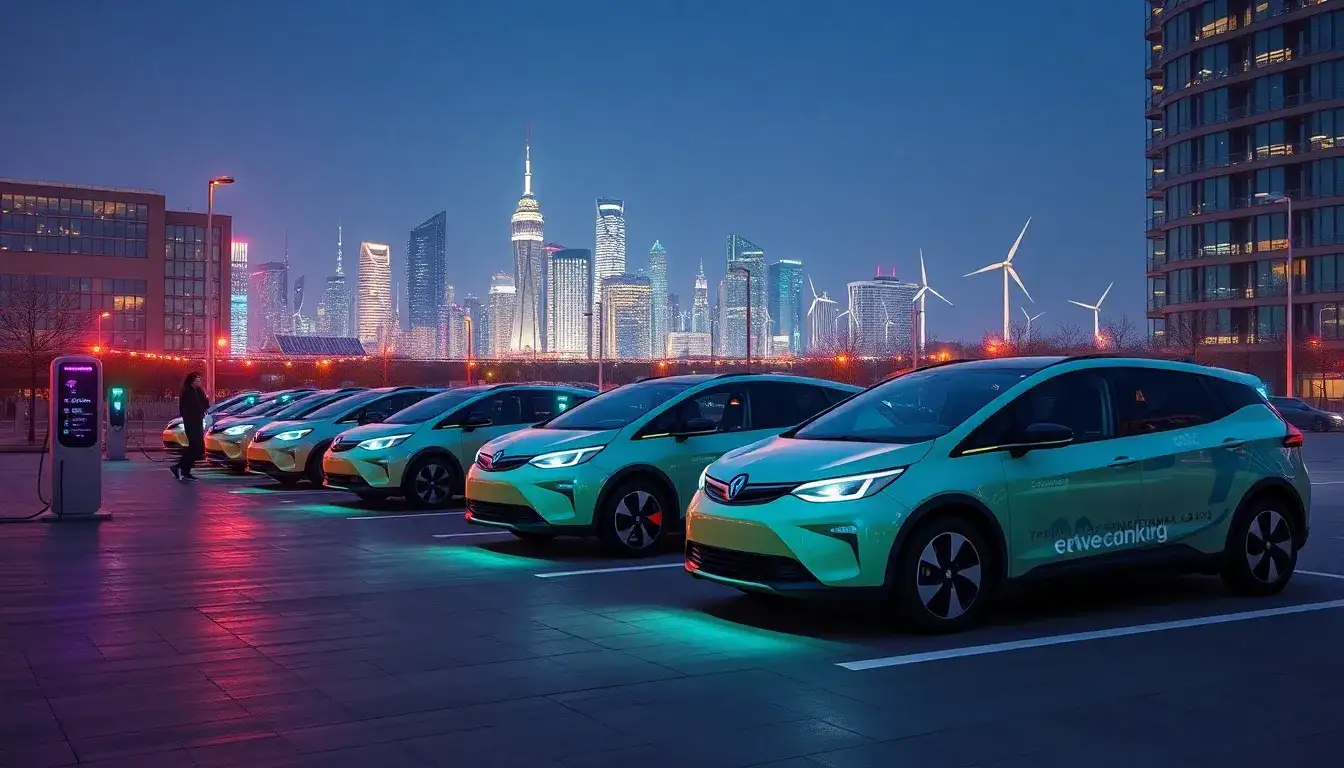
New Energy Vehicles Transform into Urban “Power Banks”
On April 15, 2025, the National Development and Reform Commission, along with the National Energy Administration and other departments, announced the first batch of pilot cities and projects for large-scale vehicle-to-grid (V2G) interaction in China. A total of 39 projects were included, featuring nine cities such as Shanghai, Changzhou, and Guangzhou, as well as 30 projects in Beijing that focus on new energy storage-based V2G coordination.
In simple terms, vehicle-to-grid interaction allows new energy vehicles to act as “power banks,” enabling them to exchange electricity with the grid. With the support of bidirectional charging and discharging technology, electric vehicles can charge during low electricity demand periods and supply energy back to the grid during peak times.
According to data released by the Ministry of Public Security in January, by the end of 2024, the number of new energy vehicles in China is expected to reach 31.4 million. The disorderly charging of these vehicles poses significant challenges to the balance of supply and demand in the power system, highlighting the urgent need for the widespread application of vehicle-to-grid interaction.
Balancing Grid Load
On March 28, a demonstration of vehicle-to-grid interaction took place at a multi-charge station on Huanshi West Road in Nansha, Guangzhou, where an electric car responded to demand for load relief. The charging robot automatically recognized the vehicle, initiated charging, and completed the transaction within 80 seconds.
Meanwhile, at the charging station in Maluan Mountain Leisure Park in Pingshan, Shenzhen, a BYD pure electric heavy truck participated in reverse discharging for the first time. Statistics show that each heavy truck can discharge up to 300 kilowatt-hours, equivalent to the daily electricity consumption of over 30 households or enough to fully charge 15,000 mobile phones.
This event marked the first interprovincial vehicle-to-grid interaction organized by the Southern Power Grid Company. The initiative spanned five provinces and regions—Guangdong, Guangxi, Yunnan, Guizhou, and Hainan—covering 63 cities and involving over 100,000 new energy vehicles, with a total interaction energy exceeding 500,000 kilowatt-hours. Notably, the maximum discharging power recorded at Shenzhen’s Lianhua Mountain Supercharging Station reached 1,052 kilowatts, achieving true megawatt-level V2G interaction and breaking the nationwide single-day reverse discharging record of over 10,000 kilowatt-hours.
Li Minhung, the market director of Southern Power Grid Company, stated that the event facilitated the consumption of 500,000 kilowatt-hours of new energy, equivalent to the daily electricity needs of 50,000 households, while vehicle owners earned over 400,000 yuan. Through various scenarios such as reverse discharging to the grid, intelligent orderly charging, and load relief charging invitations, the feasibility of vehicle-to-grid interaction was thoroughly tested in terms of technology application, business models, and innovation.
Exploring Commercial Scenarios
As electricity consumption and the proportion of installed new energy sources continue to rise, pressure on grid operations is increasing. V2G technology, which can participate in peak shaving and demand response, has garnered significant attention for its commercial application potential. Wang Qi, deputy general manager of Southern Power Grid Electric Vehicle Service Company, emphasized the importance of developing commercially viable applications for the sustainable business model of V2G.
The National Development and Reform Commission’s notice on promoting large-scale vehicle-to-grid application pilots suggests exploring advanced technologies and clear, replicable business models centered around V2G projects, aiming to steer the large-scale development of vehicle-to-grid interaction through market mechanisms.
Several enterprises and institutions have already begun to take action. For example, the Guangzhou Power Supply Bureau, in collaboration with GAC Group, has launched a “city-level benchmark” pilot project for vehicle-to-grid interaction under the “Automobile + Electricity” dual-chain collaboration, which was selected as one of the first large-scale application pilot projects in China. GAC Group has already introduced six models equipped with V2G functionality, achieving sales of over 30,000 units.
Wang Yuyin, deputy director of the Guangzhou Municipal Bureau of Industry and Information Technology, stated that the city will develop supporting policies to encourage local auto manufacturers to enhance the research and sale of V2G vehicles and explore the establishment of an integrated “electricity charge, storage, and discharge” network, promoting the participation of V2G facility users and aggregators in local virtual power plant operations.
Wang Gang, operations director at Nanning Teld New Energy Technology Company, believes that participating in vehicle-to-grid interaction will become a new growth point for businesses, enhancing their competitiveness.
Liu Zhihui, general manager of GAC Energy Technology Company, noted that vehicle-to-grid interaction represents not only a technological breakthrough but also a reconstruction of production relationships, propelling China’s new energy vehicle industry from “capacity output” to becoming a “system solution provider.”
Addressing Promotion Challenges
Despite the promising prospects of vehicle-to-grid interaction, its large-scale application faces three major challenges.
The first challenge is the need to improve the trading market mechanism. “The electricity market requires innovation to accommodate the characteristics of vehicle-to-grid interaction, enabling small-scale and widely distributed resources to effectively participate in market transactions,” said Chen Haoyong, a professor at South China University of Technology. He suggested establishing a mechanism that organically integrates centralized and distributed resources, allowing dispersed new energy vehicle electricity to form a collective for participation in traditional centralized electricity market transactions. Distributed resources like electric vehicles can utilize technologies such as blockchain to implement end-to-end distributed trading and achieve overall coordination between decentralized and centralized trading.
Many regions are currently exploring this area. For instance, Southern Power Grid Company has developed a dual-driven model of “wholesale + retail.” Specifically, on the wholesale side, the grid company achieves market-oriented guidance of the full-scenario response mechanism through load relief charging invitations, V2G reverse discharging, and intelligent orderly charging. On the retail side, operators attract electric vehicle participation in vehicle-to-grid interaction through incentives such as charging discounts, cash subsidies, and reward points.
The second challenge is the need to enhance participant engagement. “Frequent charging and discharging can accelerate battery aging. If the subsidies received for charging do not cover the losses due to battery aging, will vehicle owners still be willing to participate in charging and discharging? Additionally, how can we continuously monitor battery life?” Chen Haoyong raised several questions that may affect vehicle owners’ willingness to participate. The enthusiasm of automakers and charging station operators also needs improvement, as most new energy vehicles have not yet enabled reverse power supply to the grid, and the number of charging stations that facilitate vehicle-to-grid interaction remains limited.
Chen Haoyong suggested that it is crucial to change the habits and perceptions of users and automakers. Moreover, accelerating the resolution of key technologies related to vehicle-to-grid interaction, battery life safety, and improving battery management technology are essential.
The third challenge is the need to establish a robust standard system. In the current technical standard system for new energy vehicles and charging infrastructure in China, frameworks addressing V2G functionality and information security are still lacking. Furthermore, compatibility issues between V2G charging stations and vehicle V2G communication protocols remain.
“We are exploring a multi-tier market system that integrates ‘grid electricity prices + demand response + electricity market’ and are working with upstream and downstream industry chains to establish an ecosystem for vehicle-to-grid interaction. This collaboration aims to promote the development of equipment standards, technical standards, and market standards to support the application of smart energy, power interoperability, and autonomous driving technologies,” stated Feng Qingliao, general manager of the marketing department of Guangzhou Power Supply Bureau.
Original article by NenPower, If reposted, please credit the source: https://nenpower.com/blog/new-energy-vehicles-transform-into-urban-power-banks-for-smart-energy-management/

