

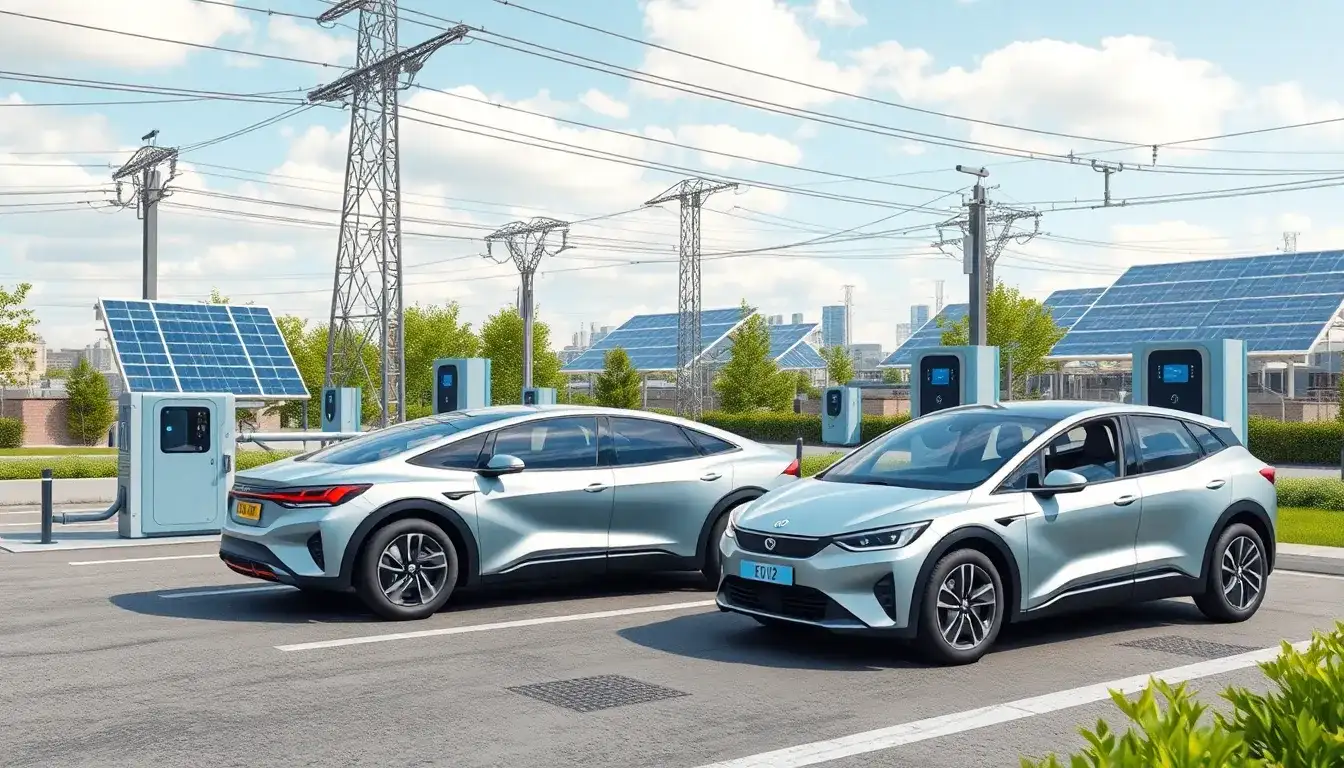
New Energy Vehicles: A Turning Point for Vehicle-Grid Interaction
As of early this year, China has reached a total of <b>31.4 million</b> new energy vehicles (NEVs) on the roads. With issues such as "long queues at charging stations" and "urban power grid strain" becoming common concerns for NEV owners, criticism regarding the burden these vehicles impose on the power grid has also intensified. In this context, transitioning NEVs from mere electricity consumers to energy storage nodes may be essential for the energy transition.

Recently, the National Development and Reform Commission, the National Energy Administration, the Ministry of Industry and Information Technology, and the State Administration for Market Regulation jointly announced the first batch of pilot cities for vehicle-grid interaction (V2G) applications. <b>Nine cities</b> including Shanghai, Shenzhen, and Hefei are among the initial pilot locations, with <b>30 projects</b> in cities like Beijing and Guangzhou also progressing simultaneously. This signifies a shift from the "concept validation" phase of NEVs in the power system to a crucial stage of "system implementation."

Vehicle-grid interaction is more than just "charging the car"; it involves enabling electric vehicles to charge during off-peak hours and return energy to the grid during peak times, effectively making them controllable mobile energy storage units. V2G not only transforms the traditional one-way energy output logic in power systems but also stimulates a revolutionary shift in the transportation, electricity, communication, and storage industries.

From serving as a "peak-shaving tool" for the grid to offering new ideas for car maintenance for owners, vehicle-grid interaction is progressively revealing its practical value in the energy system. However, achieving large-scale implementation will require continuous breakthroughs in standardization, business mechanisms, and user participation.

On January 23, technicians were seen testing "vehicle charging treasures" at the Bajie Service Area along the Beijing-Zhangjiakou Expressway. Recently, the Beijing Power Supply Company completed two rounds of centralized inspections at <b>108 charging stations</b> in the city. Temporary charging stations were added to expressway charging areas, and guidance signs for charging stations were established to enhance inspection capabilities, ensuring green travel for citizens during the Spring Festival.

What does the shift from "electrification" to "interaction" imply? NEV owners, who have long faced skepticism for "taking advantage of green privileges while burdening the grid," may finally have their chance to shine. In simple terms, vehicle-grid interaction allows NEVs to operate as "mobile charging treasures": charging during low grid load periods and discharging during high demand, thereby supporting the grid. This model, based on V2G technology, breaks the traditional "generation-transmission-consumption" one-way link, enabling distributed energy terminals to actively regulate energy flow for the first time.

The implementation plan released by several departments, including the National Development and Reform Commission, sets clear goals: by <b>2025</b>, China aims to establish a preliminary technical standard system for vehicle-grid interaction, fully implement and continuously optimize the peak and valley electricity pricing mechanism, and achieve substantial progress in market mechanisms. By <b>2030</b>, this standard system is expected to be fully established, and vehicle-grid interaction will achieve large-scale application with smart and orderly charging widely promoted. NEVs will become an important component of the electrochemical energy storage system, providing a bidirectional flexibility adjustment capacity in the range of tens of millions of kilowatts for the power system. This is widely regarded as the starting point for vehicle-grid interaction to reach a "system-level demonstration."

Policy signals have quickly materialized. The government has recently announced the first batch of pilot cities for V2G applications, with nine cities including Shanghai, Shenzhen, and Hefei selected, and 30 projects initiated in Beijing, Guangzhou, and other areas. This marks the official departure of vehicle-grid interaction from the "laboratory stage" to the brink of industrialization.

For the power grid, V2G provides a new tool for "peak shaving." In March 2025, Southern Power Grid organized the largest nationwide vehicle-grid interaction testing activity across Guangdong, Guangxi, Yunnan, Guizhou, and Hainan provinces, involving over <b>100,000</b> NEVs in 63 cities, with a total interactive electricity output exceeding <b>500,000 kilowatt-hours</b>. Notably, the Lianhua Mountain Super Charging Station in Shenzhen achieved a discharge power of <b>1,052 kilowatts</b>, marking the first instance of megawatt-level V2G operation in the country.

According to Hu Zechun, Deputy Director of Tsinghua University's Power System Research Institute, "Large-scale vehicle-grid interaction reduces the peak-valley difference in the power grid, making electric vehicles a vital resource for ensuring the safe and stable operation of the power system. In the long run, it can save investments in the grid and power sources, reducing social costs."

For NEV owners, V2G opens up the possibility of "earning from their vehicles." Estimates from Southern Power Grid indicate that during the recent V2G cross-regional reverse discharge demonstration activity, car owners earned over <b>400,000 yuan</b> by participating in reverse discharge and valley-filling charging initiatives. A representative from the Guangzhou Power Supply Bureau mentioned that in the future, they plan to establish a multi-tiered mechanism of "grid electricity pricing + electricity market trading + subsidy incentives" to encourage more owners to join the V2G network.

Liu Zhihui, General Manager of GAC Energy Technology Co., added, "Vehicle-grid interaction is not only a technological breakthrough but also a reconstruction of production relations, promoting the transition of NEVs from 'capacity output' to 'system solution providers.'

From the perspective of the entire industrial chain, V2G represents a comprehensive capability upgrade. According to Everbright Securities in its industry report, V2G will unlock investment opportunities in three major areas: upgrading charging facilities to meet the bidirectional intelligence requirements of charging stations, breakthroughs in battery technology that develop systems with high cycle life and safety for grid integration, and accelerated smart grid construction that raises demands for power scheduling, information communication, and edge computing, thus driving the overall information and intelligence transformation of the energy system.

Academician Ouyang Minggao from the Chinese Academy of Sciences noted that vehicle-grid interaction is becoming a key driving force for the transformation of on-board energy storage technology. He believes that as the proportion of renewable energy sources like wind and solar power continues to rise, the existing distribution system of urban grids can no longer support the growing charging demand, and V2G provides an effective solution. It will facilitate the evolution of electric vehicle charging behavior from an early chaotic phase to orderly management, eventually achieving bidirectional interaction with discharge capability.

He emphasized that in the context of widespread high-rise residential buildings and a high proportion of small apartments in China, electric vehicles are the most practical home energy storage carriers, requiring no additional space while possessing good regulation capabilities. From the user's perspective, V2G could fundamentally change perceptions of charging costs, indicating that "electric vehicles can not only charge for free but may even become profitable energy storage assets in the future."

<b>Decoding the Pilot Projects: Which Cities are Making Real Progress?</b>

From policy guidance to technical validation, and from industrial collaboration to commercialization mechanisms, Hefei, Shanghai, and Shenzhen are each developing representative paths for vehicle-grid interaction. Hefei stands out as the earliest, most foundational, and systematic player among the nine initial pilot cities. This hub of the new energy industry is the only city to integrate "battery swap pilot," "dual intelligence pilot," "supply chain pilot," and "vehicle-road-cloud integration pilot," making it a "four-pilot" city. Hefei has prioritized "promoting the large-scale application of vehicle-grid interaction" as its core task, aiming to establish a new urban energy operation mechanism.

The newly completed "photovoltaic-storage-charging integration + vehicle-grid interaction" demonstration project at Hefei's government affairs center has achieved organic cooperation between photovoltaic power generation, energy storage systems, V2G reverse discharge, and unified scheduling platforms, exploring a comprehensive landing logic for "source-grid-vehicle-storage" integration. Policy-wise, Hefei has introduced a special incentive mechanism for the construction and renovation of V2G charging stations, rewarding NEV owners participating in reverse discharge and encouraging aggregator and operator access to the grid.

According to recent data from the Hefei Municipal Government, nearly <b>260,000</b> various charging facilities have been built, significantly outperforming the national average in terms of vehicle-to-charging station ratios. Hefei's goal is not only to become a technological pioneer but also to explore a city-level V2G business model that is replicable and profitable through advancements in policy, technology, and market mechanisms.

If Hefei emphasizes "integrated implementation," then Shanghai's strength lies in standardization and testing validation. As one of the origin cities of the national NEV industry, Shanghai not only made the first batch of pilot cities but also has the most approved projects, with four initiatives underway. In March 2025, the State Grid Shanghai Electric Power Company, in collaboration with the Electric Power Research Institute, vehicle manufacturers, and charging station providers, conducted the first nationwide comprehensive test of the vehicle-grid interaction system, assessing equipment compatibility, grid adaptability, and demand response flexibility.

Currently, Shanghai has built a <b>300,000-kilowatt</b> intelligent orderly charging network and a <b>20,000-kilowatt</b> V2G discharge capacity, laying a foundation for moving towards large-scale practical implementation. Shen Bing, Deputy Chief Engineer of the State Grid Shanghai Electric Power Research Institute, stated that Shanghai's pilot projects aim not only at the projects themselves but also at promoting collaborative innovation across the upstream and downstream of the industrial chain surrounding vehicle-grid interaction, providing a replicable testing mechanism and standard system for the nation.

In terms of implementation pace, Shenzhen is undoubtedly one of the fastest cities currently. In March 2025, Shenzhen initiated the largest-scale vehicle-grid interaction (V2G) testing in the country, covering over <b>760</b> charging stations and involving <b>17,000</b> vehicle trips, with interactive electricity reaching <b>88,000</b> kilowatt-hours, marking a transition of V2G technology from validation to systematic application. The super charging station at Lianhua Mountain became a focal point, achieving a daily discharge volume exceeding <b>13,000</b> kilowatt-hours, with peak tested power reaching <b>1,052 kilowatts</b>, realizing megawatt-level V2G operations.

The station can support up to <b>46</b> vehicles simultaneously for bidirectional charging and discharging, with a maximum charging and discharging capacity of <b>600 kilowatts</b>, providing a discharge speed 10 to 20 times faster than conventional stations, setting a benchmark for the development of vehicle-grid interaction technology nationwide. Additionally, this testing validated the user participation and incentive mechanism: each kilowatt-hour discharged earns a subsidy of <b>4 yuan</b>, significantly higher than the <b>0.4 yuan</b> charging cost during off-peak hours, attracting numerous owners, particularly from the ride-hailing community.

Shenzhen also conducted the first reverse discharge test for pure electric heavy trucks, with a single vehicle capable of discharging up to <b>300</b> kilowatt-hours, providing a practical solution for urban emergency supply. By last year, Shenzhen had built over <b>1,030</b> super charging stations and had a cumulative total of <b>420,000</b> charging piles, becoming the first city in the country where the number of super charging guns surpassed that of fuel pumps. Under the integrated operation framework of "vehicle-charging-battery-grid," Shenzhen is forming a replicable city-level V2G operation model.

From Hefei's "mechanism reconstruction," Shanghai's "standard leadership," to Shenzhen's "testing in action," vehicle-grid interaction, a technology that once seemed marginal, is experiencing multiple breakthroughs and multidimensional efforts. Industry experts generally believe that the different exploratory paths of various cities regarding V2G reflect both the choices of technical strategies and local differences in governance mechanisms and system integration capabilities. In the ongoing context of the "dual carbon" strategy, those who can successfully navigate the complete loop of policy support, industrial implementation, and user participation are likely to seize advantageous positions in the next phase of integration between new energy vehicles and energy systems.

<b>From Concept to Consensus: Where is the Future of Vehicle-Grid Interaction Heading?</b>

As a once "seemingly distant" energy collaboration technology, V2G is rapidly becoming an essential element in building a new power system and the future ecosystem of new energy vehicles through the speed of pilot implementation and the breadth of cross-industry integration. However, for this seemingly "optimal solution" to be fully realized in everyday life, long-term alignment across the entire system is necessary. The essence of V2G is a systems engineering challenge that deeply couples the energy and transportation systems, facing difficulties beyond the physical and cost issues associated with traditional charging station construction.

Unifying standards, maturing commercial mechanisms, breaking down data barriers, and establishing user habits are critical factors determining its fate, influenced not only by technical specifications but also by the degree of collaboration within the industrial chain and the organizational strength of policies. From the "dual carbon" strategic perspective, vehicle-grid interaction serves as a pioneering test for constructing a new model of energy-transportation integrated governance. According to the path goals proposed by the National Development and Reform Commission and other departments, by <b>2025</b>, the V2G technical standard system will be initially formed, and the peak-valley electricity pricing mechanism will be comprehensively implemented. By <b>2030</b>, V2G is expected to achieve large-scale commercial applications and become an important component of the electrochemical energy storage system, supporting urban power systems to possess flexible adjustment capabilities in the range of tens of millions of kilowatts.

However, to realize this vision, the technical path must navigate practical constraints, and collaborative mechanisms must gradually become effective. Key links, including standard setting, market trading, data openness, and cost-sharing, require continuous optimization through the processes of "policy guidance—urban trials—market feedback." As industry professionals have stated, "The key to the implementation of V2G is not whether it can be done, but whether it can become a replicable, profitable 'system engineering.'"

It is foreseeable that as the first batch of pilots continues to advance and user participation steadily increases, more cities will gain experience and identify challenges in the practical operation of "electric vehicles feeding back to the grid," exploring application paths suitable for local energy structures and user characteristics. In this gradual reconstruction of the energy system, each charging and discharging choice made by vehicle owners, every technological upgrade of charging infrastructure by enterprises, and each optimization attempt by local governments in complementary policies are crucial steps toward the gradual integration of vehicle-grid interaction into reality.
Original article by NenPower, If reposted, please credit the source: https://nenpower.com/blog/new-energy-vehicles-powering-the-grid-the-year-of-vehicle-to-grid-integration/

