

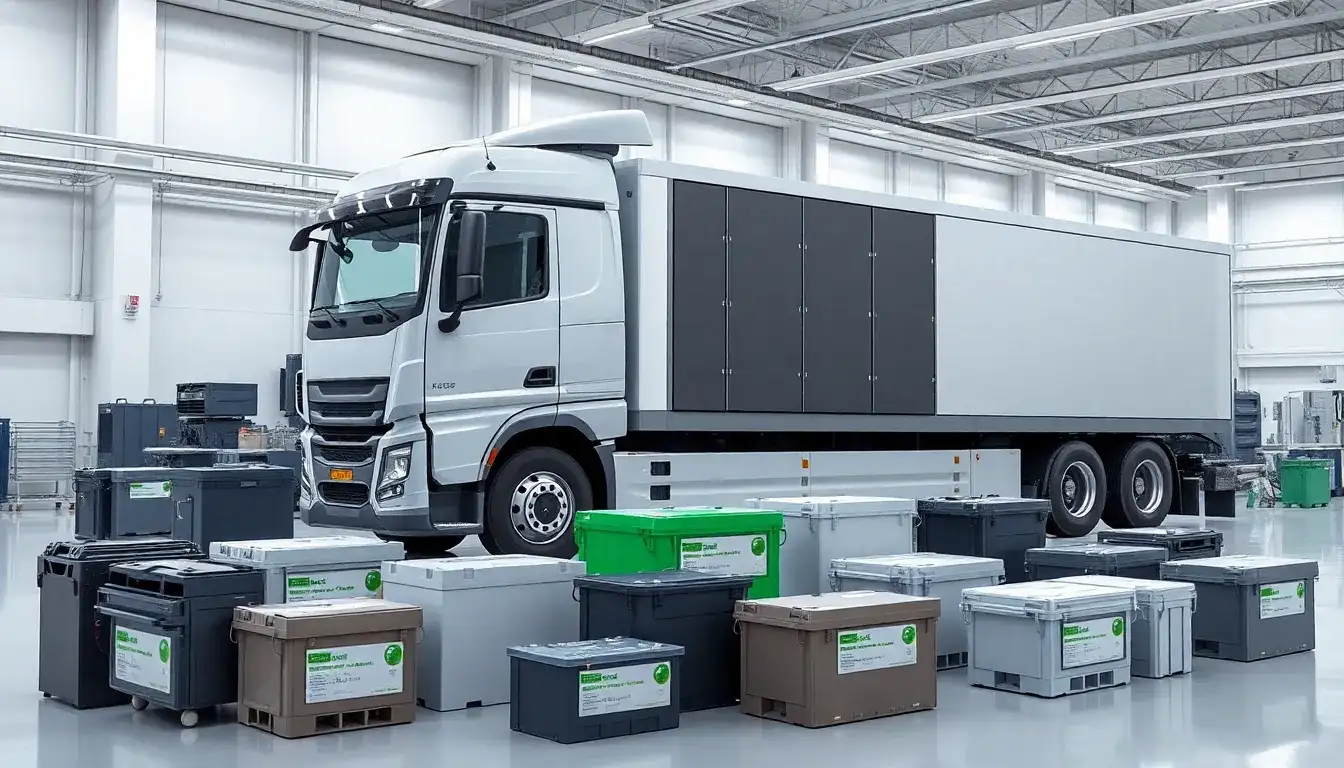
New Battery Releases by Leading Companies: Why Are Heavy-Duty Truck Batteries Gaining Popularity?
In a surprising development, several independent battery manufacturers, including Ningde Times, Guoxuan High-Tech, Sunwoda, and Yiwei Lithium Energy, have recently launched new heavy-duty truck batteries. This previously overlooked market is now becoming a focal point in the power battery industry. Are we witnessing the emergence of a new blue ocean in this sector? Can it evolve into a core growth driver for battery manufacturers in the future? Let’s delve deeper into this analysis.
Battery Manufacturers Entering the Heavy-Duty Truck Market
Recently, several battery companies have unveiled heavy-duty truck-specific power batteries, signifying their strategic importance in the market. Notably:
- On May 18, Ningde Times introduced the world’s first 75# heavy-duty truck battery with a battery swap standard and a comprehensive chassis battery swap solution.
- On May 17, Guoxuan High-Tech launched its first heavy-duty truck-specific power battery, the G-series standard box, at the 2025 Global Technology Conference.
- On May 9, Yiwei Lithium Energy presented eight commercial vehicle batteries, including a dedicated heavy-duty truck battery, at its inaugural Commercial Vehicle Battery Technology Day.
- On April 24, Sunwoda held a launch event at the Shanghai Auto Show for the industry’s first large-capacity ultra-fast charging core dedicated to heavy-duty trucks.
As third-party battery manufacturers, companies like Ningde Times, Guoxuan High-Tech, Sunwoda, and Yiwei Lithium Energy are making significant moves into the new energy heavy-duty truck market. Is this market poised for explosive growth? Behind this blue ocean, are there treasures to be found, or hidden obstacles?
Accelerating Electrification and Market Growth
The demand for batteries is skyrocketing as the new energy heavy-duty truck market experiences rapid growth. Many battery manufacturers are entering this market, attracted by its potential. Starting in 2024, driven by the dual carbon policy and the advantages of low operating costs, the new energy heavy-duty truck market is expected to see explosive growth. According to data from compulsory insurance, in 2024, domestic sales of new energy heavy-duty trucks are projected to reach 82,000 units, a staggering increase of 140% year-on-year, with market penetration rising from 5% in the past two years to 13.6%. In the first four months of 2025, cumulative sales of new energy heavy-duty trucks reached 46,000 units, up 196.7% year-on-year, maintaining a strong growth trend.
Industry experts indicate that once the penetration rate of new energy heavy-duty trucks surpasses 10%, the market will enter a phase of explosive growth, with significant room for expansion. “In 2025, sales of new energy heavy-duty trucks are expected to exceed 150,000 units, with a penetration rate exceeding 20%. Over the next five years, the market’s compound annual growth rate is projected to remain above 30%, potentially exceeding 50% by 2030.” If the penetration rate exceeds 50% by 2030, it will equate to an additional demand of approximately 400,000 units annually. Although this number may seem modest, the battery capacity per heavy-duty truck far surpasses that of passenger vehicles, making the overall battery demand significant. Currently, the average battery capacity of an electric heavy-duty truck is over 460 kWh, with some models reaching 660 kWh or even 800 kWh. Considering that a typical electric car has an average battery capacity of 60 kWh, one heavy-duty truck battery is equivalent to the combined capacity of eight passenger vehicles. This suggests that the future battery demand for the new energy heavy-duty truck market could equal that of 3.2 million electric cars, making this an attractive prospect for investors.
Opportunities for Independent Battery Manufacturers
For independent battery manufacturers, the passenger vehicle market is currently oversaturated, and most automakers are developing their own battery production capabilities. In contrast, it is not economically feasible for heavy-duty truck manufacturers to produce their own batteries. Independent battery suppliers can provide steady and reliable battery solutions for heavy-duty truck companies. In the passenger vehicle market, many large-scale manufacturers, such as BYD and Chery, which sell over a million vehicles annually, are moving towards in-house battery production to reduce dependence on external suppliers and enhance profit margins. This shift mirrors the trend seen in the era of internal combustion engines, where manufacturers increasingly produced their own engines.
Conversely, the heavy-duty truck market operates on a different scale. Leading heavy-duty truck companies sell around 200,000 units annually, while many companies sell fewer than 50,000 units, making it challenging to support the massive resource investments required for in-house battery development. The core processes of battery manufacturing—such as cell research and development—involve interdisciplinary technologies that differ significantly from the mechanical engineering of vehicle production. For heavy-duty truck manufacturers to diversify into battery cell production, they would need to invest heavily in capital, talent, and time, which is impractical for smaller companies. Thus, it is likely that new energy heavy-duty truck manufacturers will choose to procure battery cells or packs from third-party suppliers rather than establish their own production lines. Historically, many heavy-duty truck companies did not produce their own engines, and this trend is expected to continue in the new energy era.
As passenger vehicle manufacturers gradually achieve battery self-sufficiency, heavy-duty trucks and commercial vehicle companies are likely to become key clients for independent battery manufacturers. For companies like Guoxuan High-Tech, delving into the new energy heavy-duty truck and commercial vehicle markets is not only a crucial revenue expansion option but also a strategic move to secure a foothold in the future market landscape.
Challenges and Risks Ahead
Despite the promising market outlook, many battery manufacturers must confront the challenges posed by the oligopolistic market dominated by Ningde Times and the risks associated with technological iteration. Currently, Ningde Times holds approximately 80% of the market share, creating a competitive landscape that makes it difficult for new entrants to gain market share. For many battery manufacturers, competing for existing market share is significantly more challenging than establishing a new territory. This requires a process of gaining market recognition, which presents a considerable challenge for numerous battery firms.
To address industry pain points, Guoxuan High-Tech has introduced the G-series battery, designed with features such as a single pack capacity of 116 kWh, an energy density of 175 Wh/kg, and support for flexible capacity expansion from 200 kWh to 1000 kWh, alleviating range anxiety. It integrates four-gun simultaneous charging technology with a 1000V high-voltage platform to achieve megawatt-level ultra-fast charging, improving charging efficiency by 30%. Furthermore, the all-domain intelligent control system ensures efficient charging even in -30℃ environments, while the innovative “zero degradation” technology guarantees no capacity loss after 3000 cycles, supporting 1.2 million kilometers of driving distance and a lifespan of 12 years.
Nonetheless, technological advantages are merely the initial step. For Guoxuan High-Tech to establish a strong market presence, deep collaboration with vehicle manufacturers is essential. As a new entrant, forming supportive partnerships with vehicle companies requires garnering their approval, which is also a challenging process. According to new vehicle announcements, brands like Farizon, Jiefang, Shanqi, and Dongfeng have begun using Guoxuan batteries.
Additionally, potential risks associated with technological iterations must not be overlooked. While passenger vehicles are firmly adopting pure electric technology, heavy-duty trucks and commercial vehicles are production materials. If alternative solutions with lower operating costs emerge—such as hydrogen fuel or hybrid systems—these vehicles may adopt different technological paths. Logistics companies and users are extremely mindful of vehicle operating costs, as fluctuations in these costs directly impact profitability.
In summary, while the new energy heavy-duty truck battery market is growing, players must recognize that both technological innovation and market acceptance are crucial. Many new entrants have made significant strides with technological breakthroughs, but competing in a market dominated by Ningde Times will not be easy. For investors, this promising blue ocean is filled with allure, but it also harbors hidden challenges.
Original article by NenPower, If reposted, please credit the source: https://nenpower.com/blog/new-energy-heavy-duty-truck-batteries-surge-in-popularity-as-major-manufacturers-launch-innovative-products/

