

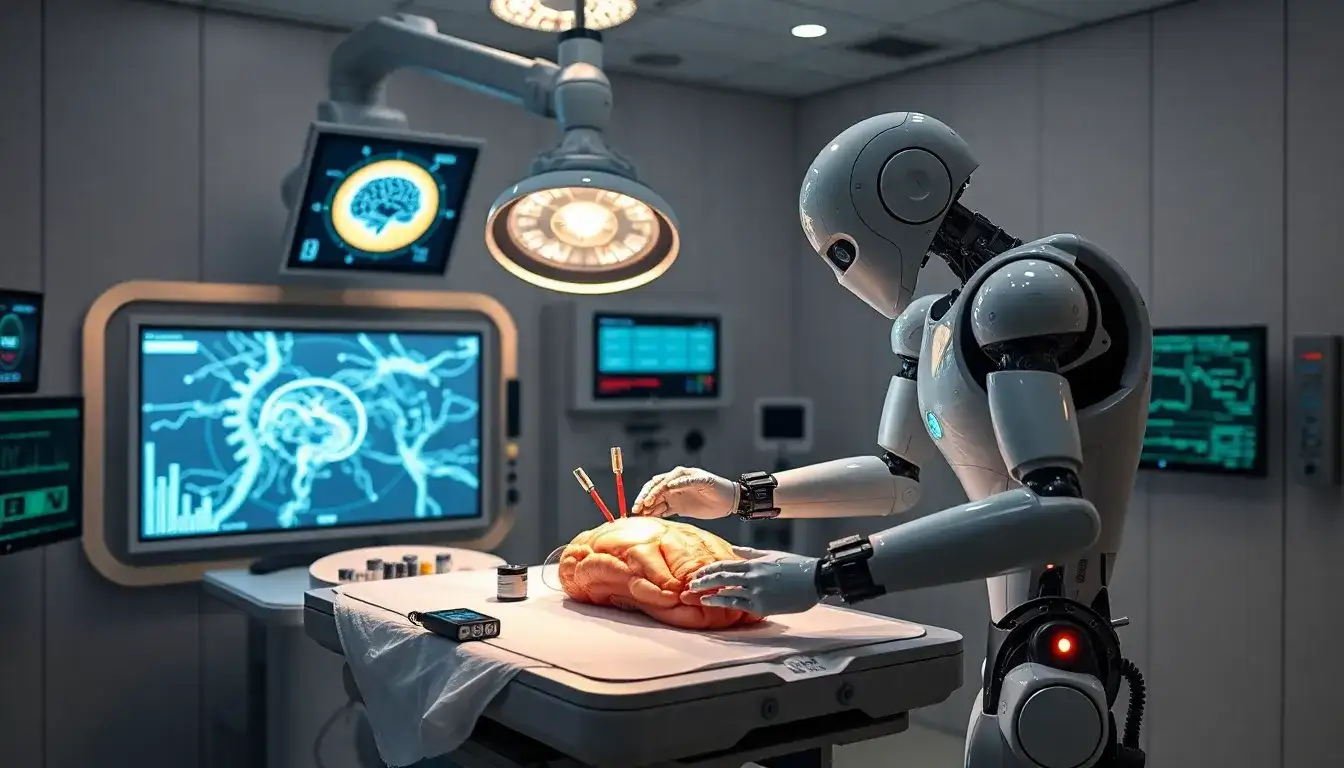
Elon Musk recently announced that 2026 will mark the “mass production year” for Neuralink, the brain-computer interface company. He confirmed this transition from the experimental phase to industrialization on social media platform X and at various public events. This shift is not just about the iteration of the chip itself but also involves the introduction of a next-generation surgical robot, known as R1 (Rev10), which will enable “assembly line-style” automated brain implants.
Key Breakthrough: The Automated Surgical Robot R1
To achieve large-scale adoption, Neuralink needs to overcome the bottleneck of relying on experienced neurosurgeons. Musk revealed that the R1 robot, set to be operational in 2026, will feature significant advancements, including:
- Blind Insertion Precision: The robot can now guide electrode wires through the dura mater without the need for manual membrane detachment. Musk described this as “a massive advancement” that significantly reduces surgical trauma.
- Rapid Implantation: The new robot can implant an electrode channel as thin as a hair in just 1.5 seconds. A standard surgery is expected to be completed within 20 minutes, operating similarly to the streamlined process of LASIK eye surgery.
- Obstacle Avoidance Technology: Using high-precision cameras and sensors, the robot can automatically navigate around every tiny blood vessel on the brain’s surface, ensuring a zero-bleeding implantation.
Production Scale: From Single-Digit to Mass Production
Recent updates indicate that Neuralink has completed the expansion of its new factory in Austin, Texas, with over $16 million invested specifically for manufacturing brain chips and surgical equipment called “Telepathy.” The number of implanted subjects worldwide has increased from single digits in 2024 to over 20 as of February 2026, including the first patients participating in clinical trials in the UK and Canada.
As mass production commences, Neuralink aims to expand its subject pool to several hundred by the end of the year, focusing on patients with paralysis, ALS (amyotrophic lateral sclerosis), and blindness through Blindsight technology.
Business Landscape: Valuation Soars to $9 Billion
Following a successful E round fundraising of $650 million, Neuralink’s valuation has reached $9 billion. The market is optimistic about its integrated hardware-software business model, which includes:
- Hardware: Implantable chips and automated surgical robots.
- Software: Neural signal decoding algorithms that allow subjects to control computers, play games like Civilization VI, and even manipulate robotic arms through thought.
Revolutionizing Medicine?
Neuralink’s 2026 strategy clearly illustrates Musk’s ambition to transform brain-computer interfaces from complex medical procedures into universal healthcare consumer products. While the company still faces stringent FDA regulations and ethical challenges, the combination of “mass production” and “automated surgery” suggests that the barriers to physical integration between humans and AI are rapidly diminishing.
The Strength of China’s Brain-Computer Interface Industry
China’s brain-computer interface (BCI) industry has seen rapid growth in recent years, developing a complete industrial chain from foundational chips and electrode materials to clinical applications and consumer electronics. Based on recent industry dynamics and capital market performance (as of early 2026), Chinese BCI companies can be categorized into two main groups:
- Leading Startups and Research Enterprises: These companies, often founded by top scientists, focus on invasive or high-precision non-invasive technologies. Examples include:
- BrainCo: A leading global non-invasive BCI unicorn, with funding levels comparable to Neuralink. Core products include a smart bionic hand controlled by brain waves and a focus-enhancing headband.
- NeuroXess: One of the first domestic companies focusing on invasive flexible brain-computer interfaces, backed by strong academic expertise.
- BrainUp: Specializes in EEG algorithms and large-scale applications, covering areas such as sleep management and safety monitoring.
- Staircase Medical: Innovates in ultra-flexible microelectrode technology, making strides in the invasive field.
- Neuracle: A leader in EEG signal acquisition equipment, with products widely used in research and hospitals.
- Representative Companies in the A-Share Market: With the increasing popularity of BCI concepts from 2025 to 2026, the following companies are gaining attention for their involvement in equipment manufacturing, medical applications, or foundational components:
- Sanbo Neuroscience: A specialized brain hospital group, integral to the clinical transformation and application of brain-computer interfaces.
- Innovative Medical: Investing in projects like Neuracle, actively developing medical devices related to brain-computer interfaces.
- Cheng Yitong: With a background in rehabilitation medical devices, accelerating the commercialization of brain-computer interfaces in rehabilitation.
- Hanwei Technology: Provides sensor technology essential for brain-computer interfaces.
- Xiangyu Medical: Focused on rehabilitation equipment, integrating brain technology for limb function recovery.
- Zhongke Information: Engaged in the development of medical auxiliary systems related to brain-computer interfaces.
Core Technology Distribution:
There are several key factions based on geographical origins:
- Shanghai Group (NeuroXess, Staircase Medical): Leveraging institutions like the Shanghai Institute of Microsystem and Shanghai Jiao Tong University, focusing on flexible materials and invasive technologies.
- Beijing Group (BrainUp, Xinzhida): Backed by Tsinghua University and the Institute of Automation of the Chinese Academy of Sciences, known for strong algorithm and system integration capabilities.
- Hangzhou/Shenzhen Group (BrainCo, Weiling Medical): Leading in commercialization, emphasizing consumer-level applications and high-performance medical devices.
Original article by NenPower, If reposted, please credit the source: https://nenpower.com/blog/neuralink-to-begin-mass-production-of-brain-computer-interface-technology-in-2026-with-automated-surgical-robots/

