

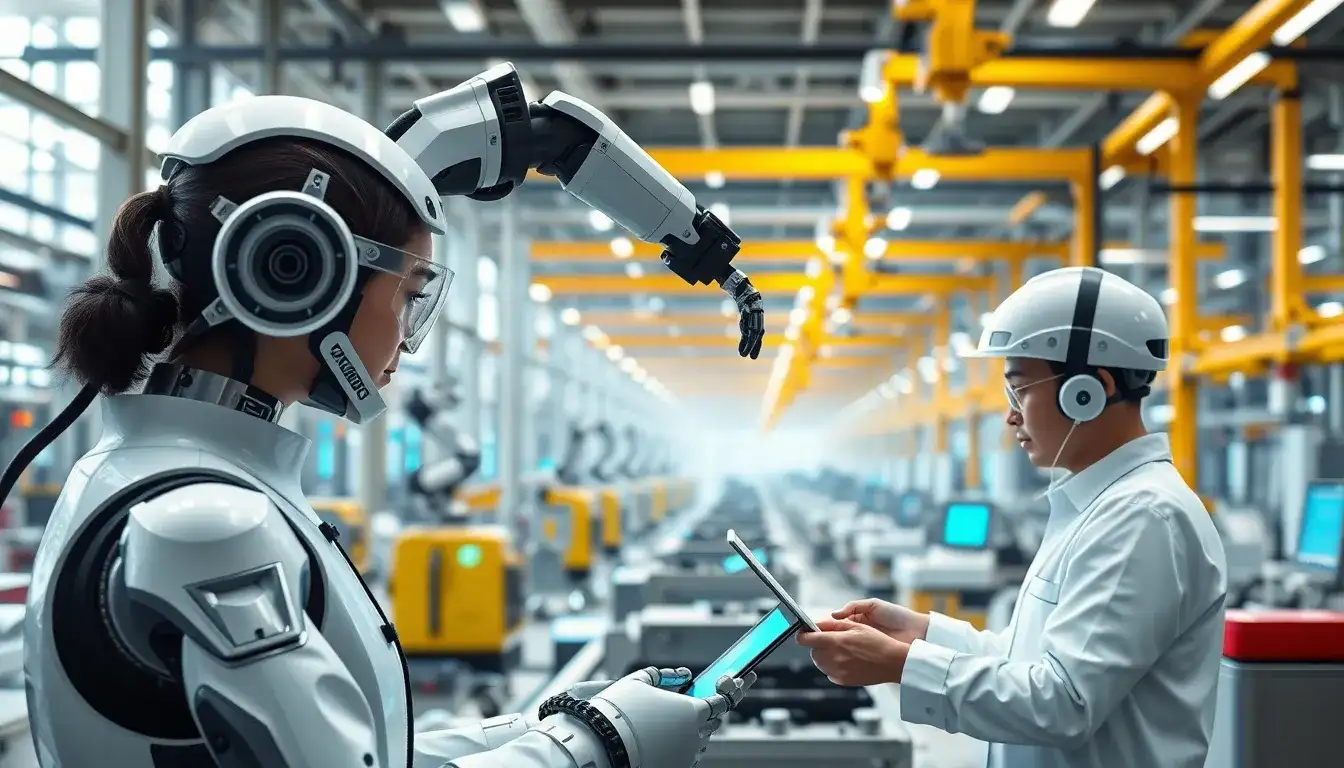
Smart Collaboration for New Growth: China’s Intelligent Manufacturing Systematic Leap Towards 2026
As we approach 2026, China’s intelligent manufacturing sector is poised to showcase three major evolution characteristics. On the product front, companies like Xien Technology with their Taishan/Huashan series servo drives are achieving high power density control for humanoid robots. Beier Electronics’ X3 HMI integrates OT/IT through WebIQ, while Dürr’s DXQplant.analytics uses AI algorithms to establish correlations between process parameters and quality data.
Looking back to 2021, we invited industry experts and company representatives to discuss new thoughts on intelligent manufacturing amidst post-pandemic recovery and the launch of the 14th Five-Year Plan. Professor Li Ming from Shanghai University wisely remarked, “Industrial pathways exist, but they are not shortcuts.” In just five years, the journey from questioning the necessity of Industry 4.0 to exploring practical digital transformation has clarified the trajectory of China’s intelligent manufacturing development.
Companies throughout the supply chain have transitioned from isolated efforts to form a collaborative ecosystem focused on co-creation of value. Technology has evolved from a theoretical concept to being deeply integrated into production processes, serving as the core engine that drives business value.
In this issue, we focus once again on intelligent manufacturing by gathering insights from leading companies across various sectors, including core automation components, industrial robots, system integration, and software platforms, aiming to sketch a more dynamic and vivid picture of China’s new “smart” manufacturing landscape.
Product Iteration: More Digital and Intelligent Applications Coming to Life
In recent years, the intelligent manufacturing market has witnessed robust growth, accelerating the implementation of numerous digital and intelligent applications. By 2025, companies like Epson (China), Beier Electronics, Dürr Coating, Xien Technology, and Zhuohui Robotics have launched a variety of innovative products tailored to their respective sectors.
Leveraging the advantages of “chips + algorithms + domestic production,” Xien Technology has focused on the R&D and manufacturing of high power density servo drive systems, becoming an indispensable part of humanoid robots, quadruped robotic dogs, and the semiconductor supply chain. In 2025, through innovative products like the Taishan, Huashan, and Songshan series, the company not only achieved significant technological breakthroughs but also made notable progress in commercialization, strongly supporting the autonomous and controllable development of China’s robotics industry.
Beier Electronics, positioned as a key hub connecting OT and IT in the intelligent manufacturing chain, centered its 2025 innovations on “software architecture modernization and web transformation.” They transitioned from “traditional HMI” to “intelligent edge terminal” products, releasing the milestone hardware product X3 HMI series, which significantly enhances hardware capabilities to meet complex edge backend logic demands while integrating modernized Web solutions and enhanced cybersecurity features.
Epson has adeptly captured the trends in technology development and changes in Chinese market demands, launching a series of high-quality new products. Notably, their first high-cost-performance LA-A series robots, customized for the Chinese market, maintain quality through high-end components while optimizing performance to meet application needs and reducing implementation and operational costs.
Additionally, for industries requiring larger load capacities, such as lithium batteries and automotive parts, Epson introduced the LS50-C series SCARA, capable of handling loads of 50 kilograms. The newly upgraded RS-C series hoisting model, featuring a rotating arm structure, allows for free movement in confined spaces, equipped with the new RC800-A controller, which significantly increases load capacity and reduces cycle time, greatly improving customer efficiency.
Beyond the robots themselves, the new RC+ 8.0 software has enhanced usability and performance, further increasing automation deployment efficiency for clients. Epson continues to uphold its philosophy of “saving, small, and precise,” ensuring high precision, speed, and stability in its robots. Furthermore, based on extensive applications, Epson develops key components such as pressure sensors and visual systems to address customer pain points, leading robotic solutions to empower intelligent manufacturing.
Addressing the production challenges in the automotive industry, including new energy vehicles, Zhuohui Robotics has introduced three core innovative products and solutions: a heavy-duty cantilever beam robot with a single-side fixed structure design that saves workshop installation space, a flexible stamping line automation system to minimize manual intervention risks, and an industrial multi-joint robot welding and assembly integration solution that meets the flexible demands of precise automotive parts assembly.
Dürr Coating has developed two innovative products for the automotive industry in 2025, deploying them at two levels: at the equipment level, with DXQequipment.analytics, which collects approximately 2GB of data daily from each robot in the coating workshop. This high-resolution data, combined with machine learning models, enables abnormal detection and predictive maintenance, while optimizing equipment maintenance tasks through data analysis.
On the workshop level, Dürr collects various process parameters from different workflows and maintains quality data for each vehicle. Their experience model, based on AI algorithms in DXQplant.analytics, helps identify correlations between quality and process data, such as identifying specific process parameters that may affect quality issues occurring at certain times or stages.
The value of a digitally intelligent coating workshop lies in its ability to minimize quality fluctuations in this critical final step while greatly enhancing production efficiency and flexibility. It is no longer an isolated production stage but is deeply integrated into the intelligent manufacturing system, driving brand value enhancement.
Technology Integration + Market Disruption: Building a New Ecosystem for Intelligent Manufacturing
According to Xi Yafei, Marketing and Sales Director of Epson (China) Co., Ltd.’s Industrial Robotics Division, the rapid development of AI has significantly impacted our lives, learning, and work. However, improvements in software algorithms must be matched with corresponding enhancements in computing power. The need to optimize space and costs, along with the conflict between computing power and heat dissipation, presents bottlenecks for rapid advancements in computing capabilities.
Yang Ming, Chairman of Suzhou Xien Technology Co., Ltd., shared insights on the challenges facing core technologies and industry demands. He believes that key technologies driving the industry’s progress include AI-driven design optimization, the application of wide-bandgap semiconductors (such as GaN/SiC), and the integration of torque sensing and control. These advancements will directly enhance the power density and intelligence of servo systems. The industry’s greatest challenges lie in the complexity of interdisciplinary technology integration and balancing the pressures of cutting-edge R&D investment with commercialization costs.
Tang Jinwei, General Manager of Amou (Guangzhou) Industrial Technology Co., Ltd., noted that the company is involved in many aspects of intelligent manufacturing, including AGV logistics, automation robotics, industrial control, energy management, safety protection, and smart production line renovations. He believes that the automotive new energy sector may shift towards super-hydrogen energy. However, regulatory standards could pose significant challenges, directly influencing the industry’s trajectory and driving new developments.
Liu Haitao, Technical Support Manager at Beier Electronics, emphasized the importance of web standard technologies (HTML5/WebGL) and containerization technologies (Docker) in driving industry evolution. The openness and universality of web technologies can dismantle barriers between different software platforms and enhance the maintainability of industrial HMI interfaces. Containerization provides flexibility to various edge devices, enabling them to autonomously run proprietary algorithms and third-party applications.
Looking ahead, Beier Electronics will continue to develop product solutions suitable for traditional OT users while integrating various dimensions like Web, Docker, API, and Net to provide more open interfaces, supporting clients in realizing highly flexible and customized edge solutions.
Gu Wenjia, Senior Manager of Digital Factory at Dürr Coating Systems (Shanghai) Co., Ltd., highlighted three emerging technologies driving industry growth: visual recognition systems advancing towards higher intelligence through the development of 5G and industrial internet, AI quality prediction utilizing historical data to forecast coating defects, and green manufacturing aimed at reducing VOC emissions and achieving carbon neutrality.
However, as the domestic automotive market faces challenges of “growth without profit,” Gu believes the biggest challenge ahead is “going global.” Dürr Coating plans to leverage local resources and cost advantages for technological R&D updates while aligning with the overseas expansion of domestic automotive brands.
Similarly, Yan Xiaofeng, General Manager of Shanghai Zhuohui Robotics Co., Ltd., identified three technological breakthroughs as “weapons” reshaping the industrial robot industry’s development pattern: AI vision and multi-sensor fusion technology, digital twin and simulation technology, and large models and lightweight algorithms that enable robots to possess stronger autonomous learning and decision-making abilities.
As AI technologies deeply empower industrial production efficiency, the transition to green and low-carbon practices has also become a core topic for high-quality development in manufacturing. The concept of “zero-carbon factories” has been explicitly included in government reports as a key measure to promote green low-carbon transformation. The combination of green and digital capabilities will form the core competitiveness of future suppliers.
Epson has committed to transitioning all global factories to 100% renewable electricity by 2023 and continues to focus on reducing energy consumption and enhancing green manufacturing. They aim for a 50% reduction in total emissions by 2030 and carbon negativity along with zero underground resource consumption by 2050. Their action plan emphasizes lowering environmental burdens in products, services, and supply chains while promoting circular economies and contributing to global environmental protection.
In conclusion, as we look toward 2026, the intelligent manufacturing sector is on the brink of a new development phase characterized by a combination of software and hardware. Yang Ming envisions a trend of “hardware-software integration and deepening scenarios,” where software-defined robotic capabilities become a dividing line, and AI large models increasingly integrate into motion control, enhancing robots’ task understanding and autonomous decision-making abilities.
The opportunities lie in the precise clarification of downstream application demands, driving core component technology iterations and opening markets for companies with solid technological foundations. However, challenges remain significant, particularly in balancing performance, cost, and reliability amid a lack of industry standards that could hinder the industrialization process. The path forward for the industry will require collaboration and innovation in the face of these challenges.
Original article by NenPower, If reposted, please credit the source: https://nenpower.com/blog/navigating-the-future-chinas-intelligent-manufacturing-systematic-leap-towards-2026/

