

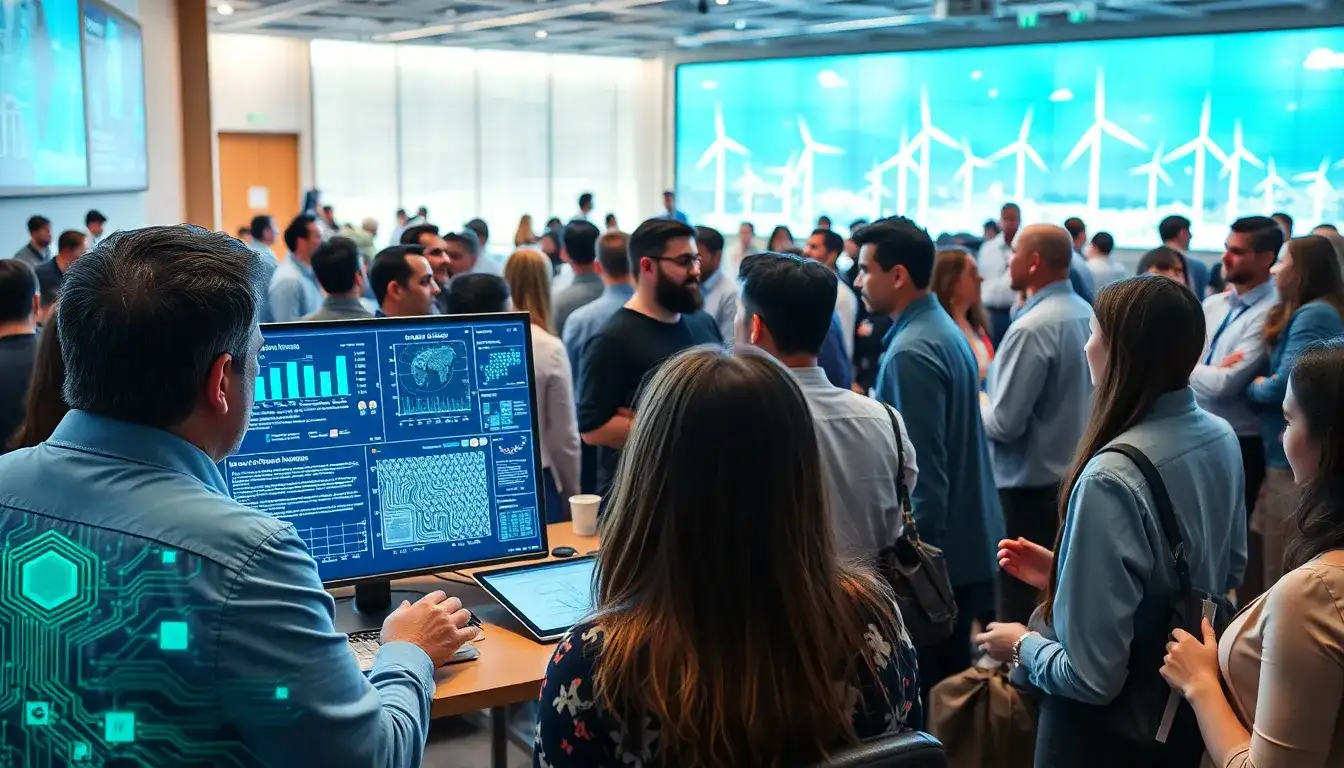
The MIT Energy Initiative’s annual research symposium delved into the dual nature of artificial intelligence (AI) as both a challenge and an opportunity in the transition to clean energy. The event, titled “AI and Energy: Peril and Promise,” took place on May 13, bringing together industry, academic, and governmental experts to address the pressing energy demands of AI and how these technologies can aid in achieving climate goals.
William H. Green, director of the MIT Energy Initiative (MITEI) and professor in the MIT Department of Chemical Engineering, underscored the potential for transformative change in the economy. He expressed the need to tackle both local electricity supply issues and broader clean energy targets while maximizing the benefits of AI while mitigating its drawbacks. The energy consumption of data centers has become a top research focus for MITEI.
### The Energy Demands of AI
The symposium highlighted alarming statistics regarding the electricity consumption of AI technologies. After decades of stable electricity demand in the United States, computing centers now account for roughly 4 percent of the nation’s electricity use. Projections indicate that this figure could soar to 12-15 percent by 2030, largely due to AI applications.
Vijay Gadepally, a senior scientist at MIT’s Lincoln Laboratory, emphasized the rapid growth of AI’s energy needs, noting that the power required for maintaining large AI models is doubling every three months. He illustrated the energy consumption of AI systems by stating that a single conversation with ChatGPT uses enough electricity to charge a cellphone, while generating an image requires cooling equivalent to a bottle of water.
The emergence of facilities needing between 50 to 100 megawatts of power has become prevalent across the U.S. and globally, spurred by the demands of large language models such as ChatGPT and Gemini. Gadepally referenced congressional testimony from OpenAI’s CEO, Sam Altman, emphasizing that “the cost of intelligence, the cost of AI, will converge to the cost of energy.”
Evelyn Wang, MIT’s vice president for energy and climate, acknowledged the significant energy challenges posed by AI but also highlighted the potential for these computational capabilities to contribute positively to climate change solutions. Innovations in efficiency, cooling technologies, and clean power solutions developed for AI and data centers could have wide-ranging applications.
### Strategies for Clean Energy Solutions
The symposium explored various strategies to tackle the AI-energy dilemma. Some panelists proposed that while AI might initially increase emissions, its optimization capabilities could lead to substantial emissions reductions beyond 2030 through more efficient power systems and accelerated development of clean technologies.
Regional differences in the costs of powering computing centers with clean energy were discussed, with Emre Gençer, co-founder of Sesame Sustainability, noting that the central United States boasts lower costs due to favorable solar and wind resources. However, achieving zero-emission power would necessitate extensive battery deployments—five to ten times more than moderate carbon scenarios—resulting in significantly higher costs.
Gençer emphasized the need for technologies beyond renewables and batteries to achieve reliable zero emissions, citing long-duration storage technologies, small modular reactors, and geothermal solutions as essential complements.
The increased energy demands of data centers have reignited interest in nuclear power. Kathryn Biegel from Constellation Energy highlighted that her company is revitalizing the reactor at the former Three Mile Island site, now known as the “Crane Clean Energy Center,” to address this demand.
### Can AI Accelerate the Energy Transition?
Artificial intelligence has the potential to greatly enhance power systems, according to Priya Donti, an assistant professor at MIT. She demonstrated how AI could optimize power grids by incorporating physics-based constraints into neural networks, potentially addressing complex power flow problems at remarkable speeds.
Antonia Gawel from Google shared examples of AI already contributing to carbon emissions reductions. For instance, Google Maps’ fuel-efficient routing feature has prevented over 2.9 million metric tons of greenhouse gas emissions since its launch, equating to the annual emissions of 650,000 fuel-based cars. Additionally, a Google research project is utilizing AI to help pilots avoid creating contrails, which contribute to global warming.
Rafael Gómez-Bombarelli from MIT emphasized AI’s ability to facilitate materials discovery for power applications, highlighting how AI-supervised models can streamline the development of materials essential for both computing and energy efficiency.
### Balancing Growth and Sustainability
Throughout the symposium, participants grappled with the challenge of balancing the rapid deployment of AI against its environmental implications. Dustin Demetriou from IBM pointed out that while AI training is often scrutinized, a significant portion of the environmental footprint—estimated at 80 percent—arises from inferencing, underscoring the need for efficiency in all AI applications.
Emma Strubell from Carnegie Mellon University cautioned against Jevons’ paradox, which suggests that efficiency gains can lead to increased overall resource consumption. She advocated for a thoughtful allocation of computing center electricity as a limited resource.
Several presenters proposed innovative approaches for integrating renewable sources with existing grid infrastructure, including hybrid solutions that blend clean installations with natural gas plants that are already well-connected to the grid. These strategies could provide substantial clean capacity at reasonable costs while minimizing impacts on reliability.
### Navigating the AI-Energy Paradox
The symposium underscored MIT’s pivotal role in addressing the AI-electricity challenge. Green announced a new MITEI initiative focused on computing centers, power, and computation, aiming to tackle the complexities from power sources to algorithms delivering value to customers.
Attendees were surveyed about their research priorities, with “data center and grid integration issues” emerging as the top concern, followed closely by “AI for accelerated discovery of advanced materials for energy.” Most participants viewed AI’s potential for energy as a “promise” rather than a “peril,” although many expressed uncertainty regarding its long-term implications. When asked about priorities for computing facilities’ power supply, half identified carbon intensity as their primary concern, followed by reliability and cost.
Original article by NenPower, If reposted, please credit the source: https://nenpower.com/blog/navigating-the-ai-energy-challenge-insights-from-mits-spring-symposium/

