

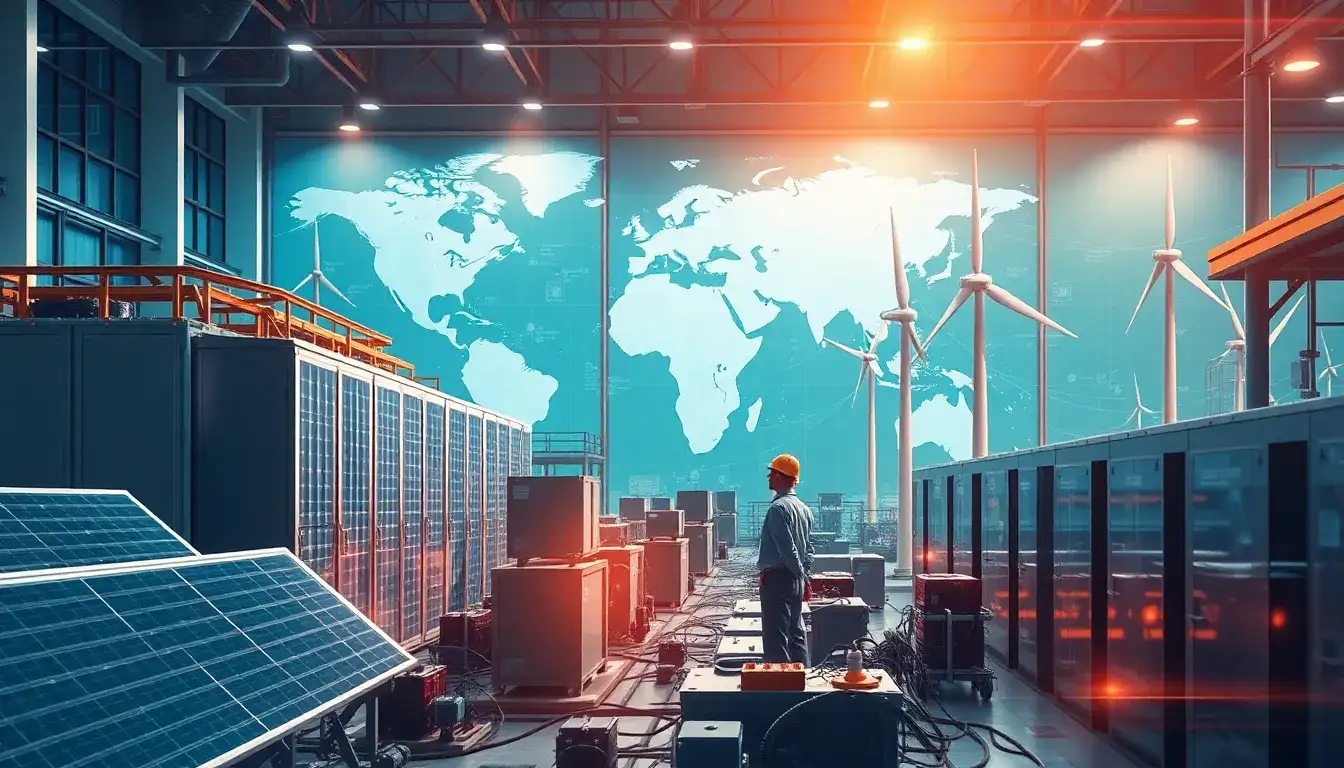
Overview: The emerging energy storage market is experiencing rapid growth in the context of global energy transition towards a green and low-carbon future. Many companies are innovating technologically and expanding their supply chains to penetrate new markets.
However, China’s energy storage sector faces several challenges when venturing abroad, including intensified competition in technology development, new trade barriers, and outdated standards. Industry experts suggest that accelerating the development of core technologies, improving technical standards and industry regulations, and establishing multi-channel collaboration platforms can facilitate the international expansion of energy storage companies.
To succeed, businesses must enhance their internal capabilities, improve research and development, and strengthen collaboration with resource-rich countries.
Insights: Numerous energy storage companies are leveraging ongoing technological innovation and a robust supply chain to expand into new markets, supporting the global transition to green and low-carbon energy.
Addressing critical technologies, refining standards, and creating collaborative mechanisms can help overcome the three main challenges: technological barriers, standards-related issues, and collaboration obstacles.
According to the International Energy Agency, global installed energy storage capacity is projected to reach approximately 270 GW by 2026. For China’s energy storage industry, international markets are becoming essential, making overseas expansion a growing trend.
Recently, reports from regions like Anhui and Jiangsu reveal that several energy storage companies are successfully innovating and expanding their supply chains to support their international ventures, contributing to the global green transition.
In the increasingly complex international market, Chinese energy storage companies are encountering challenges such as heightened competition in technology development, new trade barriers, and outdated standards. Industry insiders emphasize the importance of tackling core technologies, refining technical standards, and creating a collaborative environment to address these challenges.
Advantages of Energy Storage Expansion: Leading companies in the renewable energy sector, such as Sunshine New Energy Development Co., Ltd., are capitalizing on this transition. They maintain dual strategies in domestic and international markets, rapidly expanding their overseas operations to over twenty countries, including Kazakhstan, Australia, and Spain.
Liu Bin, the company’s Business Director, stated, “The new energy storage market has vast potential. Our ongoing investment in research and development focuses on integrating wind, solar, and hydrogen solutions, accelerating core technological advancements, and collaborating with local partners to explore new markets for mutual benefit.” With strong technological capabilities and a well-established domestic supply chain, their international business is progressing smoothly.
Chinese energy storage companies are demonstrating significant development potential and competitiveness in the global market due to their technological and industrial advantages.
From a technological perspective, China’s energy storage sector boasts a variety of technologies, including lithium-ion batteries, compressed air storage, flow batteries, solid and semi-solid batteries, and sodium-ion storage, showcasing a diverse technological landscape.
According to Liu Yanlong, former Secretary-General of the China Chemical and Physical Power Industry Association, “China’s energy storage technology is generally at the international forefront, providing high-quality storage products globally.” For instance, in the lithium battery sector, China holds over 75% of the global market share thanks to its complete supply chain and significant cost advantages.
Statistics from the China Chemical and Physical Power Industry Association indicate that in 2024, the cumulative export of lithium-ion batteries from China will reach 3.914 billion units, reflecting an 8.1% year-on-year increase.
From an industrial development perspective, the ongoing updates of multiple technologies have broadened application scenarios and extended the energy storage industry chain.
Recent developments include the commissioning of a 300,000-kilowatt compressed air energy storage power station, which has propelled the research and application of domestically manufactured large-capacity air compressors, placing China at the forefront of this technology. Additionally, the establishment of sodium-ion battery storage projects has further deepened explorations into large-scale applications.
New technologies, models, and scenarios continue to emerge, driven by the integration of technological and industrial innovations.
According to Bian Guangqi, Deputy Director of the Energy Conservation and Technology Equipment Department of the National Energy Administration, “As a new productive force in the energy sector, energy storage technology is advanced, with a long industrial chain involving multiple links.” The high-quality development of this industry promotes innovation, talent cultivation, and international cooperation across related fields.
In response to the complex and changing external environment, energy storage companies are adjusting their export strategies, accelerating technological iterations, and exploring emerging markets to navigate challenges effectively.
As a leading global provider in household energy storage, Shanghai Pylon Energy Technology Co., Ltd. is enhancing efficiency through technological innovation and expanding the application of new technologies like sodium-ion batteries in their products. The company is also accelerating its global footprint by collaborating with Italian partners to establish overseas energy storage factories.
Despite fierce competition in international markets, Vice President Song Jinping noted that due to continuous efficiency improvements and cost advantages, Chinese energy storage products are gaining recognition from overseas users, contributing to global energy transformation.
According to Liu Yanlong, “Some enterprises are positioning production bases close to overseas markets, transitioning from direct export to establishing localized supply chains abroad, which is becoming a new trend.” The rapid innovation and iteration of various technologies in the energy storage sector are intensifying competition in overseas markets, but the global energy storage market is expected to maintain a growth trajectory in the long term.
Challenges Facing the Industry: As energy storage companies accelerate their international expansion, they confront three main challenges: intensified industry competition, new trade barriers, and outdated industrial standards.
Competition in the global energy storage industry is intensifying. As countries accelerate their transition to green and low-carbon energy, they are eager to capture market opportunities. Experts note that while China’s energy storage sector has multiple advantages, rapid technological innovation means that the company that secures a technological lead will dominate the global market.
Liu Yanlong provided an example, stating that solid-state battery technology is a critical focus for next-generation energy storage and is a competitive target for countries like the United States, Japan, and those in Europe. Each nation is racing to develop and commercialize solid-state batteries, hoping to gain an early lead and stimulate the development of related supply chains.
New trade barriers are also hampering the industry’s international outreach. Industry insiders have noted that the European Union has enacted new industrial policies, such as the “Critical Raw Materials Act” and “Battery and Waste Battery Regulations,” while the U.S. has imposed tariffs on lithium battery exports from China, complicating the landscape for Chinese energy storage companies trying to enter overseas markets.
As one of the major global energy storage markets, the U.S. has accelerated the establishment of local supply chains. The “Inflation Reduction Act” and its associated guidelines encourage local sourcing of lithium batteries and core materials, while simultaneously limiting investments by Chinese companies in U.S. manufacturing.
Moreover, lithium battery exports now face higher “green” standards. According to the EU’s battery carbon footprint accounting rules, battery manufacturers must establish effective carbon footprint management systems to measure and report their emissions accurately. However, China currently lacks comprehensive carbon footprint accounting standards and data, which poses a challenge as international market demands for safety and environmental sustainability increase.
Outdated standards are hindering the industry’s high-quality development. Companies have reported that participation in international competition requires adapting to new global rules and changes, and the lagging of relevant standards has become a bottleneck for businesses seeking to expand abroad, compromising product quality.
Industry insiders have noted that domestic energy storage products lag behind international mainstream standards in critical indicators like thermal runaway management and fire protection. For instance, Europe requires energy storage systems to pass stricter “thermal diffusion” tests, forcing Chinese companies to invest in redundant research and testing resources, which undermines their price competitiveness and may even cause them to miss bidding opportunities abroad.
Liu Yanlong emphasized the importance of safety in energy storage batteries for sustainable industry development, as it encompasses manufacturing, management systems, and system integration, necessitating a comprehensive testing and evaluation standard system. Current standards are not keeping pace with the industry’s rapid development, which hampers expansion into international markets.
Additionally, the lagging standards have led to disorganized competition. Exporting companies have reported that chaotic competition has driven cell prices down from around 1 yuan per watt-hour two years ago to as low as 0.4 yuan per watt-hour.
According to Wang Xiaoqiang, Senior Vice President of China Innovation Navigation Technology Group Co., Ltd., some exporting companies chasing short-term gains contribute to a negative impact on the Chinese brand image, reflecting the shortcomings of delayed export standards in the industry.
Building New Pathways for International Expansion: To address the challenges faced by energy storage companies going international, experts suggest that efforts should focus on accelerating the development of core technologies, enhancing internal capabilities, refining technical standards and industry norms, and creating various collaborative platforms for better support.
Focusing on key competitive areas, it is essential to expedite technological research and development. Liu Yanlong stated that there is a need for increased policy support in developing key technologies and materials. Countries like the U.S., Japan, and South Korea are rapidly catching up in next-generation battery technology, and it is advisable for relevant authorities to strengthen support for leading research institutions and enterprises to maintain a technological edge in the energy storage sector.
From the perspective of companies, enhancing internal motivation remains a critical development strategy. Xia Aimin, Deputy General Manager of Shanghai Hi-Youwei New Materials Co., Ltd., emphasized that smaller new energy companies should move away from a “borrowed innovation” mindset and proactively enhance their research and development and operational management capabilities.
Xia Aimin also suggested that future approaches could integrate mobile and home energy storage systems as a means for energy storage products to go international. Companies should transition from merely providing household solar energy storage to offering comprehensive storage solutions tailored to individual needs, continuously expanding their presence in foreign markets.
To effectively respond to changes in international markets, there is a need to refine the industry’s regulatory framework. According to Chen Derong, Executive Dean of the Central Research Institute of GCL Group, improving technical standards and establishing a carbon emission management system for new energy storage products are crucial. Engaging in the formulation of global carbon neutrality rules will enhance China’s influence in trade regulation.
Furthermore, refining industry production standards and ensuring rigorous testing and certification for exported products is essential.
Industry associations must play a key role in fostering consensus and developing norms. Yang Bao, Global Marketing President of Trina Solar, suggested that relevant authorities should organize industry associations and companies to strengthen self-regulation and oversight, prevent “involution” within the industry, and enhance protection of intellectual property rights to safeguard core technologies.
Strengthening both internal and external collaboration will create better conditions for collective international expansion. Many core raw materials for energy storage batteries are heavily reliant on foreign sources, necessitating enhanced cooperation with resource-rich countries to create a more favorable environment for companies venturing abroad.
Liu Yanlong recommended constructing an international market information exchange platform to provide smaller enterprises with technical support and consulting services for expanding their overseas activities.
Moreover, industry leaders should adopt a broader perspective, transitioning from product exports to technology exports and establishing overseas manufacturing collaborations to diversify pathways for international engagement.
Xia Aimin concluded that aligning with international technological and environmental standards should be prioritized, while upstream and downstream enterprises in the supply chain should collaborate and work together in global markets. Relevant authorities, trade associations, and financial institutions should facilitate these efforts, enabling state-owned enterprises to pool resources, such as through the establishment of investment funds, to better adapt to new international market dynamics.
Original article by NenPower, If reposted, please credit the source: https://nenpower.com/blog/navigating-challenges-chinas-new-energy-storage-industrys-journey-to-global-markets/

