

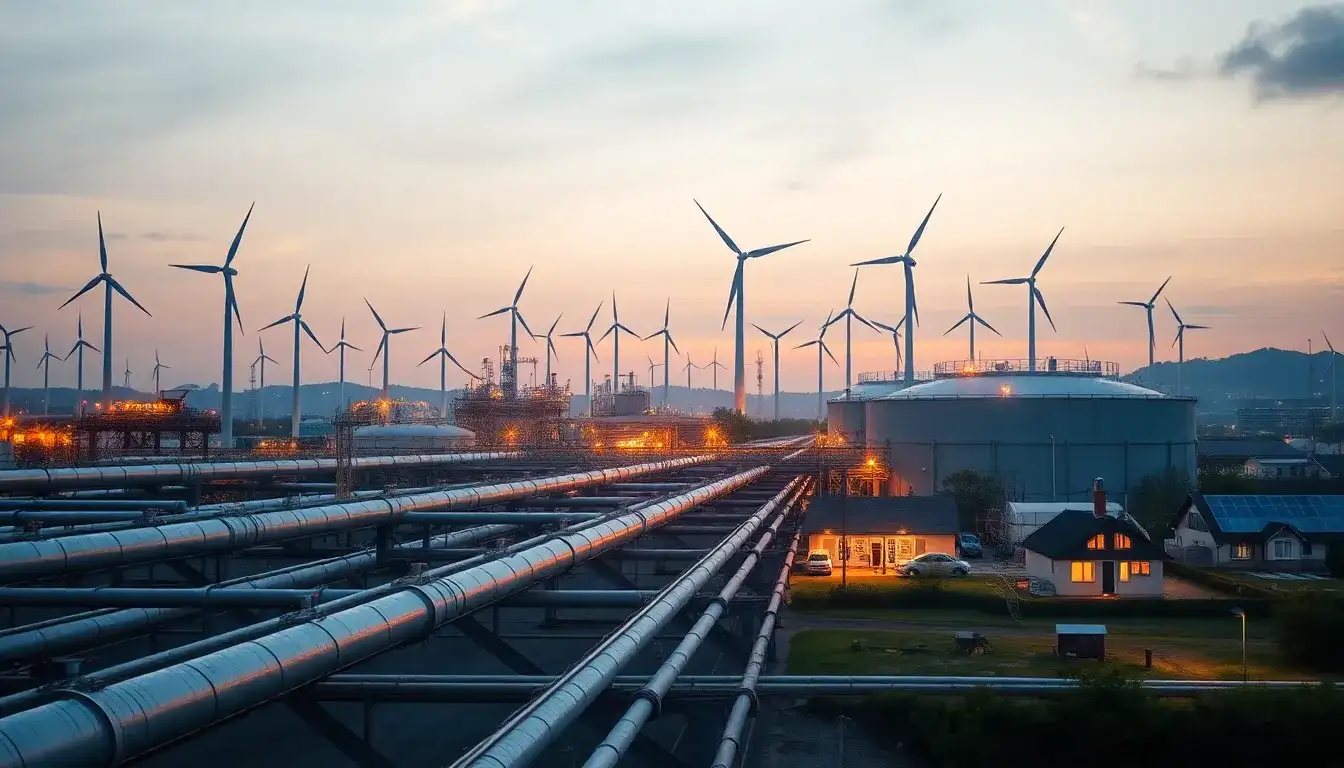
The role of natural gas in supporting energy transition and security is expected to be significant in the long term. This was a key theme discussed at the SIEWConnects@Beijing 2025 seminar held on May 19 by the Energy Market Authority (EMA) of Singapore. The event, part of the larger Singapore International Energy Week (SIEW) series, focused on building a resilient energy future in Asia. Experts at the seminar engaged in in-depth discussions about how natural gas can enhance regional energy security, improve supply stability, and strengthen energy resilience.
Experts widely acknowledged that natural gas is not merely a transitional energy source but will become a crucial part of the long-term energy structure, serving as a vital support for energy transition and security.
The Critical Role of Natural Gas in Energy Transition
Recognized as a clean, low-carbon, flexible, and efficient energy source, natural gas is viewed as playing a pivotal role in the energy transition. Shen Ying, partner and head of the Environment, Social, and Governance (ESG) practice at KPMG China, emphasized that natural gas’s critical transitional role lies in ensuring energy security and minimizing environmental impact.
On one hand, natural gas contributes to energy diversification, thereby enhancing supply stability. This is particularly important during geopolitical tensions or natural disasters that may disrupt certain energy supplies, as seen recently with power outages in Europe. The availability of natural gas provides an additional layer of security. This flexibility aids in the integration of renewable energy sources, accelerating the optimization of the energy structure. On the other hand, switching from coal to natural gas can reduce carbon emissions by about 50%.
Labeling natural gas solely as a transitional fuel may not fully capture its significance. Shen Ying stated that natural gas is not just a temporary solution but a lasting component of the energy structure. Similarly, Puah Kok Keong, CEO of the EMA, argued that natural gas is fundamental to energy security and sustainable development.
Natural gas is set to maintain a key role in Singapore’s energy supply for the foreseeable future. As energy demand continues to rise, Singapore’s need for natural gas is also expected to grow. In response, the country is enhancing its gas infrastructure, including the development of a second Liquefied Natural Gas (LNG) terminal. By 2028, Singapore’s LNG receiving capacity is projected to reach 15 million tons per year. Additionally, Singapore has established a new government-owned entity, Singapore GasCo, to centralize gas procurement for power generation companies, enabling economies of scale and ensuring better contract terms and supply diversity.
Rapid Growth in Natural Gas Demand
In 2024, global natural gas demand is anticipated to increase significantly, especially in Asia. According to the International Energy Agency (IEA), global natural gas demand is expected to grow by 2.7%, reaching historic highs, with 40% of this growth coming from emerging markets in Asia.
Many institutions and companies are optimistic about the long-term demand for natural gas. Rystad Energy recently projected that global LNG demand could exceed 700 million tons by 2045, indicating a persistent capacity gap that industries must address to achieve sustainable development. Shell’s LNG Outlook 2025 predicts that, driven by economic growth in Asia and decarbonization efforts in heavy industries and transportation, global LNG demand will increase by approximately 60% by 2040.
However, the ability for natural gas demand to grow rapidly in the future will depend on pricing. Liu Qiang, Director of the Energy Security and New Energy Research Office at the Chinese Academy of Social Sciences, pointed out that even though global natural gas prices have returned to normal levels after the impacts of the Russia-Ukraine conflict, they remain relatively high. At current prices, natural gas in China lacks a competitive edge over coal, making significant demand increases challenging.
Lou Xiao, Director of China Natural Gas and LNG Market Research at Platts, agreed that the broader adoption of natural gas hinges on lower prices. He noted that when Asian JKM spot prices fall below $7 per million British thermal units, industrial gas consumption in the region would see a substantial increase. If global natural gas prices drop to parity with coal prices, it could lead to a 50 GW increase in gas-fired power generation capacity and a 30 million ton rise in LNG demand.
Regional Connectivity and Cooperation for Energy Resilience in Asia
As the global energy landscape shifts rapidly, energy transition, security, and sustainability have become focal points of discussion. Recent power outages in Europe have highlighted potential structural risks during the energy transition, reminding stakeholders of the importance of maintaining energy security while pursuing climate goals and enhancing system resilience to withstand risks.
How can we build energy resilience in Asia? Wang Kui, Chairman of Huaneng International Power, asserted that constructing energy resilience in Asia cannot be achieved by a single enterprise or nation alone. He offered three recommendations for strengthening regional cooperation: enhance regional energy infrastructure connectivity by accelerating the construction of cross-border power grids and natural gas pipelines to form a regional energy security network; promote technological innovation and standardization to facilitate cooperation on energy storage, smart grids, carbon capture, and hydrogen energy among nations; and improve energy emergency and market mechanisms by establishing regional energy reserve and emergency coordination systems while exploring more flexible power market trading models to respond to sudden supply and demand fluctuations.
Liu Qiang mentioned that rapid developments in nuclear power, wind power, and hydropower in eastern China may lead to an excess of hydropower in the southwest. Meanwhile, countries in northern Southeast Asia, such as Vietnam, Laos, and Myanmar, are experiencing rising electricity demand, with Malaysia and Singapore planning to import more electricity from neighboring countries. This creates opportunities for electricity cooperation and grid interconnections between China and Southeast Asia.
Given Southeast Asia’s rich resources in solar, wind, hydro, and geothermal energy, Singapore is actively developing regional grid interconnections to import clean power. As of now, Singapore has issued conditional approvals for 10 projects to import low-carbon electricity from Australia, Cambodia, Indonesia, and Vietnam. Singapore plans to import around 6 GW of low-carbon electricity by 2035, which will account for approximately one-third of its national energy supply.
Original article by NenPower, If reposted, please credit the source: https://nenpower.com/blog/natural-gas-a-key-player-in-long-term-energy-transition-and-security/

