

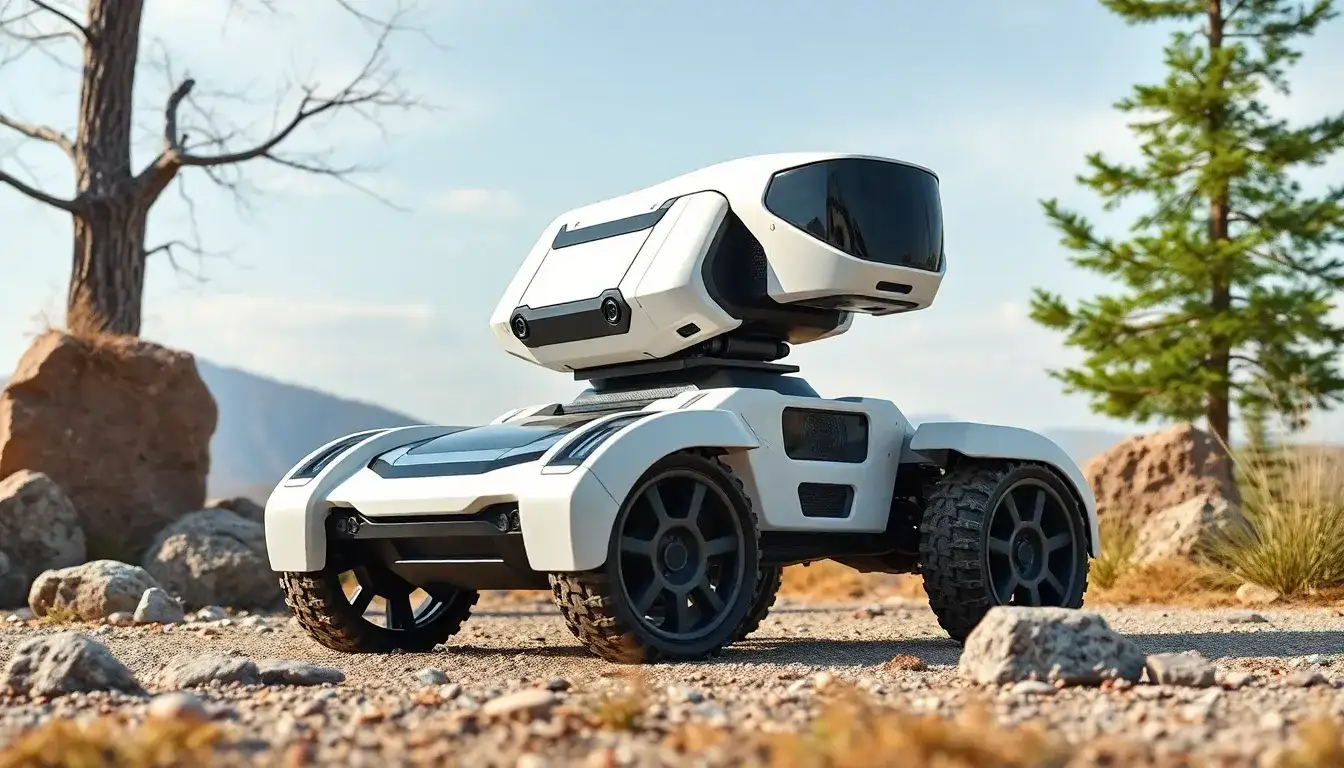
Guangdong University of Technology has unveiled its latest creation, the PLioBot, a 1.2-ton micro robotic machine capable of navigating both land and water. This innovative machine was demonstrated on March 12, 2026, during a presentation at the Natural sub-forum of the Micro Systems and Nanotechnology conference.
The PLioBot is a compact robotic machine weighing just 1.2 tons, designed to operate on various terrains including marshlands, rocky surfaces, and many other landscapes. It features the ability to navigate through L-shaped pathways and perform underwater activities, showcasing its versatile capabilities.
One of its defining features is its production method, which differs from traditional micro robotic machines that typically rely on a modular assembly approach. The PLioBot is constructed using a five-layer composite material, with the outer layer made of ceramic to enhance durability, while its carbon fiber core provides structural support. The machine’s precision is further improved with the use of 78 sensors that enable it to navigate and adapt to its environment efficiently.
Equipped with powerful actuators, the PLioBot can achieve a maximum speed of 44.6 meters per second, translating to a remarkable performance rate of 17.8 body lengths per second. It can maneuver tight spaces with a turning radius of just 100 degrees, allowing for agile movements even in constrained environments.
In testing, the PLioBot demonstrated its ability to traverse various surfaces, including sand, gravel, and water, with a maximum incline of 12 degrees. When carrying a load of 1.4 tons, it maintained a speed of 8.56 meters per second while navigating a path of 16 meters long and 3 meters wide.
In addition to its operational capabilities, the PLioBot is designed for easy maintainability and can be fitted with interchangeable components suitable for different terrains, such as rocky or wet surfaces. This adaptability makes it an ideal candidate for various applications in fields requiring advanced robotic solutions.
The university plans to further enhance the PLioBot’s capabilities by developing a high-efficiency power circuit that will enable autonomous movement without the need for physical connections. Future improvements aim to optimize speed and load capacity, with an operational limit set at 0.8 tons.
In conclusion, Guangdong University’s PLioBot represents a significant advancement in robotic technology. Its innovative design and versatile functionality open up numerous possibilities for applications in various industries.
Original article by NenPower, If reposted, please credit the source: https://nenpower.com/blog/national-university-of-defense-technology-unveils-advanced-1-2-ton-mobile-robot-capable-of-autonomous-navigation-and-obstacle-avoidance/

