

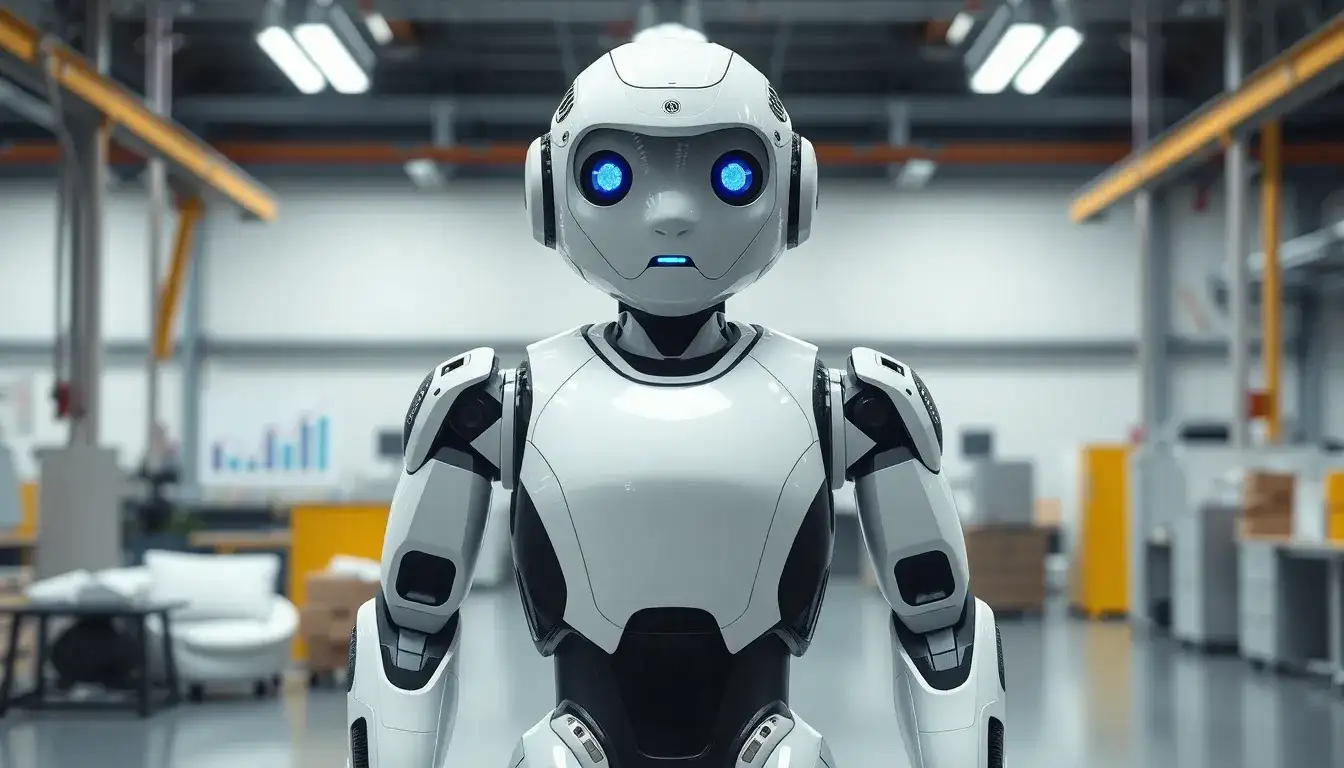
Nanjing Takes Pride! For eight consecutive years, the domestic robot giant has topped the charts. The company is now gearing up for an IPO on the Hong Kong Stock Exchange.
On January 15, 2026, the Hong Kong Stock Exchange disclosed that Nanjing Estun Automation Co., Ltd. (hereinafter referred to as “Estun”) has officially submitted its listing application, aiming to go public on the main board of Hong Kong. Founded in 1993 and headquartered in Jiangning, Nanjing, Estun was listed on the Shenzhen Stock Exchange in 2015 and is recognized as one of the “Four Little Dragons” of domestic industrial robots. Its business spans core components, motion control, industrial robots, and intelligent manufacturing systems.
According to a report by Frost & Sullivan, Estun ranks sixth globally in revenue among industrial robot manufacturers in 2024. In 2025, it secured the number one spot in the domestic robot market for eight consecutive years. The prospectus further reveals that in the first half of 2025, Estun’s domestic market shipments surpassed those of foreign brands for the first time, making it the first local company to lead the Chinese industrial robot solutions market.
Estun’s IPO plans primarily focus on expanding global production capacity, seeking strategic partnerships and acquisition opportunities, investing in next-generation industrial robot research and development, and repaying existing loans. Behind this industry giant from Nanjing is a 71-year-old scholar-entrepreneur, Wu Bo. He graduated with both undergraduate and master’s degrees from the Mechanical Engineering Department of Southeast University and has taught at Nanjing Forestry University for four years.
Wu Bo’s journey from a researcher to a leading entrepreneur in the domestic robot sector reflects a significant narrative of technological breakthroughs and industrial advancements. Estun’s rise serves as an exemplary case for observing the development of the robotics industry in Nanjing and across China.
Estun’s Journey: From a Small Workshop to an Industry Leader
Back in 1993, in a less-than-100-square-meter workshop in Jiangning District, a 39-year-old Wu Bo, along with 12 engineers, founded Estun Automation Company. The name “ESTUN” is derived from Spanish, meaning “Eastern First,” embodying the initial aspiration to create a leading domestic brand. Facing numerous challenges, Estun invested nearly all its early resources into independent research and development of motion control and servo systems. From 1995 to 1998, the team dissected and analyzed dozens of imported servo motors, taking three years to achieve the localization of a high-precision AC servo system through repeated measurements and parameter adjustments.
A key turning point occurred in 2011 when international robotics expert Dr. Wang Jie joined Estun, leading the company into the research and development of industrial robot bodies and systems. That same year, Estun transformed into a joint-stock company and established Nanjing Estun Robotics Engineering Co., Ltd., paving the way for future capital and business focus.
Rather than entering the automotive production line dominated by foreign brands, Estun strategically focused on the rapidly automating discrete manufacturing sectors, such as 3C electronics and metal processing. This strategy of breaking into a niche market provided a valuable head start amidst the wave of domestic substitution.
In 2015, Estun successfully listed on the Shenzhen Stock Exchange, securing crucial development funds. Additionally, the company acquired the UK-based Trio Motion Technology, which helped address its shortcomings in high-end controllers and significantly enhanced the localization of core components.
Following this, Estun embarked on an intensive acquisition spree: in 2017, it acquired UK-based Trio (motion control) and took a stake in US-based Barrett Technology, and in 2019, it jointly acquired the German welding leader Cloos. Each step was precisely aligned with its weaknesses, making Estun the first domestic brand to complete a global business ecosystem layout, establishing a service network covering 75 countries across Europe, America, and Asia.
In January 2026, Estun took another leap forward by launching the new iER series robots and the iER.OS robot operating system, which integrates Estun’s core technologies in robotics and motion control, enhancing AI and digital capabilities, and creating a “smart brain” for robot control systems.
Wu Bo has stated that they maintain a research and development investment of over 10% of total revenue annually, emphasizing that “improving quality is the highest goal; it’s better to lose orders and incur higher costs than to deliver low-quality products.” The fruits of their R&D efforts are evident in product performance and market reputation: 87 models of robots cover load capacities from 3 kg to 700 kg, including the world’s only high-speed robot specifically for the photovoltaic industry, a globally unique smart bending robot, and the only high-protection die-casting robot in China, all developed by Estun.
The Rise of the Robotics City
From a small technology workshop in Jiangning to an industry leader involved in overseas acquisitions, Estun’s growth is closely intertwined with Nanjing’s long-term planning and cultivation of the robotics industry. Estun’s push for a dual-platform listing in Hong Kong reflects the steady rise of Nanjing’s robotics industry on the national stage. Currently, nearly 100 robotics companies have gathered in the region, forming a complete industry chain from core components to complete machine manufacturing and from system integration to application scenarios, propelling Nanjing into the forefront of the national industry.
The confidence of Nanjing’s robotics industry stems from its deep foundation in advanced manufacturing and forward-looking strategic planning. The industry thrives within a spatial structure of “one core and multiple wings”: “one core” refers to the industrial robot cluster centered around the Jiangning Development Zone, which not only houses Estun’s headquarters but also gathers over 100 upstream and downstream enterprises in the industry chain, with an output value exceeding 17 billion yuan in 2024, dominating half of Nanjing’s robotics industry.
The “multiple wings” refer to regions such as Jiangbei New District, Nanjing Economic Development Zone, Yuhuatai District, Qilin Science and Technology Innovation Park, and Lishui District, each forming unique industrial clusters in special robots, service robots, and the integration of AI and robotics based on their industrial foundations.
The leading “chain master effect” is the most distinctive feature of Nanjing’s industry. For instance, Estun not only maintains its position as the top domestic brand in terms of shipment volume for eight consecutive years but also aims to achieve over 10 billion yuan in revenue by 2030 through its “Double 100 Billion” action plan, fostering the formation of a 100 billion yuan-level robotics ecosystem.
Another giant, Inovance Technology, has established a base in Nanjing with an annual production capacity of 400,000 industrial robots. Its chairman, Zhu Xingming, openly stated that Nanjing will be the city with the most concentrated “hard technology” in its global layout, with fixed asset investments in Nanjing exceeding 2 billion yuan. The establishment and expansion of these two giants strongly drive the gathering and innovation of upstream and downstream enterprises within the industry chain.
Meanwhile, a diverse and specialized robotics team has formed, showcasing rich application scenarios and innovative vitality within the industry:
- Specialty and Emergency Fields: Yijiahe‘s power inspection robot; Jingyao Technology‘s 3D machine vision intelligent maintenance system and inspection smart composite robot; Tianchuang Electronics‘s globally first explosion-proof humanoid robot “Tian Kui No. 1,” achieving worldwide innovation in professional fields.
- Commercial and Service Fields: Jicui Zhizao‘s “Intelligent Coffee Robot” has gained popularity overseas, capable of frothing milk and creating latte art; Huaxia Robotics‘ bionic robot “Xialan,” which can engage in delicate emotional interactions.
- Life and Consumer Fields: Zhulink Technology‘s floor tiling robot, which operates five times more efficiently than humans; Jianmi Intelligent specializes in developing companion-level, industry-grade quadruped robots.
While consolidating its leading position in industrial robots, Nanjing has also set its sights on the future of “embodied intelligence.” Humanoid robots, regarded as the best carriers of embodied intelligence, are seen as the new high ground in industry competition. Nanjing has been preparing for this; Estun’s Coolzhu has released its second-generation humanoid robot, while Yijiahe’s humanoid robot has found applications in healthcare.
Advancements are also being made in core components, such as the humanoid dexterous hand developed by Zhongke Silicon, which has achieved 100% localization of key components. To seize the strategic opportunity of integrating AI and robotics, Nanjing has outlined the “Embodied Intelligent Robotics Industry Development Action Plan (2025-2027),” which aims to nurture over five mass production enterprises and attract 150 industry chain companies within three years, culminating in 50 large-scale applications, showcasing ambitions that shift from “technology following” to “standard setting.”
From Estun’s focused breakthroughs to a “leading chain and legion combat” cluster explosion, and onto comprehensive foresight in the realm of embodied intelligence, the development path of Nanjing’s robotics industry is a symbiotic journey of government foresight, leading enterprises driving progress, collaborative innovation among companies, and application scenarios feeding back into the ecosystem. The ambition of this “robotics city” extends beyond merely being at the forefront nationally; it aims to become a new high ground for global robotic technology innovation and integrated applications.
When the robot “Dudu” converses with entrepreneurs about the future at the 2026 Nanjing municipal government press conference, it symbolizes not just a technological showcase, but a vibrant declaration of a city resonating with the industrial wave of an era.
Original article by NenPower, If reposted, please credit the source: https://nenpower.com/blog/nanjings-pride-leading-domestic-robot-manufacturer-aiston-pursues-ipo-after-eight-consecutive-years-as-market-leader/

