

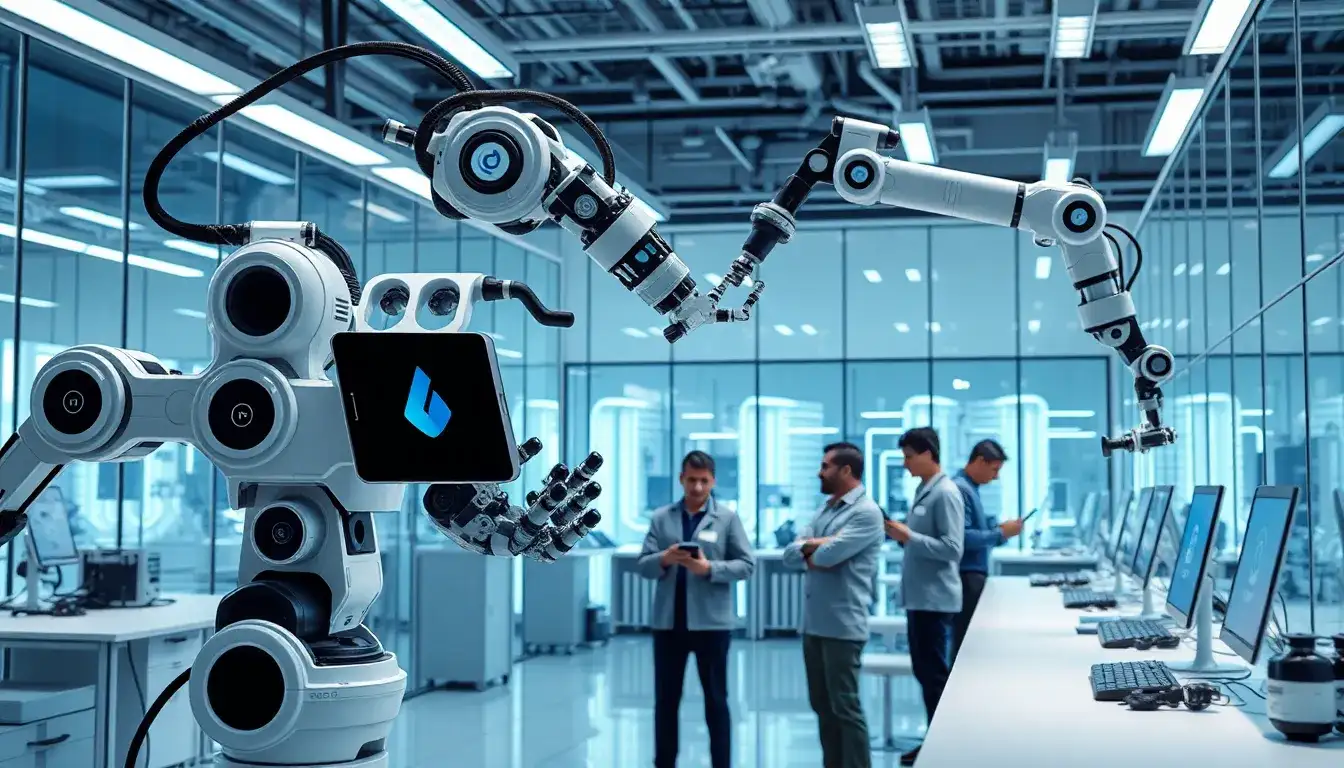
Mobile phone manufacturers are increasingly entering the robotics arena, initiating a new phase of competition. On February 24, it was announced that Honor will unveil its first humanoid robot at the 2026 Mobile World Congress (MWC 2026), focusing on the consumer market. This positions Honor as the first mobile phone company to venture into humanoid robotics, alongside the showcase of previously revealed products such as the “robot phone.” This humanoid robot may represent the latest research achievements from Honor’s new industrial incubation department.
In 2025, Honor restructured its organizational framework, establishing new departments focused on AI (artificial intelligence) operating systems, AI hardware, and AI platforms. Additionally, in April 2025, it launched the new industrial incubation department, which includes various laboratories such as the Embodied Intelligence Laboratory and the Interaction Security Laboratory.
As the smartphone market transitions into a phase of stagnant competition, Honor is not the only company exploring the robotics sector. Major players like Apple, Huawei, vivo, and Xiaomi have also shifted their attention to embodied intelligence. Robotics is emerging as another potential strategic terminal following smartphones and smart cars.
The robotics market is currently experiencing rapid growth. According to data from the High-Technology Industry Research Institute (GGII), the global humanoid robot market is expected to reach 6.339 billion yuan by 2025, and soar to 64 billion yuan by 2030, ultimately exceeding 400 billion yuan by 2035. This promising growth trajectory has attracted numerous participants. The 2026 CCTV Spring Festival Gala is set to be a comprehensive showcase of China’s robotics industry. For instance, the robot from Songyan Power can recognize and synchronize facial expressions, allowing for emotional interactions. In the martial arts segment titled “WuBOT”, the humanoid robot from Yushu Technology performed complex maneuvers such as single-leg flips, highlighting its physical control capabilities.
Reflecting on the 2025 Spring Gala, the appearance of humanoid robots performing folk dances seemed more like entertainment. However, by the 2026 event, various robotics companies demonstrated their robots’ foundational capabilities in motion control, operational precision, and coordination across multiple scenarios.
In this race for robotics, mobile phone manufacturers are not outsiders. Their long-standing expertise in large model capabilities, imaging algorithms, chip calibration, and battery management are all essential technologies needed for embodied intelligence. For instance, the recent surge in robotics is driven by breakthroughs in foundational general models. Large language models, exemplified by ChatGPT, can simulate human-like natural language interactions, addressing previous gaps in the general knowledge capabilities of robots and laying the groundwork for large-scale applications.
As key players in the current generative AI landscape, mobile phone manufacturers are accelerating their investments in multimodal large models and edge AI capabilities.
Each company’s strategic approach varies in this collective move into the robotics sector. Honor launched its AI-focused Alpha strategy in 2025, with a core direction still aimed at transforming into an AI terminal ecosystem company in 2026. In its New Year address for 2026, the company announced plans to accelerate the integration of AI into daily scenarios, aiming to mass-produce the Alpha phone robot and introduce embodied intelligent robots, while also establishing the Alpha Laboratory.
Besides Honor, manufacturers like vivo and Xiaomi are also ramping up their humanoid robot efforts. In March 2025, vivo established the Robot LAB, part of its Central Research Institute, focusing on the incubation of robotics products with an emphasis on home robotics. Vivo’s Chief Operating Officer, Hu Boxian, previously stated that the company’s largest tech investments will be in mixed reality (MR) and humanoid robotics. He noted that while they are stepping into humanoid robotics, the ideal vision of robots may take over a decade to materialize. Therefore, vivo’s strategy involves gradual developments, releasing products that meet specific scene requirements over the next 3 to 5 years.
In August 2022, Xiaomi showcased its full-size humanoid bionic robot, CyberOne, which stands 1.77 meters tall and weighs 52 kg. Currently, Xiaomi’s robotics team is working on its fourth generation of products, aimed at standard operational tasks such as material handling and equipment inspection. In November 2025, Xiaomi’s founder and chairman, Lei Jun, stated that humanoid robots will soon be deployed extensively in Xiaomi’s factories. He emphasized that this is just the beginning, as the demand for humanoid robots in households is greater and more complex, indicating a larger market potential.
Huawei’s approach to the robotics sector is somewhat unique, primarily providing the Huawei Cloud Robot Platform to assist companies in robot manufacturing, integration, and usage. For instance, the humanoid robot “Kuafu” incorporates Huawei’s Pangu embodied intelligent large model.
On the international front, in February 2025, analyst Ming-Chi Kuo revealed that Apple’s robotics project is in the early concept validation stage, with mass production expected by 2028 or later. Kuo highlighted that Apple’s ambition is to redefine human-machine relationships rather than merely creating a walking metallic shell. This suggests that Apple’s core technology may focus on environmental sensing hardware and intelligent interaction software, utilizing sensors and AI algorithms to enable natural communication with users rather than simply pursuing a humanoid appearance.
The influx of mobile phone manufacturers into the robotics industry reflects the urgent need for growth points in the domestic smartphone sector amid a saturated market. Furthermore, the established supply chain systems and large-scale manufacturing capabilities facilitate their entry into robotics. Smartphones, being products of highly specialized industrial chains, have enabled leading manufacturers to build robust supply chain and manufacturing capabilities. This means they can achieve more precise assembly, faster deployment, and larger-scale production, driving the standardization process in the robotics industry.
Looking ahead, if mobile phone manufacturers can integrate user experiences across smartphones, homes, cars, and robots, it could offer a more efficient and convenient experience for users while enhancing brand loyalty and unlocking new growth opportunities. However, the robotics sector is not without its challenges. For mobile phone manufacturers, crossing into the robotics industry entails navigating significant obstacles, including high technical difficulties, extended profitability cycles, and slow market cultivation.
Original article by NenPower, If reposted, please credit the source: https://nenpower.com/blog/mobile-manufacturers-enter-the-robotics-arena-a-new-competitive-landscape-emerges/

