

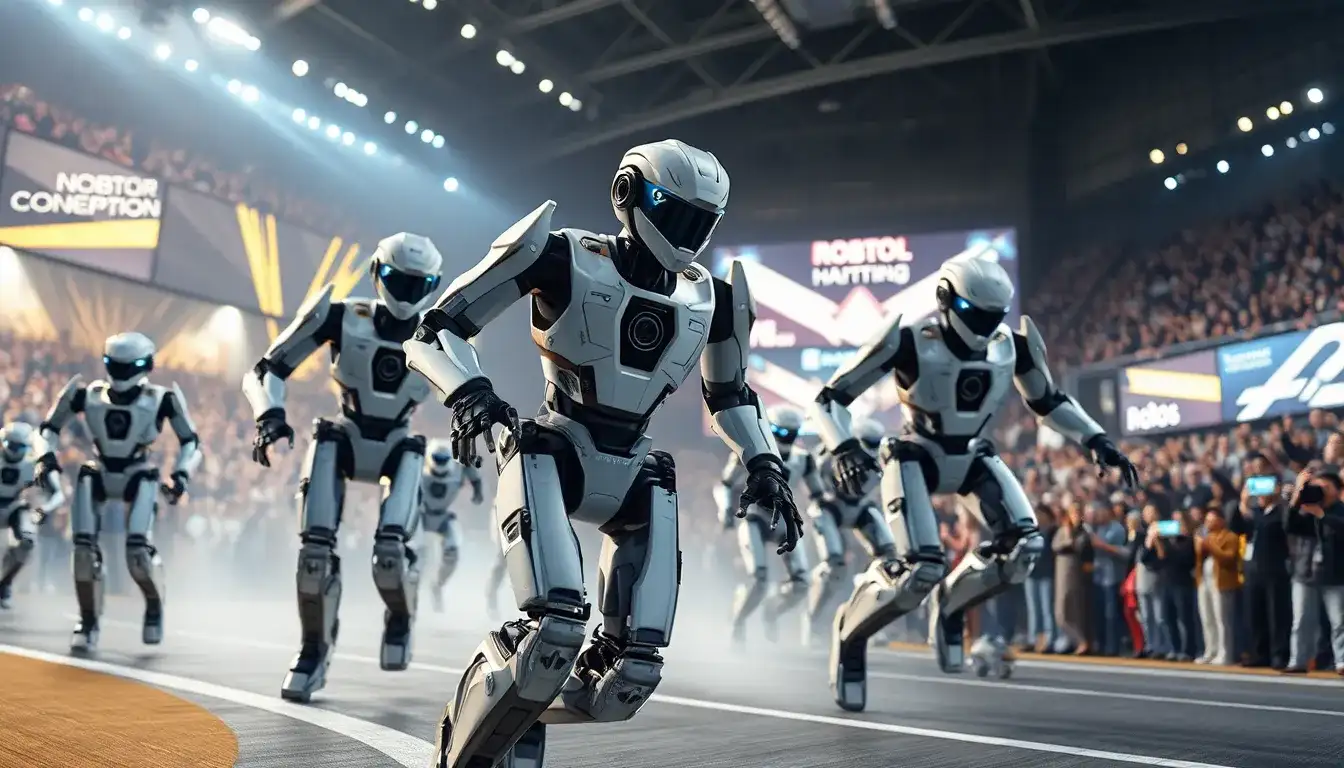
On February 24, news emerged that Honor plans to unveil its first humanoid robot at the 2026 World Mobile Communication Conference (MWC). The company has recently restructured its organization and established a new industrial incubation department. The robot market is experiencing rapid growth, with smartphone manufacturers like Vivo, Xiaomi, and Huawei entering the field, each following a different strategic path. This move by phone makers highlights their urgent pursuit of new growth opportunities. A seamless integration across all device scenarios could enhance user loyalty, but the crossover also presents challenges in technology, profitability, and market development.
At the upcoming MWC 2026, Honor will showcase its humanoid robot, targeting the consumer market and positioning itself as the first smartphone company to enter this space. Alongside the humanoid robot, Honor will also present other previously unveiled products, including a “robot phone.” This humanoid robot may be one of the latest developments from Honor’s new industrial incubation department. In 2025, Honor restructured its organization to create new divisions focused on AI (artificial intelligence) operating systems, AI hardware, and AI platforms, and established the industrial incubation department in April 2025, which includes various laboratories dedicated to embodied intelligence.
Honor is not alone in venturing into the robotics sector, as other smartphone manufacturers such as Apple, Huawei, Vivo, and Xiaomi have also turned their attention toward embodied intelligence. Robots are increasingly seen as a potential strategic terminal following smart phones and smart cars. Currently, the robot market is at a pivotal moment of rapid development. According to data from the GGII Robotics Industry Research Institute, the global humanoid robot market is projected to reach 6.339 billion yuan by 2025 and grow to 64 billion yuan by 2030, eventually surpassing 400 billion yuan by 2035. The significant future growth potential has attracted numerous participants. Notably, this year’s CCTV Spring Festival Gala showcased the capabilities of robotics in China: a robot from Songyan Power could recognize and replicate subtle facial expressions, enabling emotional interactions; the martial arts segment featured a humanoid robot from Yushu Technology performing advanced maneuvers; and Galaxy General Robots demonstrated practical skills in daily tasks, such as folding clothes and picking up glass shards.
Reflecting on the 2025 Spring Festival Gala, the portrayal of humanoid robots was largely an entertaining spectacle. However, by the 2026 event, various robot companies validated the underlying capabilities of robots in motion control, operational precision, and coordination across multiple scenarios. In this competitive landscape of robotics, smartphone manufacturers are not outsiders; their extensive experience in large model capabilities, imaging algorithms, chip calibration, and battery management are all essential technologies for embodied intelligence. For instance, the current wave of interest in robotics is driven by breakthroughs in foundational large model technologies, exemplified by ChatGPT, which has enabled robots to engage in natural language communication that closely resembles human interaction, addressing previous limitations in robot intelligence.
Why are smartphone manufacturers collectively entering the robotics sector? Each company is following its distinct strategic path. Honor introduced its AI-focused Alpha strategy in 2025, aiming for a transformation into an AI terminal ecosystem company by 2026. In its New Year address for 2026, the company announced plans to accelerate the integration of AI into everyday scenarios and intends to produce Alpha phone robots and embodied intelligence robots while establishing an Alpha laboratory. Similarly, Vivo and Xiaomi are also intensifying their efforts in humanoid robotics. In March 2025, Vivo established a robotics lab under its central research institute, focusing on the incubation and research of robotics products, particularly household robots. Vivo’s Chief Operating Officer, Hu Boxuan, previously stated that the company’s largest technological investments would be in mixed reality (MR) and humanoid robotics, anticipating that the ideal vision of robots will take over a decade to realize.
Xiaomi showcased its full-size humanoid bionic robot, CyberOne, in August 2022, which stands at 1.77 meters and weighs 52 kg. The Xiaomi robotics team is currently working on its fourth generation of products, aimed at standard operational tasks such as material handling and equipment inspection. In November 2025, Xiaomi’s founder and chairman, Lei Jun, stated that humanoid robots would be widely deployed in Xiaomi factories within the next five years, emphasizing the greater demand and higher standards for household humanoid robots. Huawei’s approach to robotics is somewhat unique, primarily providing a cloud robotics platform to assist enterprises in manufacturing and developing robots. For instance, the humanoid robot “Kuafu” from Leju is equipped with Huawei’s Pangu embodied intelligence model.
Internationally, Apple is in the early concept validation stage of its robotics project, with expectations of mass production by 2028 or later. Analyst Guo Mingqi from Tianfeng International noted that Apple’s ambition lies in redefining human-machine interactions rather than merely creating a walking metal shell. This suggests Apple’s core technology may focus on “environmental perception hardware and intelligent interaction software,” leveraging sensors and AI algorithms for natural communication with users, rather than simply aiming for a humanoid appearance.
The influx of various smartphone manufacturers into the robotics realm reflects an urgent desire within the domestic smartphone industry to seek new growth points during a period of market saturation. Additionally, a mature supply chain system and large-scale manufacturing capabilities provide a solid foundation for these companies to enter the robotics field. The smartphone industry is characterized by a high degree of specialization, and leading manufacturers have already established robust supply chains and manufacturing capabilities. This enables them to achieve more precise assembly, expedite delivery, and scale production, thus promoting the standardization of the robotics industry.
Looking ahead, if smartphone manufacturers can connect users’ mobile phones, homes, cars, and robots across all device scenarios, it could lead to a more efficient and convenient experience for users and further enhance brand loyalty. However, the robotics sector is not without its challenges. For smartphone companies, entering the robotics industry presents significant hurdles, including high technical difficulties, long profitability cycles, and slow market cultivation.
Original article by NenPower, If reposted, please credit the source: https://nenpower.com/blog/mobile-manufacturers-enter-robot-race-as-market-expands-and-competition-intensifies/

