

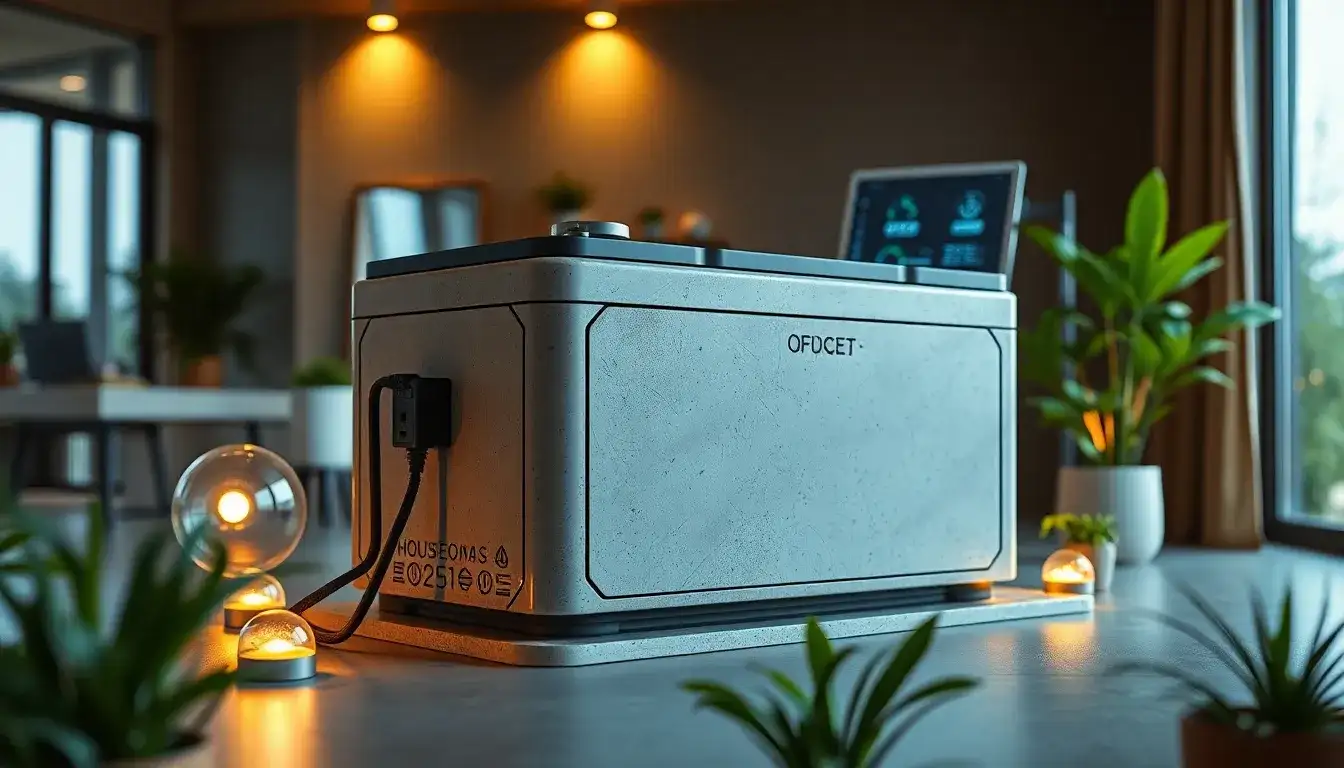
MIT has announced a breakthrough in energy storage technology with the development of a new type of electron-conducting carbon concrete (abbreviated as EC³), which can store and release electrical energy like a battery. Research indicates that this material has achieved a tenfold increase in energy density compared to previous results, paving the way for buildings to function as energy storage batteries. The findings were published on September 29, 2025, in the Proceedings of the National Academy of Sciences (DOI:10.1073/pnas.2511912122).
This innovative material comprises cement, water, ultrafine carbon black (containing nanoscale particles), and electrolytes, creating a conductive nanoscale network for energy storage and release. This advancement suggests that ordinary walls, sidewalks, and even bridges could serve dual purposes as both structural elements and energy storage devices.
According to experimental data, a typical household in 2023 requires about 45 cubic meters of EC³ for a day’s electricity consumption. However, with the new electrolytic formula, only 5 cubic meters are needed, equivalent to the volume of a basement wall. Admir Masic, co-director of the MIT EC³ Hub, stated, “The key to concrete sustainability lies in developing ‘multifunctional concrete.’ Concrete is the most widely used building material globally; why not leverage this scale to create more value?”
During the research, the team utilized FIB-SEM tomography to image the material layer by layer, discovering that carbon black forms a fractal-like network in the pores, allowing the electrolyte to permeate and enhance current flow. Masic emphasized, “Understanding how these materials ‘self-assemble’ at the nanoscale is crucial for realizing new functionalities.”
The researchers tested various electrolytes, noting that seawater could also be effective, indicating potential applications of EC³ in coastal engineering and offshore wind facilities. Additionally, they improved the method of incorporating the electrolyte by mixing it directly with water before pouring, resulting in thicker and more efficient electrodes. Experiments showed that using an organic electrolyte, one cubic meter of EC³ can store over 2 kilowatt-hours of energy, sufficient to power a refrigerator for an entire day.
To showcase its capabilities, the team constructed a small EC³ arch, which not only bears weight but also powers LED lights. When the structure is under pressure, the lights flicker, suggesting potential future applications in real-time monitoring of building health. Previously, EC³ was tested in Sapporo, Japan, to heat sidewalks by utilizing its thermal conductivity to melt snow. MIT’s latest findings further broaden the prospects for large-scale energy storage applications.
Damian Stefaniuk, the paper’s lead author, remarked, “One of our greatest motivations is to drive the transition to renewable energy. Solar power generates electricity only during sunny conditions; how do we meet energy demands at night or on cloudy days?” Franz-Josef Ulm, co-director of the EC³ Hub, added, “The answer lies in the ability to store and release energy. Traditional batteries rely on scarce or harmful materials, and we believe EC³ offers a viable alternative.” Co-author James Weaver, a professor at Cornell University, noted, “By combining modern nanoscale science with ancient building blocks, we are opening a new door that allows infrastructure not only to support life but also to power it.”
Original article by NenPower, If reposted, please credit the source: https://nenpower.com/blog/mit-unveils-revolutionary-concrete-battery-with-tenfold-energy-density-increase-capable-of-powering-homes-for-a-day/

