

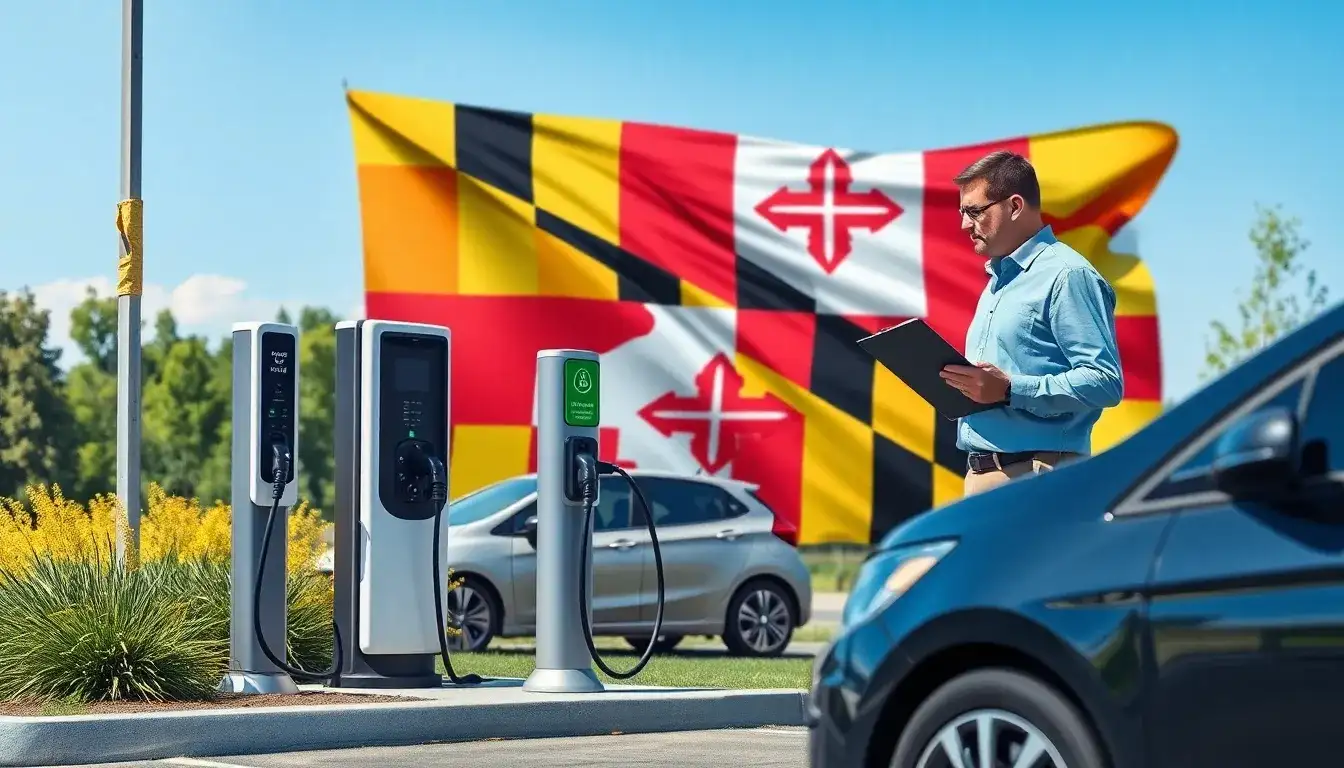
Maryland has launched its first inspection program for electric vehicle (EV) charging stations, as reported on May 8, 2025. The initiative is spearheaded by a lesser-known team of 18 inspectors from the Maryland Department of Agriculture, who traditionally focused on verifying the accuracy of fuel pumps and supermarket scales.
Recently, these inspectors have begun to assess public charging stations throughout the state, partly in response to customer complaints. Alison Wilkinson, the head of the department’s measurements division, mentioned that this effort could provide significant relief to many EV owners, including Agriculture Secretary Kevin Atticks, who often struggles to find reliable charging stations. “It’s becoming increasingly important. Sometimes I visit three locations only to find I can’t charge and end up wasting an hour,” Atticks shared.
Wilkinson clarified that while this inspection program will not enforce regulations regarding the operational hours of charging stations, it will focus on verifying that the energy consumption displayed by the chargers is accurate and that consumers are charged fairly. If an inspector identifies a non-functional charging station, the department will require the operator to make repairs. According to Atticks, “We are not responsible for monitoring operational hours, as that does not fall under the measurements’ jurisdiction. However, under Maryland law, equipment owners are responsible for maintaining their devices in an accurate and functional state.”
Some charging stations have already been temporarily closed due to violations, primarily for charging by the hour rather than by kilowatt-hour (kWh), which could disadvantage slower-charging vehicle owners. The rollout of this inspection program comes at a time when the future of the EV industry is uncertain, as the new presidential administration has withdrawn support and funding for the EV sector. This change impacts the National Electric Vehicle Infrastructure (NEVI) formula program, which was meant to add chargers along Maryland highways.
Josh Cohen, policy director of SWTCH Charging, remarked, “As the entire industry faces significant headwinds from Washington, places like Maryland that have set bold EV goals must consider whether to impose heavy regulations at this time.” However, some lawmakers believe inspections are necessary. State Senator Shelly Hettleman stated that while Tesla chargers are reliable, other brands “do not perform as well,” which could frustrate current owners and deter future purchases. Hettleman expressed, “The last thing we want is to disappoint those who have invested in EVs and have them revert to gas-powered vehicles.” She introduced Senate Bill 913, which would authorize the agriculture department to inspect EV chargers and establish reliability standards, requiring devices to be operational over 97% of the time. The bill ultimately did not pass, partly due to high enforcement costs related to the state’s budget constraints.
Nevertheless, the agriculture department stated that it would conduct EV charger inspections under existing authority, referencing the NIST Handbook 44 without requiring new legislation. Maryland EV owner and blogger Lanny Hartmann participated in a statewide charger survey from late 2024 to early 2025 and found that Tesla and Rivian account for about half of the state’s charging stations, with 99% operational. However, 31% of the remaining stations were found to be non-functional. Hartmann noted that many charging stations are publicly funded or built using user rate funds from utility companies. He expressed concerns that the government should not act as “charging police” and feared that inspection costs would ultimately be passed on to consumers, resulting in higher charging fees.
In January, the agriculture department began registering EV charger maintenance technicians, with a registration fee of $200 per institution, $50 per technician, and an additional $25 testing fee. The department will also require all consumer-facing charging stations to register, with regulations expected to be issued in the fall or winter of this year. The annual fee has yet to be determined and will be based on the actual time, labor, and equipment costs needed for inspections.
Conducting these inspections requires expensive equipment, with each standard testing machine costing over $100,000, along with specialized transportation and staff training. It is estimated that 2 to 3 additional employees will need to be hired, with statewide charging stations inspected every few years. Wilkinson pointed out that unlike gas stations, some EV charging stations are located within parking lots, requiring inspectors to pay for entry and charge their vehicles at their own expense. If they encounter slow chargers, inspectors may need to wait several hours or make multiple visits. “We generally have a plan in place, but we will face challenges; this is part of the path for promoting emerging technologies,” she remarked.
Original article by NenPower, If reposted, please credit the source: https://nenpower.com/blog/maryland-launches-first-electric-vehicle-charging-station-inspection-program/

