

Large-Scale Fire Testing: Fluence, Hithium, Canadian Solar BESS
—
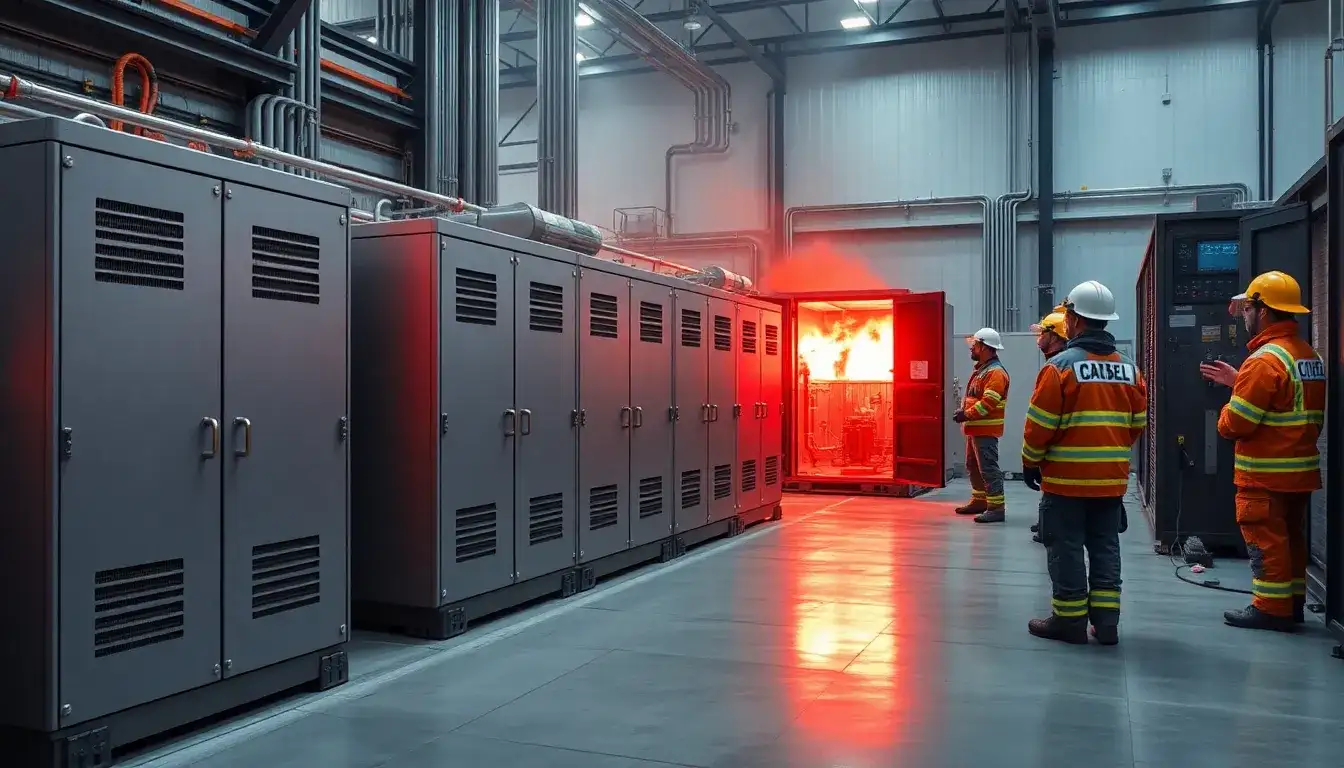
A trio of prominent players in the battery energy storage system (BESS) integration sector—Hithium, Canadian Solar, and Fluence—recently shared the results of their Large-Scale Fire Testing (LSFT). Each company reported that their tested units did not allow fire to spread to neighboring units, even when set ablaze.
Large-scale fire testing is increasingly being recognized as a best practice among BESS technology providers. This testing is designed to simulate worst-case scenarios that equipment may encounter in real-world conditions. Although modern BESS equipment typically incorporates multiple layers of fire detection and suppression features, LSFT involves igniting a unit with all fire prevention and mitigation functions disabled, allowing it to burn freely.
In November of the previous year, CSA Group partnered with Energy-Storage.news to host a free webinar titled “Evolving large-scale fire testing requirements for battery energy storage systems.” During this event, experts highlighted the purpose, scope, and methodology of the latest LSFT procedures. Michael Becker, the global business director for energy and power at CSA Group, noted that manufacturers and authorities having jurisdiction (AHJs) had requested a formal test protocol for large-scale fires at BESS installations. LSFT is expected to become a mandatory requirement under the upcoming 2026 edition of the National Fire Protection Association (NFPA) NFPA 855 standard for storage systems.
### Canadian Solar’s e-STORAGE Solbank 3.0
In early June, Canadian Solar announced that its SolBank 3.0 BESS solution, manufactured through its CSI Solar subsidiary, underwent the CSA C-800:25 §9.7 LSFT protocol. Joshua Dinaburg, a fire test specialist at CSA Group, stated that stakeholders in the energy storage industry have raised valid concerns regarding the ability of BESS units to prevent fire spread without relying on complex extinguishing systems, which could pose risks to first responders. The flames were contained within the SolBank 3.0 enclosure, without propagating to adjacent enclosures. Throughout the test, doors, louvers, and structural elements remained closed and intact. Dinaburg emphasized that the e-STORAGE system demonstrated its capability to prevent fire spread, which provides critical data for end-users, site managers, first responders, and the surrounding community.
### Fluence Gridstack Pro 5000
Fluence also conducted tests on its Gridstack Pro 5000 BESS unit, which included fire and explosion testing. Although the company did not specifically reference the CSA C-800:25 §9.7 LSFT protocol in its announcement on June 13, it confirmed that CSA Group observed the tests, which “far exceeded” current UL9540A thermal runaway testing requirements and aligned with NFPA 855 standards. The tests, carried out at SAFE Labs in North Carolina, included five days of explosion testing prior to fire testing. The explosion tests involved two days of dispersion testing, ensuring effective gas exhaustion to prevent the buildup of flammable gases, in accordance with NFPA 69. During the fire testing, four Gridstack Pro 5000 enclosures equipped with live batteries were placed closely together, with the center unit ignited. No fire spread to adjacent units, and the battery cells in the unaffected units remained within safe limits. Peter Williamson, Fluence’s chief product and supply chain officer, stated that the extensive testing not only validated their design but also showcased how next-generation systems should perform in extreme scenarios.
### Hithium’s Unique Testing Approach
Hithium recently announced a groundbreaking LSFT, claiming it to be a world-first, where all doors of its ∞Block 5MWh container were left open during testing. This unconventional approach is intended to set a new safety benchmark in the industry. The test involved four containers spaced just 15cm apart, each fully charged. One unit was ignited, and despite enduring 15 hours of combustion at temperatures reaching 1300°C, the integrity of the ignited unit remained intact, with no fire spreading to neighboring containers. The testing was conducted by UL Solutions and witnessed by certified US fire protection engineers along with Hithium customers.
Other notable instances of LSFT from various battery storage companies since late last year include Wärtsilä, which was among the first to adopt CSA’s new protocol that mimics real-world worst-case scenarios, and Sungrow, which live-streamed a four-unit burn test for select customers and stakeholders.
—
This ongoing development in fire safety testing for battery energy storage systems demonstrates the industry’s commitment to enhancing safety standards and ensuring reliability in emergency situations.
Original article by NenPower, If reposted, please credit the source: https://nenpower.com/blog/major-battery-energy-storage-systems-pass-large-scale-fire-testing-without-flame-propagation/

