

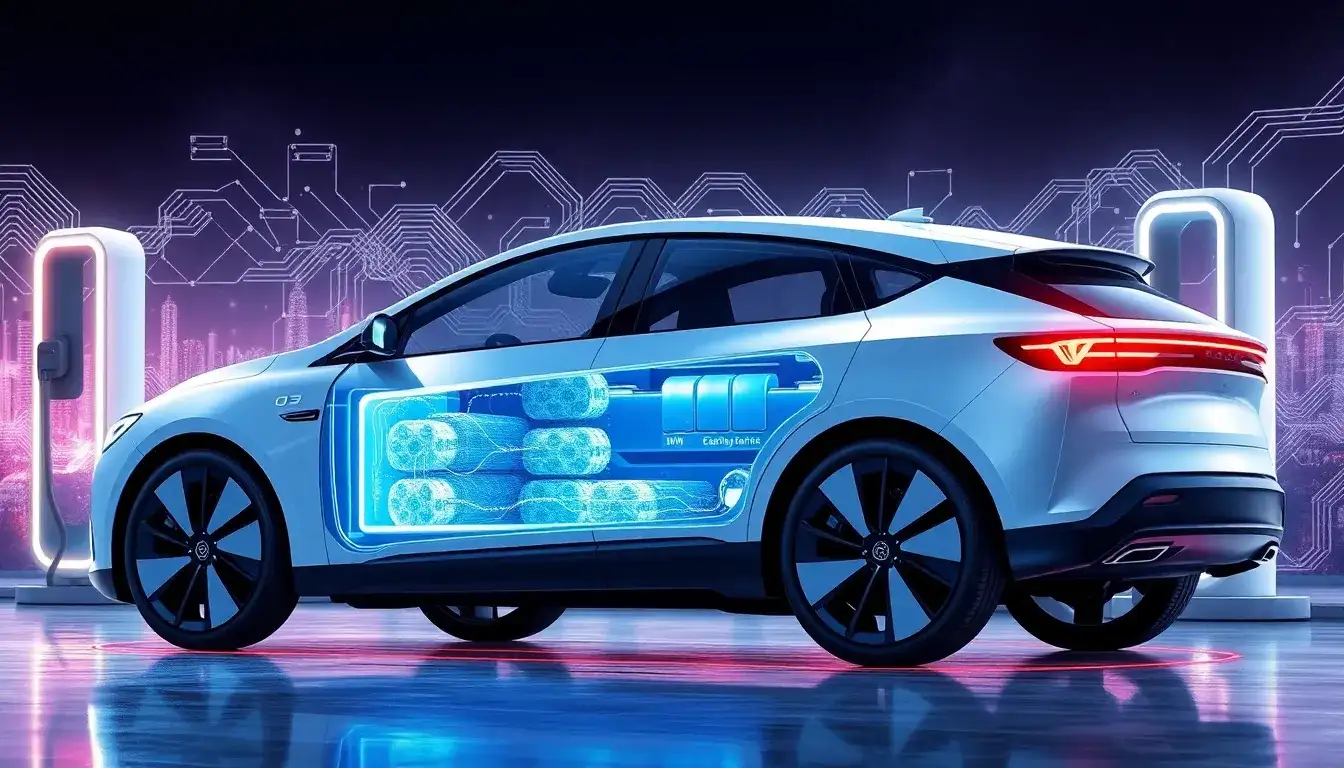
Solid-state batteries have been hailed as the ultimate solution for electric vehicle (EV) energy storage. They promise higher energy densities, quicker charging times, and enhanced safety compared to traditional lithium-ion batteries. However, achieving commercial viability has remained a challenge—until now.
Researchers from the Hong Kong University of Science and Technology (HKUST) have made significant progress by integrating machine learning (ML) with materials science to expedite the discovery of a next-generation solid electrolyte. By training their ML model on a comprehensive dataset of known materials and their properties, the team was able to identify promising candidates for new ion-conducting solids.
The breakthrough material identified is a type of elastic, ductile alloy that exhibits high lithium-ion conductivity and structural flexibility. This stretchable, quasi-crystalline alloy maintains its integrity under mechanical stress, which is a common issue with solid-state electrolytes that often fracture or lose contact over time. Its elasticity allows it to accommodate volumetric changes during charging cycles, thereby minimizing the risk of dendrite formation and enhancing long-term stability. Laboratory tests have validated the alloy’s superior ionic conductivity and its compatibility with high-voltage cathodes.
Although the HKUST team did not specify a target energy density, materials with similar structural and electrochemical characteristics—especially sulfide-based solid electrolytes—have been integrated into battery architectures aiming for energy densities ranging from 350 to 500 Wh/kg. These figures represent a substantial advancement over current lithium-ion technologies and align with the broader industry objectives for solid-state systems.
What distinguishes this research is the efficiency gained through machine learning, which has reduced years of trial-and-error experimentation to mere weeks of computation. Instead of manually sifting through thousands of chemical compositions, the team’s model streamlined the search process to focus on top candidates with a high likelihood of success. Once the alloy was pinpointed, computational modeling and physical validation confirmed its potential.
In parallel, in the automotive sector, BMW and Solid Power have initiated tests of solid-state cells in the BMW i7, marking a transition from laboratory prototypes to vehicle-scale evaluations. These batteries are also sulfide-based, with early iterations already achieving energy densities exceeding 350 Wh/kg. The ambitious goal is to reach 500 miles of range with a charging time of just 15 minutes—a significant advancement that could make EVs more attractive than fuel-powered vehicles across all metrics.
The convergence of these developments is particularly exciting. Machine learning is enabling scientists to discover high-performance materials essential for next-generation batteries, while automakers are finally testing these materials under real-world conditions. The research from HKUST could seamlessly integrate into industry pipelines, accelerating the path to commercial readiness.
Although solid-state batteries have yet to become mainstream, the combination of artificial intelligence, innovative material design, and automotive industry momentum is rapidly bridging the gap. The next significant advancement in EV range and safety may not stem from larger batteries, but rather from smarter ones.
Original article by NenPower, If reposted, please credit the source: https://nenpower.com/blog/machine-learning-accelerates-the-development-of-solid-state-batteries-for-electric-vehicles/

