

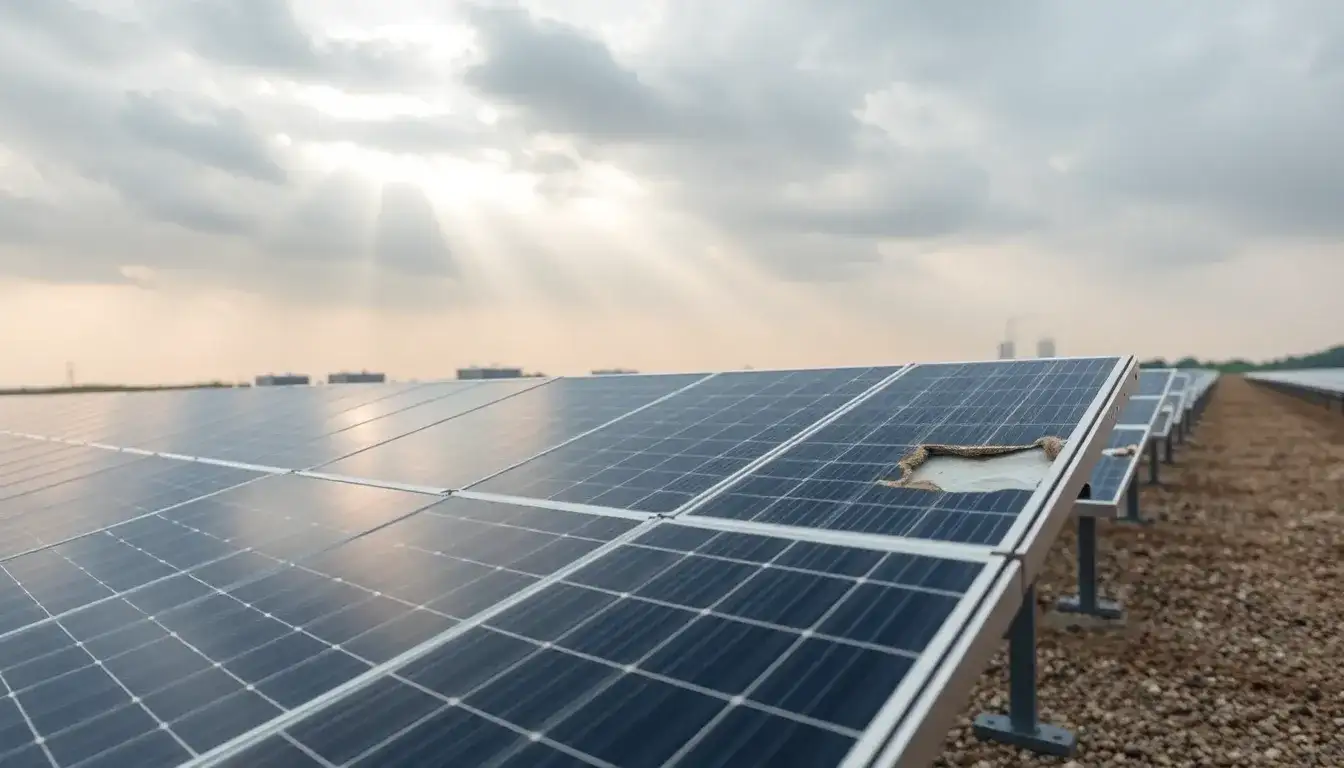
Li Zhenguo, the founder of Longi Green Energy, has been referred to as a “whistleblower” for sounding the alarm about the challenges facing the photovoltaic (PV) industry two years ago. Longi Green Energy is currently navigating what is described as the “strongest” cyclical storm in history. On April 29, the company released its annual report for 2024 and its first-quarter report for 2025, revealing losses of 8.617 billion yuan and 1.436 billion yuan respectively. This marks a period of significant difficulty for the PV industry, the most challenging in nearly a decade.
Li Zhenguo, as the “whistleblower,” predicted that in the next two to three years, more than half of the companies in the sector would be eliminated, with overcapacity potentially occurring as soon as next month, the following quarter, or later this year. In response to this forecast, Longi has committed to the development of BC technology, launching the HPBC 2.0 product line and undergoing organizational changes, efficiency reforms, and business transformations.
Despite a complex market environment in 2025, Longi Green Energy anticipates a return to a competitive and agile state in the second half of the year. The company will continue to monitor changes in domestic and international markets to address the industry’s cyclical fluctuations and competitive challenges.
Once hailed as the “king of photovoltaics,” Longi Green Energy (601012.SH) is currently traversing the “winter” cycle of the PV industry. The past year has seen a mismatch in supply and demand, leading to a drop in prices and pushing the PV sector into its most challenging times in the last decade. In May 2023, during the SNEC event, Li Zhenguo conveyed a sense of foreboding for the industry, predicting the elimination of many companies due to overcapacity.
As PV capacities are gradually released, the industry has faced the strongest internal competition in history, resulting in losses far exceeding those from previous cycles. Given this context, what actions has Longi taken? In September 2023, the company announced its commitment to developing BC technology over the next five to six years, which is expected to become mainstream in crystalline silicon batteries. Since then, Longi has launched and upgraded its second-generation BC components.
Additionally, the company has initiated organizational changes, efficiency reforms, and business transformations to “rebuild its championship spirit and regain its fighting spirit.” During Longi’s 25th anniversary speech, Li Zhenguo expressed confidence that by the second half of 2025, the company would achieve a significantly improved position.
Longi’s chairman, Zhong Baoshen, stated in a letter to shareholders that the most challenging year has passed, and the company is ready to embrace a new dawn in the industry. In a discussion on CCTV’s “Dialogue” program, Zhong joined other industry leaders who acknowledged the unprecedented performance pressures caused by cyclic fluctuations. In 2024 alone, 30 publicly traded PV companies collectively reported losses exceeding 50 billion yuan.
Longi explained its shift from profit to loss in 2024 by citing the low production ratio of its HPBC 2.0 products and the intensified competition leading to declining prices and gross margins for PERC and TOPCon products. The company faced limited capacity utilization, increased asset impairment provisions due to technological iterations, and investment losses from its silicon material subsidiaries.
Reflecting on the past three years, the PV market appeared to be filled with opportunities for demand growth and technological iteration. However, the scale and rapid expansion of both new and existing capacities have made it challenging to realize investment returns. The escalating low-price competition has further strained the entire market, leading to continuous price declines across the industry chain, even dropping below cost prices, with frequent announcements of production cuts, plant closures, and layoffs.
In this challenging environment, Longi has maintained its position within the top tier globally for silicon wafers and components, achieving shipments of 108.46 GW of silicon wafers (with 46.55 GW in external sales) and 82.32 GW of battery components in 2024. However, Li Zhenguo acknowledged that “2024 was a year of diminished accomplishment, marked by internal struggles and challenges.” He recognized the need for the company to better serve stakeholders and ensure its survival to create value for society.
Longi has been benchmarking itself against Huawei, adopting a customer-centric culture and management approach, which is evident in its organizational reforms in 2024. The company has focused on streamlining operations to reduce layers of management, allowing resources to reach customers directly while minimizing intermediary positions. Furthermore, it has emphasized a project-based approach to enhance organizational agility and responsiveness to market changes.
In terms of management efficiency, Longi’s operating costs in 2024 amounted to 76.44 billion yuan, a decrease of 27.54% year on year, with administrative expenses dropping to 3.43 billion yuan, down from 4.91 billion yuan in 2023. Anticipating industry trends, Longi has prioritized maintaining stable cash flow and financial health, focusing resources on core business areas. By the end of 2024, the company reported a debt-to-asset ratio of 59.83%, an interest-bearing debt ratio of 19.49%, and cash reserves of 53.157 billion yuan.
Longi has intentionally slowed its investment pace, considering ecological transitions globally and emphasizing long-term investment value. Zhong Baoshen mentioned that to better adapt to changes, the company has empowered long-term customers like Invenergy through joint ventures and management support while jointly investing with companies like Yingfa and Pingmei to expand BC capacity.
Over the past three years, Longi has chosen a different path, forgoing large-scale expansion of TOPCon technology in favor of more capital investment in BC technology innovation and development. Longi believes that the lifecycle of TOPCon technology is significantly shorter than that of the previous generation PERC technology, and the rapid scale of production could lead to high product homogeneity, thus increasing the risk of overcapacity before profitability.
Zhong Baoshen stated that innovation is essential for thriving in the current supply-demand dynamics of the industry. As the market grapples with supply-demand imbalances and the challenges of homogeneous competition, Longi has continued to launch successive iterations of BC technology products. Since announcing its focus on BC technology in September 2023, Longi has progressed from HPBC 1.0 to HPBC 2.0, introducing new components tailored for various applications.
Longi’s HPBC product line has seen substantial efficiency and performance improvements, addressing challenges in mass production costs. As of now, Longi has accumulated orders for 30 GW of HPBC series components, with 17 GW shipped in 2024, and reserve orders exceeding 40 GW, covering over 30 countries and regions, including Europe, the Middle East, and Asia-Pacific. Based on 2025 shipment targets, Longi expects to deliver 80-90 GW of components, with BC components accounting for over 25%.
By the end of 2025, Longi aims to achieve approximately 50 GW of production capacity for HPBC 2.0 batteries and components, with mass production costs expected to be on par with or lower than TOPCon technology. Zhong Baoshen previously indicated that while 2024 was viewed as the most difficult year for Longi, the continuous rollout of BC technology products and increasing market recognition could help the company return to a growth trajectory by 2025.
Li Zhenguo emphasized that Longi does not pursue uniqueness for its own sake but seeks to ensure that its chosen path is the correct one. Similar to its early commitment to monocrystalline technology, Longi views BC technology as a future technology with significant competitive advantages that warrants dedicated investment. Over the past decade, Longi has adhered to first principles and utilized technological innovation to reshape industry logic.
Longi’s past breakthroughs in RCZ technology, the introduction of diamond wire cutting technology, and the promotion of PERC and bifacial technology have effectively reduced costs and improved efficiency in the PV sector, driving industry advancement. Through this journey, Longi has seen its performance and stock prices soar, achieving a market capitalization exceeding 500 billion yuan in 2021, illustrating a wealth story driven by innovation.
As Longi leads the transformation to BC technology, it aims to usher in a new era for the industry. The BC technology ecosystem is expanding, with numerous PV companies, including Yidao New Energy, Zhengtai New Energy, JinkoSolar, Aiko Solar, Yingfa, and Pingmei, also advancing their BC technology efforts. Industry predictions suggest that the SNEC exhibition in 2025 will feature a series of BC products as a highlight of the year. While it remains uncertain whether BC technology will become the mainstream market offering, it is clear that Longi values technological innovation and is committed to investing heavily in research and development.
Over the past five years, Longi has invested a total of 23.5 billion yuan in R&D, with around 5 billion yuan allocated in 2024 alone. The cumulative investment from HPBC 1.0 to HPBC 2.0 has exceeded 2 billion yuan. Currently, Longi holds world records in efficiency for both monocrystalline silicon batteries and silicon-perovskite tandem batteries.
As of the first quarter of 2025, most PV companies are still facing difficulties, with even leading firms reporting losses exceeding 1 billion yuan. Longi Green Energy also recorded a loss of 1.436 billion yuan. During an earnings briefing, Zhong Baoshen expressed confidence that due to the significant efforts made in 2024, 2025 will show marked improvement, aiming for Longi to return to profitability by the third quarter.
Li Zhenguo reiterated that Longi is focusing on improving its situation, especially by the second half of 2025, confident that the company will be in a strong position. He outlined two key factors: Longi’s advanced BC capacity will be scaled by mid-2025, and the effectiveness of the organizational changes, efficiency reforms, and business transformations implemented over the past year will be evident. “In the second half of 2025, Longi will regain its competitive edge and agility, continuing to forge ahead,” Li Zhenguo stated.
As we enter 2025, the domestic and international PV market environments have become increasingly complex. Domestically, since the fourth quarter of 2024, relevant departments and organizations have implemented measures to adjust the supply side and mitigate “involutionary” competition. This has led to some stabilization in product prices through self-regulated production cuts and price limits.
In February 2025, the introduction of the “Notice on Deepening the Marketization of Renewable Energy Grid Pricing to Promote High-Quality Development” spurred a short-term surge in demand, elevating product prices briefly. However, the policy has also altered the investment logic for renewable energy projects, and currently, PV product prices are once again declining.
Industry experts suggest that attention should be paid to the launch of centralized projects in the second half of 2025 and changes in overseas demand, as well as market competition dynamics. On the international front, following new anti-dumping investigations by the US against four Southeast Asian countries (Cambodia, Malaysia, Thailand, and Vietnam), additional tariffs have been imposed globally. Furthermore, the implementation of India’s ALMM list and increased tariffs on PV product imports in Brazil and South Africa add uncertainty for companies looking to expand internationally.
Longi’s performance in the global market in 2024 indicates that the company has successfully penetrated various channels and promoted product value: it leads in market share in China’s and Europe’s centralized markets; its US joint venture component factory is operating at full capacity, driving strong growth in the high-value US market; and its brand and channel advantages in emerging markets, particularly in the Middle East and Africa, have resulted in a 76% increase in component sales, with a 136% year-on-year surge in Pakistan.
Looking ahead to 2025, Zhong Baoshen anticipates that the overall market will enter a phase of moderate growth. Due to the significant increase in 2024 and the uncertainties surrounding 2025, market demand may remain flat or see minimal growth. Additionally, the impact of US tariff policies is affecting imports from the four Southeast Asian countries, Laos, Indonesia, and India, while the size of the domestic US market remains uncertain and requires monitoring.
Zhong Baoshen concluded in his letter to shareholders that “the most challenging year for Longi has passed.” The company aims to navigate through cycles by offering differentiated products and solutions tailored to customer pain points, maintaining a competitive cost structure, a robust balance sheet, and an open capacity ecosystem globally, ready to embrace a new dawn in the industry.
Original article by NenPower, If reposted, please credit the source: https://nenpower.com/blog/longi-green-energy-navigates-the-toughest-period-in-solar-industry-history-amid-significant-losses-and-strategic-transformations/

