

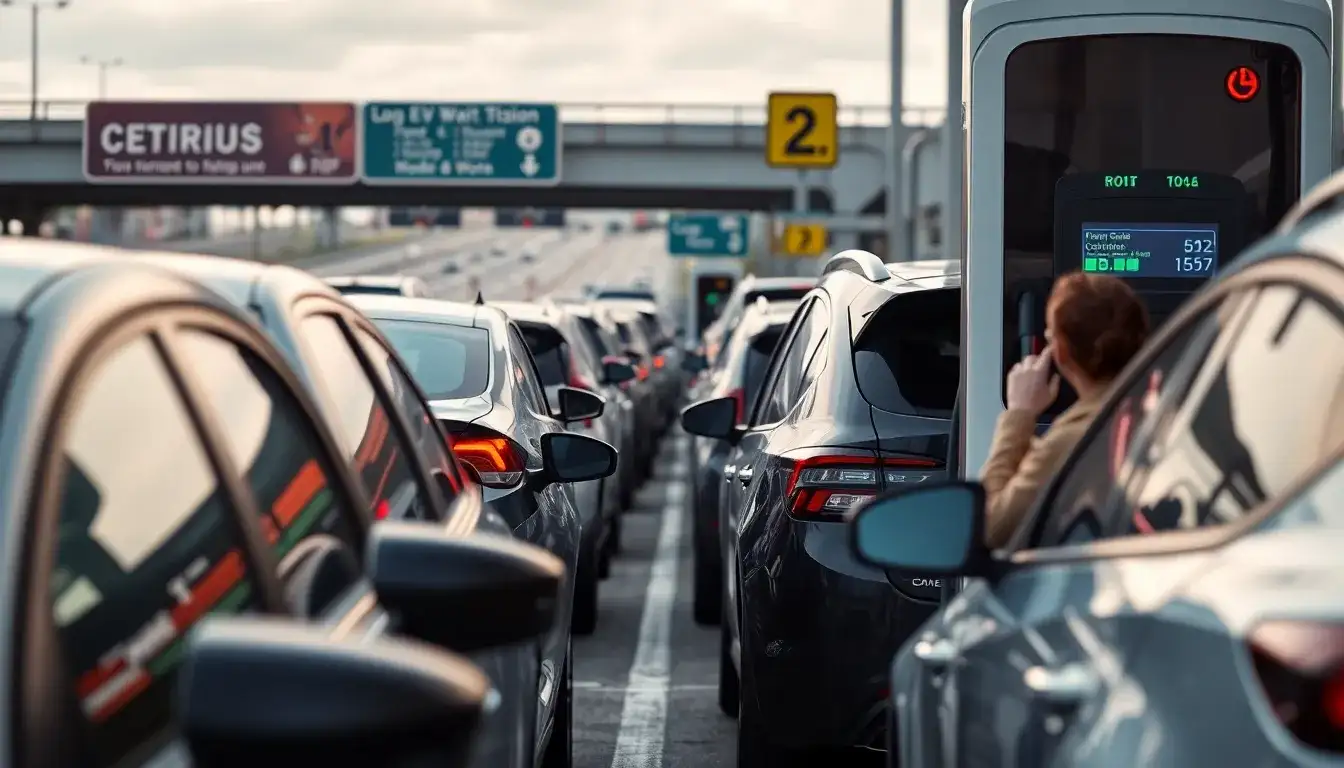
On the evening of September 30, a video shared by a netizen showed electric vehicles charging at a highway service area, where a staff member was calling out numbers for charging. One car owner reported waiting for over four hours, reaching number 60 in line. Another owner humorously remarked, “I woke up from a nap and it still wasn’t my turn!”
On the first day of the National Day holiday in 2025, many highway service areas across the country experienced severe congestion at electric vehicle charging stations, with some owners waiting over three hours. The charging stations had implemented a “number-calling mode” to maintain order. As of October 1, 2025, the State Grid predicted that more than a third of charging stations at highway service areas nationwide were at full capacity.
Reducing charging times is seen as a crucial factor in alleviating range anxiety for electric vehicles and is currently a key area of competition among automakers. Higher power charging facilities are essential for achieving shorter charging times.
In light of significant enthusiasm from companies and local governments for high-power charging facilities, the National Development and Reform Commission, along with the National Energy Administration, issued a notice in June aimed at promoting the scientific planning and construction of such facilities. This was the first document from national ministries addressing high-power charging infrastructure, emphasizing the need for an “appropriate advanced” layout of charging facilities, with a goal of exceeding 100,000 high-power charging stations nationwide by the end of 2027.
Determining the right balance for “appropriate advancement” to ensure that high-power charging facilities function effectively while avoiding oversupply is currently a focal point.
On June 30, 2023, during the International Digital Energy Expo in Shenzhen, a demonstration station featuring full liquid cooling technology and ultra-fast charging was launched by Southern Power Grid and Huawei, providing an experience of “one second per kilometer” and “full charge in the time it takes to drink a cup of coffee.”
The power level of charging stations directly affects charging speed. For instance, home charging stations typically provide around 7 kilowatts of power, which would take about ten hours to fully charge a vehicle with a 70-kilowatt-hour battery. Early public charging networks also primarily consisted of slow AC charging stations. However, with the gradual rollout of DC fast chargers, power levels have increased significantly, reaching hundreds of kilowatts and even megawatt levels. Technologies referred to as fast charging, ultra-fast charging, and rapid charging are being rapidly adopted.
Cities like Chongqing, Guangzhou, and Shenzhen have set ambitious goals to become “ultra-charging cities.” Shenzhen has set a short-term target for 2023 to establish no fewer than 150 public ultra-charging stations by the end of the year, reaching a minimum of 300 by the end of March 2024. However, there is currently no unified definition for what constitutes ultra-charging, though cities like Beijing and Shenzhen consider ultra-charging equipment to have a rated power of no less than 480 kilowatts.
What is the ideal power level for charging facilities? The answer is not simply to pursue “higher power.” Achieving high-power charging depends on both the charging infrastructure and the technology of the vehicles and batteries. “The capacity of the charging station may be limited by the vehicle, and vice versa. For example, the charging capacity at the vehicle end largely depends on the voltage platform,” explained Li Lili, Deputy Director of the Energy Internet Research Institute at Tsinghua University.
Shenzhen’s requirement for ultra-charging to start at 480 kilowatts is considered high. Zhu Hongjia, Deputy Chief Engineer at the Shenzhen Urban Transport Planning and Design Institute, explained that this threshold was determined through a comprehensive discussion among experts from various fields based on technical conditions, service levels, and grid capacity. According to him, Shenzhen’s high-power charging technology is relatively mature.
In 2023, several leading charging facility companies in Shenzhen, such as Huawei Digital Energy and Infineon, have introduced charging products rated at 600 kilowatts. Operators have also started to configure facilities with capacities of 120 kilowatts, 240 kilowatts, and even higher. However, the readiness of electric vehicles remains a concern. “As of May this year, nearly 180 models of electric vehicles based on an 800-volt platform were available, a significant increase from about 30 models in 2023,” Zhu said. The 800-volt high-voltage platform can accommodate charging facilities with power levels of four to five hundred kilowatts, allowing more models and batteries to adapt to high-power charging.
Industry insiders generally believe that if charging facilities are considered infrastructure, there should be a stable increase in charging power, focusing on compatibility with the majority of vehicles in the market to serve as many vehicles as possible. Regarding the notice that set 250 kilowatts as the threshold for high-power charging facilities, Fu Bian, an assistant researcher at the Energy Research Institute of the National Development and Reform Commission, explained that this regulation primarily references the 2015 version of national charging standards and its subsequent upgrade, which raised the maximum charging power from 250 kilowatts to 800 kilowatts.
How does a 250-kilowatt charging facility perform? A vehicle with a 50-kilowatt-hour battery can be fully charged in about half an hour. After several rounds of technological iterations, an increasing number of charging stations, as well as vehicles and batteries, can support charging power of 250 kilowatts.
Fu stated that the current period is a turning point for charging infrastructure updates. “Compared to the traditional infrastructure that people are familiar with, such as railways and roads, charging infrastructure has a shorter lifespan and a faster rate of technological iteration. Some charging facilities implemented before 2020 have already reached the point where they need to be updated.”
How many facilities should be built and where should they be located? Although achieving this from a technical standpoint poses no difficulty, the question of how many high-power charging facilities are necessary remains. The notice particularly emphasizes avoiding resource wastage and chaotic construction.
“The charging power of new vehicle models released by car manufacturers each year is constantly increasing, especially for mid-to-high-end models, which generally exceed 200 kilowatts. Technology will gradually penetrate from mid-to-high-end models into mainstream market vehicles. For example, some economical models priced around 100,000 yuan now support charging powers exceeding 120 kilowatts,” Li Lili predicts that in the coming years, some economical vehicles will achieve charging rates of 3C or 4C, meaning they will be compatible with high-power charging facilities. Thus, upgrading charging infrastructure to higher power levels is an inevitable trend.
However, the key issue is the pace of this upgrade. For the approximately 40 million existing electric vehicles, most will not be able to benefit from high-power charging facilities. Li Lili believes, “During the transition phase, there is no need to retrofit all existing charging facilities.”
Oversupply of charging infrastructure is not without its precedents. “Previously, the chaotic development of charging stations led to issues like ‘zombie stations’ and ‘zombie chargers,’ with some stations experiencing low utilization rates, averaging only a little over one hour of daily use.” Li Lili attributes this to companies previously engaging in “land grabbing.” He suggests that the government should introduce a dynamic overall control mechanism for total capacity in the future, akin to policies controlling the deployment of shared bicycles. For instance, Shanghai has recently categorized the saturation levels of charging facilities in different areas based on the “vehicle-to-charger ratio” in each street or township.
By the end of June this year, Shenzhen had built 1,057 ultra-charging stations with a service radius of approximately one kilometer, effectively covering over 80% of the city’s construction land. However, these ultra-charging stations predominantly combine fast and ultra-fast charging, with fast charging facilities likely comprising a larger share. Zhu Hongjia stated that during the ultra-charging planning conducted in 2023, a total scale was calculated for ultra-charging stations across the city. Based on this, development scales for ultra-charging stations were determined according to data on electric vehicle ownership, economy, and population in various districts. Additionally, conditions for future upgrades and expansions were flexibly reserved, allowing operators to adapt based on demand as ultra-high voltage platform technology and battery technology advance.
Some industry experts pointed out that a high number of ultra-charging models does not necessarily mean that there is a high frequency of ultra-charging. “When determining how many high-power charging facilities to build, it is crucial to analyze the charging behaviors of ultra-charging vehicles and monitor how frequently these vehicles utilize ultra-charging facilities, although accessing this data can be quite challenging.”
The construction of high-power charging facilities does not intend to disrupt the existing charging infrastructure network. By the end of 2024, the number of public charging infrastructure in China is expected to reach 3.579 million units. The target set forth in the notice is not overly ambitious, aiming for over 100,000 high-power charging facilities by the end of 2027, which represents a limited share. The priority for new construction and renovations will include highway service areas and charging facilities with utilization rates exceeding 40% during major holidays.
Currently, different power levels of charging facilities serve distinct roles. In Shenzhen, the layout of ultra-charging facilities primarily focuses on slow charging for residential and work environments, while ultra-fast and slow charging are combined in commercial centers and transit hubs, with ultra-fast charging being predominant in urban public parking lots. Zhu Hongjia noted that, based on actual usage data, the utilization rate of ultra-charging equipment at public charging stations is higher than that of fast and slow charging, particularly for facilities located near commercial complexes and parks.
He believes that smart and orderly slow charging remains the mainstay, while ultra-fast charging serves more as a supplementary option. “From the refueling habits of electric vehicle owners, people still prefer to charge their vehicles at home using home charging stations at night when electricity prices are lower. Public charging stations are more about meeting temporary energy replenishment needs, which necessitates high-power charging facilities to reduce waiting times, but this does not constitute the main use case.”
“From a planning perspective, we hope to establish a pattern where slow charging is the primary method and ultra-fast charging serves as a supplement. This will ensure that the impact on the power grid remains manageable; otherwise, with the further proliferation of high-power charging facilities, concentrated charging at ultra-fast stations could significantly impact local distribution networks,” Zhu Hongjia added.
Charging facilities are reliant on two critical elements: land and grid capacity. The latter is often overlooked. For example, in some older residential areas, the planning did not foresee the demand for electric vehicle charging, leading to limited grid capacity. This means that power companies must upgrade the grid capacity or provide charging services through scheduled charging. Home charging stations typically offer around 7 kilowatts of power, yet few household appliances can reach such high power levels. According to the current standards for electrical design in residential buildings, the electrical load for a 60 to 90 square meter apartment is only 4 kilowatts.
“High-power charging facilities may impose significant instantaneous impacts on the power grid. In practice, excluding areas where electricity resources are already tight, the impact of the 1,057 ultra-charging stations already built in Shenzhen is still manageable,” Zhu Hongjia stated. When proposing the construction of ultra-charging stations in 2023, Southern Power Grid assessed the impact of these stations on the grid. When operators apply to build stations, the power department evaluates the grid conditions of the relevant distribution area based on the reported power capacity of the station to mitigate the impact on the grid after the station becomes operational.
Although current impacts are manageable based on Shenzhen’s experience, Li Lili warns that as more vehicles compatible with high-power charging facilities emerge, it will be necessary to enhance grid capacity, especially considering scenarios where a single station is fully utilized. If a station’s capacity remains within 2 megawatts, the existing distribution network can support it, which can reduce the connection costs for charging stations. However, if the capacity is too large, new power supply lines will need to be constructed, which involves coordinating new land and infrastructure resources in urban areas. Therefore, it is essential to manage the scale of individual stations, encouraging moderate capacity, such as around 1 megawatt, with a dispersed layout to improve service radius.
Another significant challenge lies in deploying high-power charging facilities in highway service areas outside urban areas, which may face even more obstacles. Li Lili noted that the electricity demand in highway service areas has historically been primarily commercial, and the addition of charging needs has increased their power requirements significantly. Particularly in high-traffic areas far from urban centers, the supply capacity is often weak, while the demand for charging is strong. Considering future demands for heavy-duty truck charging, it is essential to align power planning with logistics channel planning. The notice also called for power companies to actively conduct research on the impact of high-power charging loads on regional distribution systems and to assess the grid’s capacity to support high-power charging facilities.
Heavy-duty truck ultra-charging is a real challenge. “Currently, the charging network primarily serves passenger vehicles, while heavy-duty truck refueling is a crucial application scenario for high-power charging facilities,” Li Lili pointed out. As the transition to electric heavy-duty trucks accelerates, meeting their charging needs becomes increasingly important. However, there are still shortcomings in land, grid capacity, and related technological investments.
Yang Peipei, head of the transportation project at the Energy Foundation, emphasized the need for specialized planning for heavy-duty truck charging facilities, particularly along freight routes. “Building high-power charging facilities along freight routes requires a coordinated approach to land and electricity conditions. Site selection must also align with logistics hubs and freight routes. By developing a dedicated plan for heavy-duty truck charging facilities, various resources can be integrated, ensuring compatibility with relevant power and transportation planning, incorporating the needs for heavy-duty truck charging into respective planning frameworks.”
This is essential because, compared to passenger vehicles, heavy-duty truck charging facilities have significantly different requirements for power, distribution, and station design. Some local governments have started to propose development goals for heavy-duty truck high-power charging facilities. For example, Tianjin has issued the country’s first policy document in the field of electric heavy-duty truck charging and swapping infrastructure, proposing to establish facilities to meet the needs of no fewer than 10,000 electric heavy-duty trucks by 2025, and to meet the needs of no fewer than 20,000 electric heavy-duty trucks by 2027.
Starting in 2024, Shenzhen will begin promoting the construction of heavy-duty truck charging facilities primarily focused on ultra-fast charging, driven by practical needs. In 2018, the Shenzhen government provided subsidies to replace three to four thousand fuel-powered dump trucks with electric versions. In the second half of 2024, electric trucks operating in Shenzhen’s port and container transport will begin their transition. This shift is partly due to the national “old-for-new” subsidy policy for trucks, as well as the compatibility of Shenzhen’s logistics characteristics with the performance of electric heavy-duty trucks. The average transport distance for heavy-duty trucks in Shenzhen is between 200 and 300 kilometers, aligning well with the current mainstream heavy-duty trucks equipped with 400-kilowatt-hour batteries.
Zhu Hongjia reported that, according to data from the Shenzhen Transportation Bureau, there are approximately 1,000 electric heavy-duty trucks in Shenzhen, with significant growth observed over the past year. Land availability poses a major bottleneck for the construction of heavy-duty truck charging facilities. Cities generally do not allocate parking spaces for heavy-duty trucks, which are more likely to park in logistics parks, factories, or temporarily on roads near port areas.
After the rapid increase in electric heavy-duty trucks in Shenzhen, it has become apparent that the existing charging stations do not adequately meet the needs for servicing large vehicles. Currently, Shenzhen has about 20 charging stations primarily serving heavy-duty trucks, specifically those that were replaced in 2018. Dump trucks are approximately 9 meters long, and when towing containers, they can reach nearly 20 meters in length, making the scale of existing stations insufficient for heavy-duty truck needs.
Charging a heavy-duty truck equipped with a 400-kilowatt-hour battery typically takes about an hour and a half. In Shenzhen, some owners leave their trucks with the charging station operator in the evenings, parking them nearby until a batch of vehicles has been charged before entering the station. In a space-constrained environment with high land costs, some heavy-duty truck charging stations operate in this unique fashion.
Additionally, the impact of high-power charging facilities for heavy-duty trucks on the power grid can be more pronounced. “While passenger vehicle ultra-charging stations operate at a power level of around four to five thousand kilowatts, heavy-duty truck ultra-charging stations can reach levels of 20,000 to 30,000 kilowatts. Moreover, passenger vehicle charging does not necessarily occur during peak hours, but heavy-duty trucks tend to charge during nighttime, which could have a significant impact on the grid,” Zhu Hongjia mentioned.
Li Lili believes that the demand for power capacity from heavy-duty truck ultra-charging facilities is more than double that of passenger vehicles, and they cannot be easily integrated into existing distribution networks like passenger vehicle charging stations. Heavy-duty truck charging stations are often located in suburbs where the grid is relatively weak, necessitating the construction of new distribution lines and potentially higher-level substations for power supply. Therefore, upgrading the distribution network is a crucial prerequisite for constructing megawatt-level heavy-duty truck charging stations.
Moreover, breakthroughs in the technology for heavy-duty truck ultra-charging are still needed. Yang Peipei pointed out that the notice mentions conducting research on single-gun megawatt charging technology and pilot applications; however, the industry has not yet invested significantly in this area. This technology presents higher demands for components on both the vehicle and charging side, requiring better component durability and higher charging rates for batteries.
“For instance, can we standardize the position of heavy-duty truck charging interfaces? Currently, there are no relevant standards in the country, and interfaces can be located on the left side, right side, or even the rear of vehicles. We should strive for consistency to facilitate uniform design of charging stations,” Yang added.
Li Lili believes that heavy-duty trucks are retracing the path that passenger vehicles have traveled, with both vehicle and charging technologies undergoing upgrades and cost reductions. It is crucial to apply scientific planning to avoid repeating the mistakes made in the development of passenger vehicle charging infrastructure.
Original article by NenPower, If reposted, please credit the source: https://nenpower.com/blog/long-waits-for-ev-charging-at-highways-highlight-need-for-improved-infrastructure/

